
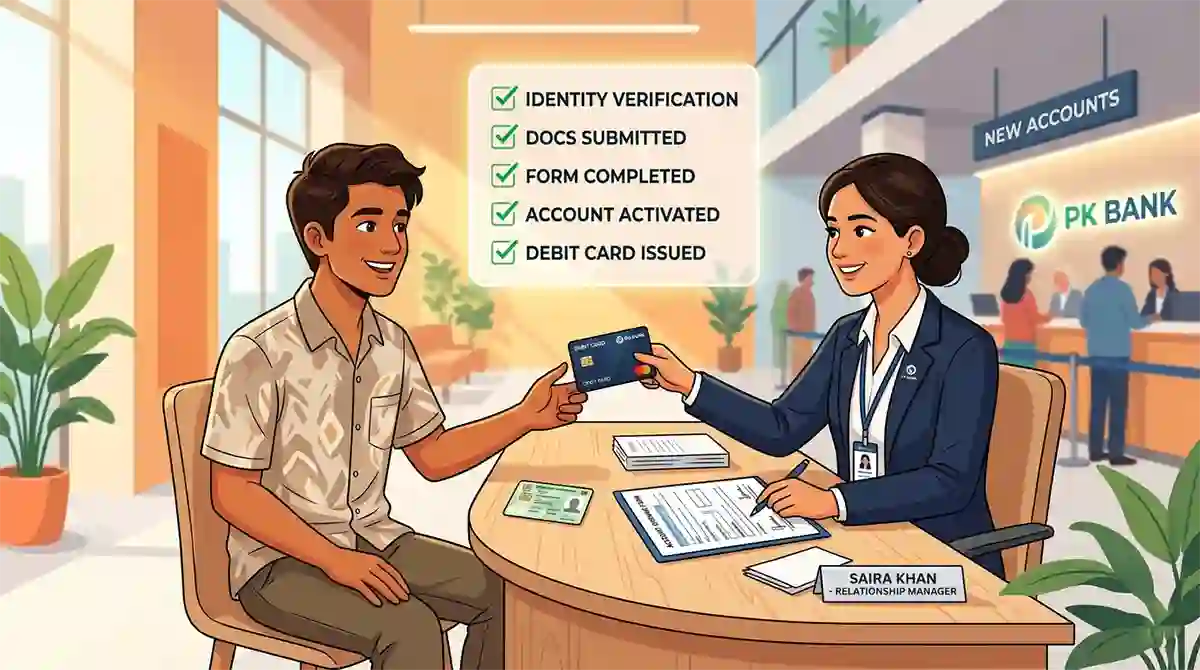
The first time I went to open a bank account on my own, I came back without one. Not because the bank refused me, but because I showed up without the right documents. The officer listed everything I was missing, handed me a requirements slip, and told me to come back. I felt embarrassed walking out of that branch empty-handed, mostly because a five-minute Google search beforehand would have saved me the entire trip. So, here you will learn how to open a bank account in Pakistan.
That experience stuck with me. And over the years, I have watched other people go through the same thing, showing up underprepared, getting confused by account types, not knowing what questions to ask, or simply not realizing how straightforward the whole process actually is once you know what to expect.
So if you are opening your first bank account in Pakistan, or even switching banks after years with the same one, this guide will walk you through exactly what you need, what to expect, and a few things worth knowing before you walk through that branch door.
Table of Contents
Why Having a Bank Account in Pakistan Matters More Than Ever
Before I explain how to open a Bank Account in Pakistan, you need to understand why having one matters more than ever. A few years ago, managing life without a bank account was still somewhat feasible in Pakistan. You received cash, paid in cash, and kept savings at home. That world is fading fast.
Today, receiving a salary from a registered company requires a bank account. Freelancers earning from international platforms like Upwork and Fiverr need a local bank account linked to services like Payoneer or Wise. Government benefit programs, including Benazir Income Support Programme payments, are distributed through banking and branchless banking channels. Investing in mutual funds, buying prize bonds online, or even applying for a loan all require a formal bank account.
Beyond necessity, a bank account gives your money a layer of safety and utility that keeping cash at home simply cannot match.
Before You Walk Into the Bank: Things to Decide First
Opening a bank account is straightforward, but a couple of decisions beforehand will save you time and make sure you end up with the right account.
Which bank should you choose?
Pakistan has a solid range of options. For conventional banking, banks like HBL, UBL, MCB, Allied Bank, and Bank Alfalah have wide branch and ATM networks across the country, which matters a lot if you live outside a major city. For Islamic banking, Meezan Bank is the most established fully Islamic bank, though most conventional banks also have dedicated Islamic banking windows.
Consider where the nearest branch and ATM are located, whether the bank has a strong mobile app, and what charges they apply. The Schedule of Bank Charges is publicly available on every bank’s website and worth a quick look before deciding.
Which account type do you want?
If you are an individual looking for a personal account to receive salary, save money, and handle everyday transactions, a savings account is almost certainly the right choice. If you run a business and need to issue cheques or handle high-volume transactions, a current account makes more sense. If you are opening your very first account and want no minimum balance pressure, ask about the Asaan Account or Basic Banking Account.
If you are unsure, just tell the bank officer your situation and what your business plan to use the account. They will point you to the most appropriate option.
Documents Required to Open a Bank Account in Pakistan
This is the part that trips most people up. The exact requirements can vary slightly by bank and account type, but the following covers what you will almost always need.
For a standard individual account:
- Original CNIC (Computerized National Identity Card). This is non-negotiable. Every bank requires it for KYC purposes under State Bank of Pakistan regulations.
- A copy of your CNIC, front and back.
- One recent passport-sized photograph. Some banks require two.
- Your mobile number, which should ideally be registered under your own CNIC on the NADRA database.
For some account types or banks, you may also need:
- Proof of income or employment, such as a salary slip or employment letter. Not always required for basic savings accounts, but some banks ask for it.
- Utility bill as proof of address. Again, not universally required but sometimes requested, especially for premium account types.
- Next of kin information, which is standard practice across Pakistani banks and simply means listing a family member as an emergency contact on the account.
For a minor’s account (under 18):
- The minor’s B-Form or CNIC if they are old enough to have one.
- Parent or guardian’s CNIC.
- The account is typically operated by the guardian until the minor turns 18.
For a business or current account:
- All of the above personal documents.
- Business registration documents such as your NTN, partnership deed, or company incorporation certificate depending on your business structure.
Learn more: Risk and Return in Investing: What Every Beginner Must Know
The Step-by-Step Process of Opening an Account
Step 1: Visit the branch with your documents
Go to the branch of the bank you have chosen. Bring your original CNIC, CNIC copies, and a photograph. If you are not sure whether you need additional documents, call the bank’s helpline or check their website beforehand.
Tell the reception or security staff that you want to open a new account, and they will direct you to the account opening desk or the relevant officer.
Step 2: Fill out the account opening form
The bank officer will give you an account opening form. It asks for your personal information, including your full name as per CNIC, address, occupation, source of income, and next of kin details. Fill it out carefully and make sure the name matches exactly what is on your CNIC. Even small discrepancies can cause issues later.
You will also need to select your account type at this point, so knowing in advance whether you want a savings, current, or Asaan account saves time here.
Step 3: Submit your documents and get verified
Hand over your completed form along with your CNIC copy and photograph. The officer will verify your original CNIC against the copy and may run a quick NADRA verification on the spot. This is standard procedure and nothing to worry about.
Some banks will also do a biometric verification using your fingerprint, particularly for Asaan Accounts and accounts opened under State Bank’s simplified KYC process.
Step 4: Initial deposit (if required)
Some account types require an initial deposit to activate the account. For a standard savings account, this is typically between PKR 100 and PKR 1,000 depending on the bank. Current accounts may require a higher initial deposit. Asaan Accounts and Basic Banking Accounts often have no minimum opening deposit at all.
Ask the officer upfront what the minimum opening deposit is so you come prepared.
Step 5: Receive your account details
Once everything is submitted and verified, the officer will give you your account number. Your debit card and cheque book, if applicable, are usually issued separately. The debit card may be handed over on the spot at some branches, while others take a few days to process and mail it to your address or have you collect it from the branch.
Your online and mobile banking registration can usually be done on the same day, either at the branch or through the bank’s app using your account number and CNIC.
Opening a Bank Account Online or Digitally
Several banks in Pakistan now offer fully digital account opening, which means you do not need to visit a branch at all. Banks including Meezan Bank, Bank Alfalah, HBL, and others have mobile apps that allow you to open an account from your phone.
The process typically involves:
- Downloading the bank’s official app.
- Entering your CNIC number and basic personal details.
- Taking a live selfie and a photo of your CNIC for biometric and document verification.
- Recording a short video or completing a liveness check.
- Setting up your PIN and mobile banking access.
The whole process usually takes between 10 and 20 minutes, and your account is activated within one to two business days once the bank verifies your information.
This is a genuinely useful option if you live far from a branch, have a busy schedule, or simply prefer doing things digitally. The accounts opened this way are fully functional and come with a debit card that is either mailed to you or available for pickup at a nearby branch.
What Happens After the Account is Opened
Once your account is active, take a few minutes to set up the following so your account is actually ready to use.
Mobile banking registration. If the officer did not register you at the branch, download the bank’s app and set it up yourself using your account number and CNIC. Mobile banking is far more convenient than visiting a branch for routine transactions.
SMS alerts. Register for transaction alerts so you get a message every time there is activity on your account. This helps you catch any unauthorized transactions quickly.
Debit card activation. If your card was issued on the spot, activate it using the bank’s ATM or mobile app before trying to use it. Cards issued and mailed later usually come with activation instructions.
Set up your online banking PIN. Choose something you can remember, but that is not obvious. Avoid birth dates, sequential numbers, or anything you use for other accounts.
Common Mistakes to Avoid
Not asking about charges upfront. Every bank has a Schedule of Bank Charges that covers fees for everything from SMS alerts to falling below the minimum balance. Ask for it or find it on the bank’s website before committing to an account.
Giving an address you do not actually live at. If the bank needs to mail your card or contact you, they will use the address on file. Give your actual current address, not the one on your old CNIC if you have moved.
Opening an account and never using it. Accounts that remain inactive for 12 months or more are classified as dormant by most Pakistani banks. Reactivating a dormant account requires a branch visit and some paperwork. If you open an account, use it at least occasionally.
Not keeping your mobile number updated. Your registered mobile number is tied to your OTPs for online banking and your SMS alerts. If you change your number and forget to update it with the bank, you can get locked out of your own account.
Signing forms without reading them. This sounds obvious, but most people sign the account opening form and any additional agreements without reading what they say. At minimum, make sure you understand what account type you are opening and what the minimum balance requirement is.
Branchless and Digital Banking as an Alternative
If a full bank account feels like too much right now, or if you need something immediately while your main account is being processed, platforms like JazzCash, EasyPaisa, and Nayapay offer mobile wallets that you can open entirely on your phone using just your CNIC.
These are regulated by the State Bank of Pakistan, allow you to send and receive money, pay bills, and do everyday transactions. They are not replacements for a full bank account, but they are useful supplements, especially for people in areas where bank branches are not easily accessible.
Key Takeaways
Opening a bank account in Pakistan is genuinely simple once you know what to bring and what to expect. The whole process at a branch usually takes between 20 and 40 minutes if you have your documents ready. Digital account opening can be done in even less time from your phone.
The bigger decision is choosing the right bank and the right account type for your actual needs. A few minutes spent on that before you walk in will save you from switching accounts six months later.
Your bank account is the foundation of your financial life. Get it set up properly and everything else- saving, investing, receiving income, paying bills- becomes much easier to manage from that point forward.










This is really a simple and to the point guide. thanks sir.
Thanks for your feedback.
When I went to the Bank for my account, it followed the same method as you described. Well, thanks, sir.
Thank Your reading.
I thought it is tough in Pakistan. But as you are describing the method is swift. Thanks for your gudie.
Yeah understanding the process is important.
That’s amazing to learn for this account opening method.
Thanks Dear.
This is a really important detail. I want to talk about this.
Yes please how can I help you?
What is the best bank in Pakistan to open account with? Tell me at least three of them.
Here’s my best 3 banks:
1. Meezan Bank
2. UBL
3. Bank Alfalah