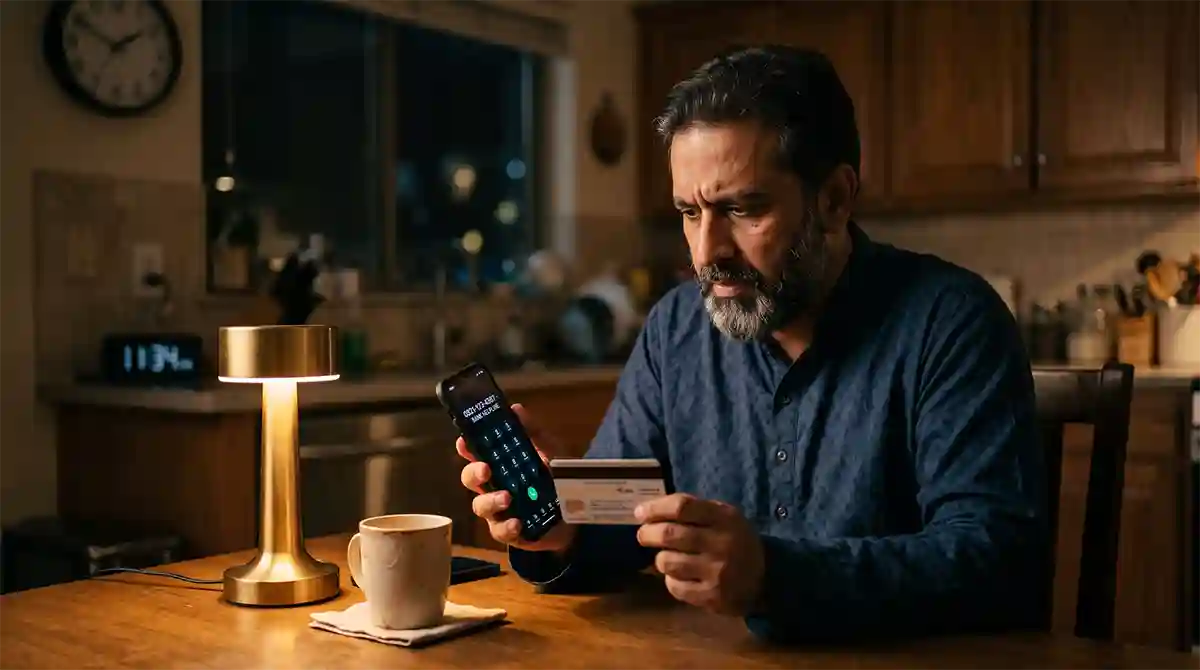
A relative of mine received a call one afternoon from a number that looked exactly like her bank’s official helpline. Her phone had briefly gone blank moments earlier, which she assumed was a network glitch. The caller, calm and professional-sounding, told her there was a suspicious transaction on her account and asked her to confirm her identity by pressing a specific sequence of buttons. She followed the instructions. Within minutes, her phone signal returned to normal, but her SIM had been silently swapped, and by the time she checked her account that evening, a significant sum had already left it, with no SMS alert ever reaching her, because the alerts were now going to the criminal’s phone instead of hers. So, here you will learn how to detect and avoid banking fraud in Pakistan.
This is not a rare or unusual story. The earlier article on online and mobile banking safety in this series covered the fundamentals of protecting yourself digitally. This article goes further: real documented fraud patterns that have targeted Pakistani bank customers, the specific mechanics behind each one, and exactly what to do in the critical first hour if you discover you have already been defrauded.
Table of Contents
The Scale of the Problem in 2026
Before I discuss deep about how to detect and avoid banking fraud in Pakistan you need to know the scale of the problem in 2026. This is not a theoretical risk. According to industry reporting on Pakistan’s cybercrime landscape, over 5.3 million device-level cyberattacks and 166,000 banking malware detections were recorded in just the first three quarters of 2025 alone, alongside web-based threats affecting a significant share of users and institutions across the country. The typology of these attacks has shifted specifically toward WhatsApp-based impersonation, OTP theft, phishing campaigns mimicking banks, FBR, and NADRA, and SIM-swap operations designed to intercept the authentication channels that are supposed to protect your account.
Illicit financial schemes have expanded at scale alongside this. In one recent enforcement action, Pakistan’s National Cyber Crime Investigation Agency (NCCIA) dismantled a Faisalabad-based Ponzi network, resulting in 149 arrests, while the Securities and Exchange Commission of Pakistan separately identified 141 fraudulent lending applications operating in the market. The scale of both technical intrusion and social engineering fraud targeting Pakistani financial customers has grown meaningfully, and understanding the specific mechanics of the most common attacks is now a genuinely essential financial literacy skill, not an optional precaution.
Real Case Studies: How These Frauds Have Actually Played Out
Understanding fraud in the abstract is far less useful than seeing how it has actually unfolded against real Pakistani institutions and customers. Here are documented patterns from recent years.
The fake investment website case. In one widely reported incident, fraudsters built a convincing fake website mimicking a major Pakistani bank’s investment portal, luring customers with promises of attractive returns before disappearing with the funds deposited, totaling several million rupees before the site was shut down. The lesson: a professional-looking website is not proof of legitimacy. Always navigate to your bank’s investment products by typing the bank’s known official URL directly, never by clicking a link sent via SMS, email, or social media.
The SWIFT-linked international transaction fraud. Pakistani financial institutions have, on more than one occasion, been targeted through vulnerabilities in the international SWIFT payment messaging system, resulting in unauthorized cross-border fund transfers running into the millions of dollars in the most serious documented cases. While this specific attack vector targets bank infrastructure rather than individual customers directly, it illustrates that even the most secure-seeming institutional payment rails are not immune, and it is one of the reasons SBP has progressively tightened its cybersecurity framework requirements for all banks over recent years.
The WhatsApp helpline impersonation wave. FIA has reported thousands of complaints related to fraudulent WhatsApp messages mimicking Pakistani bank helplines in a single year, with messages claiming an account will be blocked unless the recipient clicks a link or calls back a number provided in the message. The mechanics are simple and effective: urgency plus a familiar-looking bank name equals a rushed, panicked click.
The SIM swap and USSD interception pattern. FIA’s Cybercrime Wing has issued specific public warnings about a fraud pattern where a victim’s phone briefly goes blank, followed by a call from someone impersonating the mobile network’s representative, instructing the victim to press specific buttons. Once completed, the SIM is effectively hijacked, transaction alerts stop reaching the real account holder, and the criminal can intercept OTPs and drain the account, often before the victim realizes anything is wrong at all, exactly as happened to the relative described at the start of this article.
The Six Fraud Patterns Every Pakistani Bank Customer Should Recognize
| Fraud Type | How It Works | Key Red Flag |
|---|---|---|
| Phishing (SMS/email/WhatsApp) | Fake message mimics bank/FBR/NADRA, urges urgent click | Urgency + a link asking for login or OTP |
| SIM Swap Fraud | Criminal poses as telecom rep, hijacks your SIM via social engineering | Phone signal briefly disappears, then a “helpful” call |
| Fake Investment Platforms | Convincing fake website or app promising high guaranteed returns | Returns that sound too good, pressure to deposit quickly |
| OTP/PIN Social Engineering | Caller poses as bank fraud department, asks you to “verify” by sharing OTP | Any request for OTP, PIN, or CVV over a call |
| Advance Fee Fraud | “You’ve won a prize” or BISP/Ehsaas impersonation, asks for a processing fee upfront | Any requirement to pay before receiving money |
| Fake Banking Apps | Malicious app mimicking your bank’s real app, often shared via unofficial links | Downloaded from anywhere other than the official app store |
Why SIM Swap Fraud Deserves Special Attention
Of all the fraud types above, SIM swap fraud is arguably the most dangerous because it defeats the very security layer, SMS-based OTPs and transaction alerts, that most Pakistani banking customers rely on as their primary protection.
How it actually works, step by step:
- The criminal gathers enough personal information about you (often from data leaks, social media, or a prior phishing attempt) to convincingly impersonate you.
- They visit a mobile network franchise or use social engineering over the phone, claiming their SIM is lost or damaged, and request a replacement SIM on your number.
- Once the swap completes, your original SIM stops working entirely. Your phone signal disappears.
- All OTPs, banking alerts, and two-factor authentication codes now go to the criminal’s new SIM, not yours.
- The criminal uses these intercepted codes to access your bank account or mobile wallet and transfer funds out, often within minutes, before you have any reason to suspect something is wrong.
The single most important protective step: contact your mobile network operator (Jazz, Telenor, Zong, or Ufone) and ask specifically about placing a biometric or franchise-level restriction on SIM replacement for your number. This means a SIM replacement on your number cannot be processed without your own biometric verification at a franchise, which directly blocks the social-engineering version of this attack. As covered in the earlier freelancer banking and online safety articles in this series, this single call is one of the highest-value five minutes you can spend on your own financial security.
What to Do If You Suspect Fraud: The First 60 Minutes
If you notice an unauthorized transaction, receive a suspicious call, or your phone signal has inexplicably disappeared, speed matters more than almost anything else in this situation.
Minute 0 to 5: Call your bank’s official helpline immediately, using the number printed on the back of your debit card or your bank’s verified official website, never a number given to you by a suspicious caller. Ask them to freeze your account or card immediately.
Minute 5 to 15: If your phone signal has disappeared without explanation, contact your mobile network operator’s helpline from another phone immediately and ask whether a SIM replacement was processed on your number. If confirmed, request an immediate block and ask them to reverse the swap.
Minute 15 to 30: Change your internet banking password and any linked mobile wallet PIN from a secure, unaffected device.
Minute 30 to 60: File a formal complaint with your bank in writing (email or their official complaint portal) documenting the transaction details, time, and amount. Request a written acknowledgment.
Within 24 to 48 hours: File a complaint with the FIA’s National Response Centre for Cyber Crimes (NR3C), either online through their official complaint portal or by calling the 1991 helpline. Bring or attach your bank transaction records, any suspicious call logs or screenshots, and, if a SIM swap was involved, any written communication from your telecom operator confirming the unauthorized replacement.
If unresolved by your bank within their stated timeline: escalate to the Banking Mohtasib Pakistan, the independent statutory body that handles consumer complaints against banks at no cost to the complainant, as covered in the credit score improvement article in this series.
A Practical Comparison: Legitimate vs Fraudulent Bank Contact
| What Legitimate Banks Do | What Fraudsters Do |
|---|---|
| Never ask for your OTP, PIN, or CVV over any call or message | Always eventually ask you to “confirm” or “verify” one of these |
| Direct you to call back the number on your card if you’re unsure | Provide their own callback number and discourage independent verification |
| Send official communication from verified short codes/domains | Use lookalike numbers, spoofed caller IDs, or generic WhatsApp numbers |
| Never create extreme urgency (“act in the next 5 minutes or lose your account”) | Rely heavily on manufactured urgency and fear |
| Are willing to let you hang up and call the official helpline to verify | Actively discourage you from hanging up or verifying independently |
Common Mistakes That Make Pakistani Bank Customers Vulnerable
Assuming caller ID cannot be faked. It can, and frequently is, in exactly the kind of impersonation scams described above. A call appearing to come from your bank’s official number is not, on its own, proof that it is genuinely your bank.
Not registering for SIM-swap protection because “it won’t happen to me.” This single preventative call to your telecom operator is free, takes minutes, and closes off the specific attack vector that has caused some of the most damaging documented losses in Pakistan’s recent fraud history.
Downloading a banking app from a link shared over WhatsApp rather than the official app store. As covered in the online banking safety article in this series, fraudulent banking apps mimicking real ones have circulated specifically through informal sharing channels rather than official stores.
Treating a bank’s silence after a complaint as the end of the road. Many victims stop pursuing a case after their bank’s initial response, without realizing that the Banking Mohtasib and FIA’s NR3C exist specifically as free, independent escalation paths when a bank’s own resolution is unsatisfactory or too slow.
Sharing personal details on social media that make social engineering easier. Your full name, CNIC digits, date of birth, and mother’s name, information commonly used to answer bank security questions, are frequently visible on personal social media profiles. Reviewing your own public digital footprint periodically closes an entry point many people never consider.
In Summary
Banking fraud in Pakistan in 2026 has moved decisively toward social engineering, tricking a real person into handing over the keys, rather than purely technical hacking. This is, in a strange way, good news: it means the single most powerful defense available to any Pakistani bank customer is not a piece of software but a habit, treating any unsolicited call, message, or sudden loss of phone signal with the same suspicion you would treat a stranger asking for your house keys.
No legitimate bank will ever ask for your OTP, PIN, or CVV. No legitimate investment offers guaranteed extraordinary returns. And no genuine emergency requires you to act within five minutes without independently verifying who you are actually speaking to.
Further reading and official sources:
- FIA National Response Centre for Cyber Crimes (NR3C) — complaint portal and helpline 1991: complaint.fia.gov.pk
- State Bank of Pakistan — cybersecurity framework and consumer protection: sbp.org.pk
- Banking Mohtasib Pakistan — independent bank complaint resolution: bankingmohtasib.gov.pk