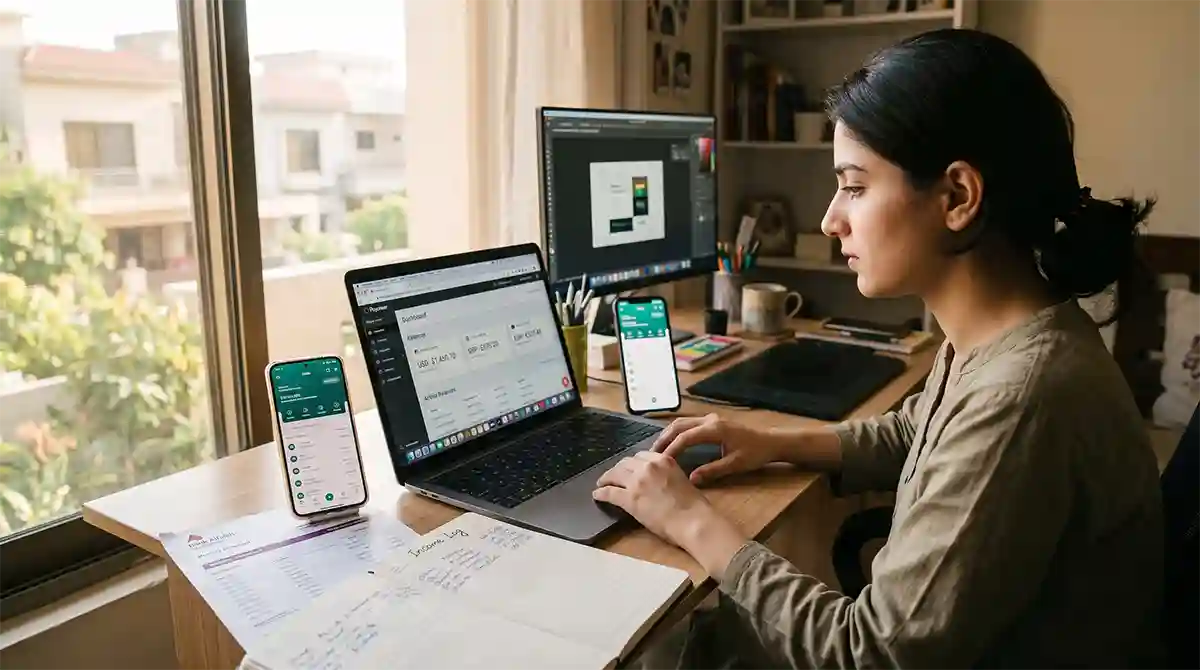
A graphic designer I know spent her first year on Upwork getting paid into her personal savings account through a chain of conversions: Upwork to Payoneer, Payoneer to her HBL account, and from there she would withdraw cash to pay rent because her landlord did not accept transfers. Here you will learn how banking works for Freelancers in Pakistan in 2026.
Every step lost her a small percentage to fees and exchange rate spreads, and none of it showed up anywhere as organized income records. When she applied for a car loan two years later, she had no salary slip, no employer letter, and a bank statement that looked, to any loan officer, like a series of random inbound transfers rather than a stable freelance income.
She eventually fixed this by opening a dedicated freelancer account, but the two years of disorganized banking cost her real money in fees and real credibility with lenders she could have avoided entirely with the right setup from day one.
Freelancers and self-employed individuals in Pakistan face a genuinely different banking reality than salaried employees. There is no employer to vouch for your income, no automatic salary slip, and often payments arriving in foreign currency from platforms and clients scattered across different countries. This article covers exactly how to set up banking that works for this reality, from choosing the right account type to receiving international payments efficiently to building the paper trail that eventually gets you approved for loans and credit cards.
Table of Contents
Why Freelancer Banking Needs Its Own Approach
Before I share how banking works for Freelancers in Pakistan in 2026, you need to learn about approach of freelance banking. Salaried employees have it comparatively simple: one employer, one predictable monthly deposit, an automatic paper trail through salary slips and employment letters. Freelancers and self-employed individuals in Pakistan typically face three specific banking challenges that a standard personal account was never designed to solve.
Irregular, foreign-currency income. Payments arrive from Upwork, Fiverr, direct international clients, or local clients, often in USD, GBP, or EUR, and often on unpredictable schedules rather than a fixed monthly date.
No conventional proof of income. Banks evaluating you for a loan or credit card are used to seeing a salary slip and an employer letter. A freelancer’s income is proven through bank statements, platform earnings reports, and tax filings instead, and not every bank officer is equally comfortable evaluating that kind of documentation.
PayPal simply does not work here. This surprises many new freelancers. PayPal has technically been available in Pakistan since 2018, but only in a limited capacity: you can send money and make purchases, but you cannot receive payments directly into a Pakistani account. This is a State Bank of Pakistan regulatory matter around foreign exchange controls, not a technical glitch, and it means every serious Pakistani freelancer needs an alternative from day one.
Step 1: Choose the Right Account Type
Dedicated freelancer digital accounts
Several Pakistani banks now offer accounts built specifically for freelancers and remote workers, and starting with one of these rather than a generic savings account solves several of the problems above at once. UBL and Meezan Bank both offer dedicated Freelancer Digital Accounts designed around receiving foreign income and simplified documentation.
Foreign currency accounts for direct clients
If you regularly receive payments directly from international clients rather than through a platform, a foreign currency account lets you hold USD, GBP, or EUR balances without immediate mandatory conversion to PKR, giving you some control over when you convert and at what rate. Bank Alfalah specifically allows freelancers to retain USD 5,000 per month, or 50 percent of their export proceeds, whichever is higher, directly in a foreign currency account, which is genuinely useful if you want to hold dollars rather than convert everything to rupees immediately.
A standard business or sole proprietor current account
As covered in the earlier article on opening a business bank account in this series, once your freelance income becomes substantial and consistent, formalizing it through NTN registration and a proper business current account creates the cleanest, most bank-friendly paper trail, separate entirely from your personal spending.
Practical comparison of the main freelancer banking building blocks:
| Need | Best-Suited Option | Why |
|---|---|---|
| Receiving platform earnings (Upwork, Fiverr) | Payoneer + linked local bank account | Direct platform integration; most freelancers’ default |
| Holding USD without converting immediately | Bank Alfalah FCY account | USD 5,000/month or 50% of proceeds retainable |
| Simplified freelancer-specific banking | UBL or Meezan Freelancer Digital Account | Built for irregular, foreign-sourced income |
| Low-fee direct client transfers | Client-side Wise transfer to your PKR IBAN | Near mid-market rate; no Wise account needed in Pakistan |
| Formal business banking as income scales | Sole proprietor business current account | Clean audit trail; required for larger loans/financing |
Step 2: Set Up Your International Payment Infrastructure
Payoneer remains the default for most Pakistani freelancers. It has operated in Pakistan for over a decade and integrates directly with Upwork, Fiverr, and most other major freelance marketplaces, as well as with Pakistani banking apps including Bank Alfalah, HBL, and MCB, and with JazzCash for instant PKR access. Withdrawals typically settle into your Pakistani bank account within two to five business days.
One detail worth knowing before you get caught out by it: Payoneer charges an inactivity fee of USD 29.95 if your account shows no transactions for twelve consecutive months. If you take a break from freelancing or platform work slows down, log in periodically or make a small transaction to avoid this.
Wise is the better option specifically for direct clients, not because you can open a Wise account from inside Pakistan (you currently cannot create a new multi-currency Wise wallet as a Pakistan-based user), but because your international client can use their own Wise account to send a transfer directly to your Pakistani bank IBAN at close to the true mid-market exchange rate, with none of the markup a standard SWIFT wire typically carries.
A worked comparison of what you actually keep: On a $1,000 monthly invoice, the difference between payment methods is not trivial. A standard bank wire (SWIFT) with typical intermediary and conversion charges might cost you 4 to 5 percent, or roughly PKR 11,000-14,000 lost on that single invoice at current exchange rates. Payoneer’s conversion spread is usually tighter, commonly in the 2 percent range. A client using their own Wise account to pay your PKR IBAN directly often costs the least of all, since Wise’s advertised rate is close to the mid-market rate with a transparent, disclosed fee rather than a hidden spread.
For freelancers who want a genuine bank account feel in USD without a US entity, Elevate Pay has emerged as a notable option in 2026, providing a US bank account structure (through a partner bank) that lets clients pay you via standard ACH or wire transfer as if you were a US-based freelancer, with withdrawal directly to your Pakistani bank account. It currently supports USD receiving only, without multi-currency balances or a card, so it suits freelancers whose clients are primarily US-based.
Step 3: Build a Real Paper Trail From Day One
This is the part that would have saved the designer in the opening story two years of frustration, and it is the single highest-leverage habit any Pakistani freelancer can build early.
Get an NTN and register with FBR as soon as your income becomes regular. As covered in the freelancing and tax filing articles in this series, freelance income is treated as IT export income under Section 10 of the Income Tax Ordinance, and PSEB-registered freelancers benefit from a significantly reduced 0.25 percent final tax rate on income received through approved banking channels, compared to 1 percent for non-registered freelancers.
Withdraw your earnings into your Pakistani bank account regularly rather than letting them sit in Payoneer or a platform wallet. Beyond the tax qualification requirement (at least 80 percent of income must flow through approved banking channels to access the reduced tax rate), a bank statement showing regular, dated inflows from Payoneer or Wise is exactly the kind of evidence a bank officer needs to assess your income when you eventually apply for a credit card or loan.
File your annual income tax return every year, even in a slow year. As covered in the personal loan and credit score articles in this series, being an FBR filer and maintaining ECIB credit history are the two things every bank checks before approving a credit product, and a freelancer with two or three years of filed returns showing consistent declared income is in a dramatically stronger position than one with none.
Keep a simple monthly log of your income sources. A basic spreadsheet noting the client or platform, the amount, the currency, and the date received, even if you never formalize a business, gives you (and eventually your bank) a clear picture of your actual earning pattern that a jumble of unlabelled Payoneer withdrawals cannot provide on its own.
Step 4: Getting Approved for Credit Without a Salary Slip
Freelancers are not automatically disqualified from credit cards, personal loans, or car financing in Pakistan, but the application process looks different from a salaried employee’s.
Most banks will ask for two to three years of bank statements showing consistent income patterns, your NTN and evidence of tax filing history, and in some cases a simple declaration or letter explaining the nature of your freelance work and your typical client base, in place of an employer letter.
Secured credit cards, where your credit limit is backed by a fixed deposit placed with the bank, remain the most reliable entry point for freelancers who do not yet have the two to three years of documented income history that unsecured products typically require, as covered in the dedicated credit cards article in this series.
A practitioner’s note on this: when I have seen freelancers get approved smoothly, it has consistently been the ones who could hand the bank a clean, printed bank statement with visible monthly Payoneer or Wise inflows and a matching FBR filer status, not the ones with the highest income but the messiest paper trail. Banks are evaluating predictability and documentation quality as much as the raw rupee amount.
Common Mistakes Freelancers Make With Their Banking
Mixing freelance income with personal spending in one account. This makes it genuinely difficult to prove your actual income pattern later and complicates your tax filing, exactly as covered in the business bank account article in this series.
Letting earnings sit in Payoneer or a platform wallet instead of withdrawing regularly. Beyond the tax rate qualification issue, idle balances in third-party wallets do not build the domestic banking relationship or paper trail that eventually gets you approved for financing.
Accepting PayPal payment requests from confused clients. Since PayPal genuinely does not support receiving funds into Pakistan, agreeing to “figure it out later” with a client who insists on PayPal wastes time. The professional response, and the one that resolves this quickly in practice, is simply offering your Payoneer or Wise-compatible bank details as the alternative.
Never registering with FBR because freelancing “isn’t a real job yet.” The tax rate difference between a PSEB-registered filer and a non-filer is substantial and compounds every single month you delay, quite apart from the credit history benefits of being an established filer.
Using informal channels like Hundi or peer-to-peer crypto trades to move money to avoid fees. Beyond the legal risk, these channels leave no formal paper trail at all, which defeats the entire purpose of building bankable, loan-ready financial credibility over time.
In Summary
Banking as a freelancer or self-employed individual in Pakistan is not fundamentally harder than banking as a salaried employee. It simply requires a different setup: choosing an account genuinely built for irregular foreign-currency income rather than forcing a standard savings account to do that job, picking the right payment method for each type of client, and consistently building the documented paper trail that Pakistani banks rely on when a salary slip is not available.
Do this from your first paid project rather than your fiftieth, and by the time you need a car loan, a credit card, or a home financing facility, your bank statement will already be doing the talking for you.
Further reading and official sources:
- State Bank of Pakistan: foreign exchange regulations for exporters and freelancers: sbp.org.pk
- Federal Board of Revenue: IT export income tax treatment and PSEB registration: fbr.gov.pk
- Pakistan Software Export Board: freelancer and IT exporter registration: pseb.org.pk