
I have a friend who put a decent chunk of his savings into a “guaranteed high-return” investment scheme a few years ago. Someone in his social circle vouched for it, the returns sounded amazing, and he thought he had finally found a smarter way to grow his money. Within eight months, the scheme collapsed. He lost nearly everything he had put in.
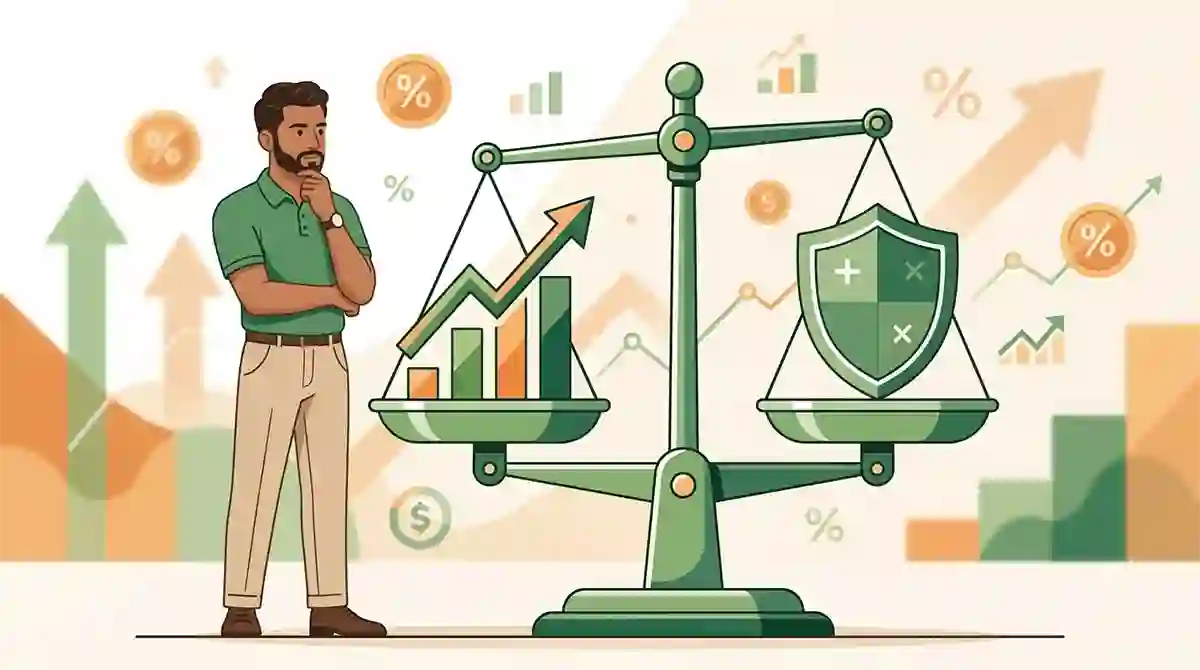
What hurt him wasn’t just the money. It was that nobody had ever explained to him in simple terms that high returns and high risk are always connected. If someone is offering you unusually high returns, they are asking you to take on unusually high risk, whether they tell you that or not.
That one concept, if he had understood it properly, would have saved him from a very painful experience.
Table of Contents
The Relationship Nobody Explains Clearly
In investing, risk and return are two sides of the same coin. You cannot separate them. The more return you want, the more risk you have to accept. The less risk you are willing to take, the lower your returns will be.
This is not a flaw in the system. It is the system. It exists because rational investors will only accept higher uncertainty if there is a meaningful reward for doing so. If a risky investment offered the same return as a safe one, nobody would take the risk. So riskier assets must offer higher potential returns to attract investors.
Once you genuinely internalize this relationship, your entire approach to investing changes. You stop chasing returns in isolation and start asking the more important question: how much risk am I actually taking on to get this return?
What Does Risk Actually Mean in Investing?
Most beginners think risk simply means losing money. That is part of it, but it is broader than that.
In investing, risk refers to uncertainty. The possibility that your actual return will be different from what you expected. That difference can go in either direction, better or worse than expected. But when investors talk about managing risk, they are mostly focused on the downside, the chance that things go worse than planned.
There are several types of risk worth understanding.
Market Risk
This is the risk that the overall market declines and drags your investments down with it. It does not matter how good a company is. If the broader market crashes due to a global event, a financial crisis, or a sharp economic slowdown, most investments will fall in value. The 2008 global financial crisis is a clear example. Even fundamentally strong companies saw their stock prices cut in half.
Inflation Risk
This one is especially relevant in Pakistan. Inflation risk is the danger that your investment returns do not keep pace with inflation, meaning your money is technically growing but losing purchasing power in real terms. If your investment gives you 8% annually but inflation is running at 12%, you are effectively losing ground even while your account balance goes up.
Liquidity Risk
This is the risk of not being able to sell your investment quickly when you need cash. Real estate in Pakistan is a good example. It can be a strong long-term investment, but if you need money urgently, you cannot easily sell a plot or house within a few days. Being locked into an illiquid asset when you need cash is a real and often overlooked risk.
Concentration Risk
Putting too much of your money into a single stock, sector, or asset class. If that one thing does badly, your entire portfolio suffers. This is why diversification matters so much.
Default Risk
With bonds or any lending-based investment, there is always the possibility that the borrower cannot repay you. Government bonds carry very low default risk. Corporate bonds carry more, and informal lending arrangements carry the most.
Understanding Return
Return is the gain you make on your investment. It can come in two forms.
Capital Appreciation is when the value of your asset increases over time. You buy a stock at PKR 100 and it rises to PKR 140. That PKR 40 gain is your capital appreciation.
Income Return is regular cash received from your investment. Dividends from stocks, interest from bonds, rent from property. This is money in your pocket without having to sell the asset.
Total return combines both. A stock that pays dividends and also rises in price is giving you both types of return simultaneously, which is why dividend-paying stocks are popular among long-term investors.
When comparing investments, always look at total return, not just price movement. A bond with steady interest payments might outperform a non-dividend-paying stock in total return terms even if the stock price grew faster.
The Risk and Return Spectrum
It helps to think of different asset classes arranged on a spectrum from lowest risk and lowest return to highest risk and highest return.
At the conservative end, you have instruments like National Savings Certificates, money market funds, and government treasury bills. Your capital is very safe, returns are predictable, but they are modest and may not always beat inflation.
Moving along the spectrum, you have corporate bonds and income funds. Slightly more risk, slightly better returns. Still relatively stable.
In the middle sits balanced funds, which blend equities and fixed income. You get moderate risk and moderate return potential.
Toward the higher end, you have equity funds and direct stock investments. Much higher volatility, meaningful potential for loss in the short term, but historically the strongest long-term returns.
At the far end, you have highly speculative investments like penny stocks, leveraged products, and unfortunately, the kind of unregulated investment schemes that are common in Pakistan. Maximum risk, occasionally spectacular returns, but also the highest probability of losing everything.
Most beginners should be investing somewhere in the middle of this spectrum, not at the extremes.
How to Think About Your Own Risk Tolerance
Risk tolerance is personal. It depends on several factors that are specific to your situation.
Time Horizon
How long before you need this money? If you are investing for retirement 25 years away, you can afford to ride out market downturns because you have time to recover. If you need the money in two years for a specific purpose, you cannot afford the volatility of equity markets. Shorter time horizon means lower risk capacity, regardless of how you feel about it emotionally.
Financial Situation
Do you have stable income? An emergency fund? No high-interest debt? The more financially secure your foundation, the more investment risk you can responsibly take on. Someone living paycheck to paycheck should not be taking high risk with their savings, even if the potential returns are tempting.
Emotional Tolerance
This is the honest part most people skip. How would you actually feel if your investment dropped 30% in value? Not how you think you should feel, but how you would genuinely react. Some people can see their portfolio down significantly and stay completely calm because they trust the long-term process. Others lose sleep, check prices constantly, and eventually sell at the worst possible time. There is no shame in being a conservative investor. It is far better to invest in lower-risk options consistently than to take on too much risk and bail out during a dip.
The Diversification Solution
The most practical tool for managing risk without sacrificing all of your return potential is diversification. It simply means spreading your money across different asset types, sectors, and geographies so that a problem in one area does not wipe out your entire portfolio.
If you own only one stock and that company runs into trouble, you could lose most of your investment. If you own 20 stocks across different industries, one company’s problems barely affect your overall portfolio.
Mutual funds are essentially pre-built diversification. When you invest in an equity mutual fund in Pakistan, your money is typically spread across dozens of companies in different sectors. You get instant diversification without having to research and manage each position yourself.
Diversification does not eliminate risk. It manages it. It reduces the impact of any single bad outcome on your overall financial situation.
A Practical Example Close to Home
Think about two investors in Pakistan.
The first puts all his savings into a single textile sector stock because someone told him it was about to rise. The second puts the same amount into a diversified equity mutual fund that holds positions across banking, energy, consumer goods, technology, and textile sectors.
If the textile sector has a bad year due to export slowdowns or raw material cost increases, the first investor’s portfolio takes a devastating hit. The second investor’s portfolio dips slightly in the textile portion but is cushioned by gains in other sectors.
Same asset class. Very different risk profiles. The difference is diversification.
Red Flags That Signal Too Much Risk
It is worth knowing what to watch out for, especially in Pakistan where informal and unregulated investment opportunities are unfortunately common.
Guaranteed high returns are the biggest red flag. No legitimate investment can guarantee high returns. Returns are always subject to market conditions. Anyone promising you 30%, 40%, or 50% annual returns with zero risk is either lying or does not understand what they are doing.
Pressure to invest quickly is another warning sign. Legitimate investments do not expire in 24 hours. Urgency is a manipulation tactic designed to prevent you from thinking clearly.
No regulation or registration is a serious concern. Any investment vehicle or AMC operating in Pakistan should be registered and regulated by SECP. If you cannot verify their registration, walk away.
Word of mouth as the only evidence. Just because someone in your family or circle made money from something does not make it safe or legitimate. Pyramid schemes and Ponzi schemes always have early winners who unwittingly bring in new victims.
Balancing Risk and Return at Different Life Stages
Your relationship with risk should change as your life changes.
In your 20s and early 30s, you have the longest runway. You can afford to take on more risk because time is on your side. Focus on growth-oriented investments like equity funds and let compounding work over decades.
In your 40s, you start to shift gradually toward a more balanced approach. You still want growth, but you also want to protect what you have built. A blend of equity and income funds makes sense.
In your 50s and approaching retirement, capital preservation becomes more important than aggressive growth. Shifting a larger portion toward stable, income-generating instruments means your savings are protected even if markets have a bad year right before you need to draw on them.
This is not a rigid formula, but the direction is clear. More risk when you have time to recover. Less risk as you approach the point when you actually need the money.
Conclusion
Risk is not something to fear or avoid entirely in investing. It is something to understand, measure, and manage according to your own situation.
The investors who get into serious trouble are not always the ones who took too much risk. Sometimes they are the ones who took on risk they did not understand, because nobody explained to them what they were actually agreeing to.
Now you know. Every investment carries some form of risk. Higher potential returns come with higher uncertainty. Diversification reduces but does not eliminate risk. And your personal risk tolerance should drive your decisions, not someone else’s appetite for returns.
Invest within your means, within your timeline, and within your actual emotional capacity to handle uncertainty. That combination will serve you far better than chasing the highest possible return without understanding what it costs you to get there.











Yes it is very hard to balance it. But you explained it well for all users. Thanks
Thanks for reading.