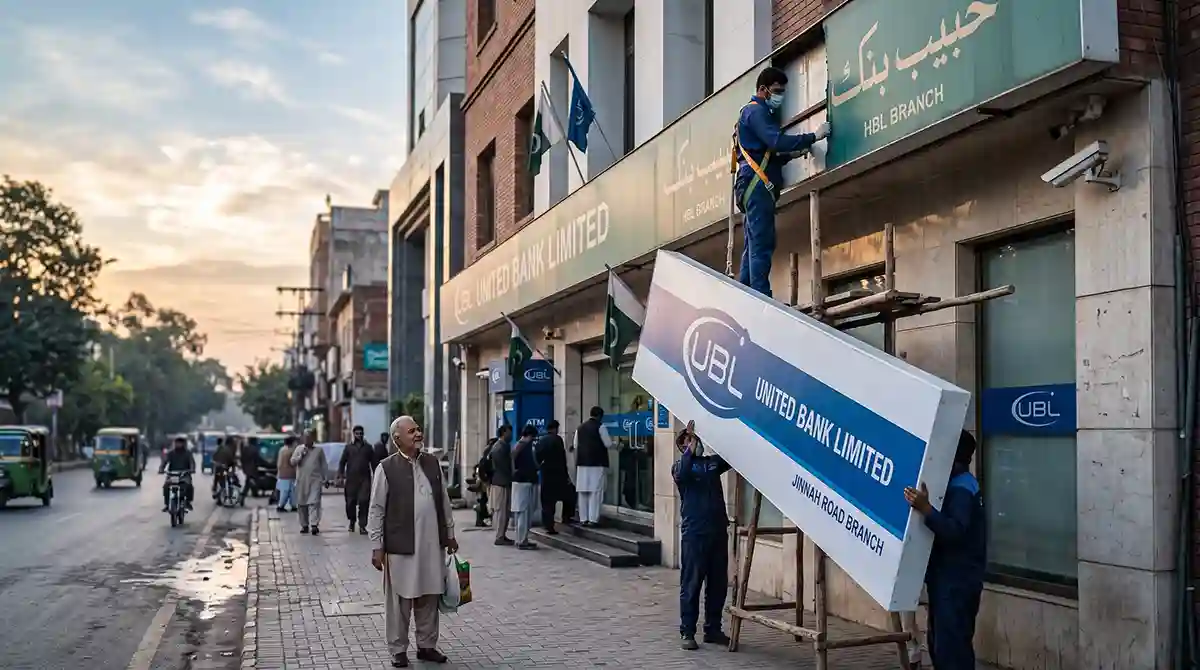
On the morning of March 11, 2025, customers of Silkbank Limited, a scheduled commercial bank that had been operating in Pakistan since 1995 with 124 branches nationwide, woke up to find their bank no longer legally existed as an independent entity. Silkbank had been fully amalgamated into United Bank Limited, one of Pakistan’s largest banks, under a State Bank of Pakistan sanction order. For the average Silkbank depositor, the immediate practical question was not about shareholder swap ratios or regulatory filings; it was simpler and more urgent: is my money safe, and what do I actually need to do now? Here, I will explain you about bank mergers and acquisitions in Pakistan.
This is a question that has come up repeatedly in Pakistan’s banking history and will come up again, since consolidation among Pakistan’s smaller and mid-sized banks has been an ongoing trend, driven by capital adequacy pressures and SBP’s own preference for a more consolidated, resilient banking sector. Using the Silkbank-UBL merger as a real, fully documented case study, this article explains exactly what legally happens to your deposits, loans, cards, and standing instructions when your bank merges into another, and what you should actually do about it.
Table of Contents
Why Bank Mergers Happen in Pakistan
It is important before you learn about Bank Mergers and Acquisitions in Pakistan that why bank mergers happen. Banks in Pakistan merge for a handful of recurring reasons, and understanding the reason behind a specific merger tells you a great deal about how smoothly your transition is likely to go.
The Silkbank case is instructive here: financial experts assessing the bank before its merger noted it required new equity in the range of Rs 10 to 15 billion to turn around a negative paid-up capital position and a negative capital adequacy ratio (CAR), the regulatory measure of a bank’s financial cushion against losses, and that it also needed a strengthened team to convert a substantial volume of non-performing loans back into performing ones.
In other words, Silkbank was not merging from a position of strength; it was merging because it needed a stronger partner to remain viable, and UBL, one of Pakistan’s largest and most capitalized banks, was able to absorb it.
This pattern, a smaller or capital-constrained bank merging into a larger, better-capitalized one, is the dominant model of bank consolidation in Pakistan, and it generally reflects SBP’s regulatory preference for resolving a struggling bank through an orderly merger with a stronger institution rather than allowing it to fail outright, which protects depositors far more effectively than a disorderly collapse would.
The Legal Process, Step by Step: The Silkbank-UBL Timeline
Bank mergers in Pakistan are not informal business arrangements; they follow a specific legal process under Section 48 of the Banking Companies Ordinance 1962, and the Silkbank case shows exactly how this unfolds in practice.
| Date | Milestone |
|---|---|
| April 2023 | UBL publicly discloses to PSX that it is exploring a potential merger with Silkbank and seeking SBP permission to begin due diligence |
| March 2024 | Silkbank and UBL announce they have reached a formal merger agreement |
| December 2024 | Silkbank shareholders formally approve the Scheme of Amalgamation at an Extraordinary General Meeting, subject to regulatory clearance from SBP and the Competition Commission of Pakistan (CCP) |
| March 10, 2025 | SBP issues its official Sanction Order approving the amalgamation under Section 48 of the Banking Companies Ordinance 1962 |
| March 11, 2025 | The merger becomes legally effective; Silkbank’s operations are fully integrated into UBL from this date |
| April 2025 | Silkbank is formally delisted from the Pakistan Stock Exchange |
Two separate regulators had to sign off before this merger could proceed: SBP, whose approval addresses the banking and financial stability dimension, and the Competition Commission of Pakistan, whose approval addresses whether the combined entity would create anti-competitive market concentration. This dual-regulator requirement exists specifically to protect depositors and the broader financial system, not just the two merging companies’ shareholders.
What Actually Happens to Your Deposits
This is the question that matters most to an ordinary customer, and the direct answer is: your deposit does not disappear, and it does not require you to “claim” it back. Under the Scheme of Amalgamation sanctioned by SBP, all of Silkbank’s assets and liabilities, which legally includes every customer’s deposit balance, transferred automatically to UBL as of the effective date. You did not need to submit a claim, sign a new agreement, or take any action for your basic deposit balance to remain intact and accessible.
Deposit protection during a merger works exactly as it does in normal circumstances. As covered in the personal loan and credit score articles in this series regarding Pakistan’s banking safety net, deposits in Pakistan are protected under the Deposit Protection Corporation up to PKR 500,000 per depositor per bank. During a merger specifically, this protection is not the primary mechanism at work, since the whole point of SBP sanctioning an orderly amalgamation rather than allowing a bank to fail is to ensure depositors are made whole through the merger itself, with their full balance transferring to the acquiring bank rather than needing to rely on the DPC’s compensation limit at all.
What does typically change, practically, is administrative: your account number or IBAN may be reissued under the acquiring bank’s numbering system, your debit card may need to be reissued with the new bank’s branding once the old one is phased out, and your online/mobile banking credentials generally need to be reset or migrated to the acquiring bank’s platform. None of this represents a loss of funds; it is the operational work of merging two separate banking systems into one.
What Happens to Loans, Credit Cards, and Standing Instructions
If you had an outstanding loan, whether a personal loan, car financing, or a credit card balance, as covered in the personal loan and credit cards articles in this series, that obligation transfers to the acquiring bank on the same terms it was originally agreed under. The acquiring bank cannot unilaterally change your agreed markup rate, tenor, or repayment terms simply because the merger happened; your original loan agreement remains legally binding, now with the acquiring bank standing in the place of the original lender.
Standing instructions, meaning any pre-authorized recurring payments or transfers you had set up, typically require re-confirmation or re-registration on the acquiring bank’s new systems, since these instructions are usually tied to the specific account infrastructure of the original bank rather than automatically portable. This is one of the most common practical gaps customers experience during a merger: a recurring utility bill payment or a loan installment standing instruction that quietly stops working because it was not re-registered on the new system, leading to a missed payment the customer did not realize had lapsed.
Cheque books issued by the original bank generally remain valid for a transitional period announced by the acquiring bank, after which customers are required to switch to cheque books issued under the new bank’s name.
Shareholders vs Depositors: A Distinction Worth Understanding
It is worth being precise about one thing that often gets confused in casual conversation about bank mergers: the shareholder swap ratio and the depositor’s account balance are two completely separate matters.
In the Silkbank-UBL merger, shareholders of Silkbank received new UBL shares at a swap ratio of one UBL share for every 325 Silkbank shares held, based on their registered shareholding as of a specific book closure date. This ratio applied only to people who owned Silkbank’s publicly traded stock (PSX ticker: SILK), an entirely different group from ordinary depositors who simply held a savings or current account at the bank. If you were a Silkbank depositor but not a shareholder, this swap ratio had no bearing on your account balance whatsoever; your deposit transferred to UBL at its full, unchanged value.
A Practical Checklist for When Your Bank Merges
Confirm the merger’s official status directly with SBP or the acquiring bank, rather than relying on rumors or informal branch conversations, since the effective date and specific transitional arrangements are formally announced and published.
Update your registered mobile number and email with the acquiring bank promptly, since transaction alerts, OTPs, and account communications will begin routing through the new bank’s systems, and outdated contact details during a transition are a common source of missed alerts, as covered in the banking fraud article in this series.
Re-register every standing instruction and recurring payment rather than assuming they carried over automatically; confirm directly with the acquiring bank’s branch or app that each one is active under the new system.
Check whether your specific account type and product features (such as a linked savings profit rate, a fee waiver you had negotiated, or a specific card benefit) are being honored under the acquiring bank’s equivalent product, since acquiring banks sometimes migrate customers to their closest standard product tier rather than an identical replica of the original product.
Keep your old bank statements and account documentation even after the merger completes, since these remain your record of your account history, particularly relevant for future loan applications where lenders review your transaction history, as covered in the credit score improvement article in this series.
Be alert to fraud specifically during the transition period. As covered in the banking fraud article in this series, periods of genuine institutional change are exactly when fraudsters attempt to impersonate “the merger process” to extract OTPs, PINs, or personal details under the guise of “verifying your account for the transition.” No legitimate bank merger process requires you to share your PIN or OTP over a phone call.
Common Mistakes Pakistanis Make During a Bank Merger
Assuming a merger means their money is at risk and panicking, potentially triggering unnecessary early withdrawal penalties on term deposits. As explained above, SBP’s sanctioned amalgamation process exists specifically to protect and transfer deposits intact; panicking and breaking a fixed deposit early, as covered in the fixed deposits article in this series, typically costs the depositor a reduced-rate penalty for no protective benefit, since the funds were never actually at risk under a properly sanctioned merger.
Ignoring official communications from the acquiring bank because they assume “nothing has changed.” Missing the transitional notices about new account numbers, card reissuance timelines, or standing instruction re-registration deadlines is how customers end up with lapsed recurring payments.
Confusing shareholder-level merger terms (like a share swap ratio) with what happens to their deposit account, as explained in the distinction above; these are separate matters entirely for the vast majority of ordinary bank customers who are depositors, not shareholders.
Not verifying a merger announcement through official channels before acting on it, particularly given the fraud risk described above; always confirm directly through SBP’s official announcements or the bank’s own verified website rather than acting on a message or call claiming to be merger-related.
In Summary
The Silkbank-UBL merger, fully completed and documented through 2025, is a genuinely useful real-world template for understanding how bank consolidation actually works in Pakistan: a formal, dual-regulator-approved legal process under Section 48 of the Banking Companies Ordinance 1962, designed specifically to protect depositors by transferring their full balances intact to a stronger acquiring institution, rather than exposing them to the far worse alternative of a disorderly bank failure.
If your own bank is ever party to a merger, the practical response is straightforward: confirm the details through official channels, update your contact information and re-register your standing instructions promptly, remain alert to fraud attempts exploiting the transition, and trust that the entire legal architecture behind a sanctioned amalgamation exists specifically to keep your deposit whole, not to put it at risk.
Further reading and official sources:
- State Bank of Pakistan: Banking Companies Ordinance 1962 and sanctioned merger announcements: sbp.org.pk
- Pakistan Stock Exchange: corporate announcements on bank mergers and amalgamations: psx.com.pk
- Deposit Protection Corporation, Pakistan: depositor protection framework: dpc.org.pk