A former colleague switched employers in 2019 and, with his new salary now landing in a different bank, simply stopped using his old account. He never formally closed it. He assumed an account with a zero-ish balance sitting untouched was harmless. Six years later, applying for a car loan, his credit officer flagged an old, technically still-open account with an unexplained gap in activity and a small negative balance from accumulated maintenance charges that had quietly eaten into what little was left, complicating what should have been a straightforward loan approval. In this article, you will learn how to close a bank account in Pakistan properly in 2026.
Abandoning a bank account in Pakistan is not the same as closing it, and the difference matters more than most people realize. This guide covers the correct closure process, exactly what triggers dormancy and what that actually means for your money, and the specific documentation and steps you need at each major Pakistani bank before you walk away from an account for good.
Table of Contents
Why “Just Stop Using It” Is the Wrong Approach
An account you simply abandon does not disappear from the banking system or from your financial profile; it enters a formal, regulated state that continues to have consequences long after you have stopped thinking about it.
The 12-month dormancy trigger. Under SBP-mandated disclosure requirements reflected in every major Pakistani bank’s Key Fact Statement, if your account remains inoperative for a continuous period of 12 months, meaning no customer-initiated debit or credit transaction and no login activity through digital channels, it is automatically classified as Dormant or Inoperative.
Once dormant, the account still exists, but debit transactions and withdrawals are blocked entirely; only incoming credits are still permitted. To reactivate it, you must physically visit your account-maintaining branch with a written request and your original valid identity document.
Maintenance charges continue during dormancy. As covered in the bank charges article earlier in this series, dormant accounts remain subject to maintenance fees at most banks, which is precisely how my former colleague’s small residual balance was quietly eroded over years of inactivity, exactly the scenario a proper closure would have avoided entirely.
The long-term endpoint: unclaimed deposits surrendered to SBP. This is a detail almost no Pakistani account holder knows about, and it is worth understanding clearly. If an account continues in dormancy for a further extended period, cumulatively 15 years of continuous non-operation according to Bank of Punjab’s published account terms, it is reclassified as an unclaimed deposit account and the bank is legally required to surrender it to the State Bank of Pakistan under Section 31 of the Banking Companies Ordinance 1962, as amended by the Banking Companies (Amendment) Act 2024.
At that point, reclaiming the money is no longer a simple branch visit; it becomes a formal claim process against SBP itself, requiring you to prove entitlement to funds that have already left your bank’s own books.
When Dormancy Genuinely Doesn’t Matter, and When It Does
If you are simply parking a small amount in an account you intend to use again occasionally, a single small transaction every six to twelve months is enough to keep it active and avoid the dormancy classification altogether, a habit already discussed in the earlier article on avoiding unnecessary bank fees in this series. But if you genuinely have no future use for an account, whether because you have switched banks, changed cities, or consolidated your banking relationships, the correct action is formal closure, not passive abandonment.
Step-by-Step: How to Properly Close a Bank Account in Pakistan
Step 1: Clear all outstanding dues first. Confirm there are no pending loan installments, credit card balances, unpaid locker rent, or other charges linked to the account. A bank will not process closure while genuine liabilities remain outstanding against it.
Step 2: Redirect every linked service before you close, not after. This is the step most people get wrong. If your salary, any loan or credit card auto-debit repayments, standing instructions for utility bills, or a linked mutual fund SIP is tied to this account, update every single one of them to your new account first. Closing the account before redirecting these creates missed payments and, in the case of a loan repayment specifically, potential damage to your ECIB credit history.
Step 3: Transfer or withdraw your remaining balance. Move whatever balance remains to your active account before initiating closure. Some accounts also carry a specific closure charge if closed within a short window of opening, commonly anywhere from the first 14 days up to a full year depending on the bank’s own policy, so confirm your specific bank’s threshold before assuming closure is free.
Step 4: Save your account statements before closing. Download or request printed copies of your transaction history while the account is still active. Historical bank statements remain genuinely useful evidence of your financial track record for future loan applications, and they become considerably harder to obtain once an account is fully closed, a point that matters directly for the ECIB and credit history process discussed in the credit score improvement article in this series.
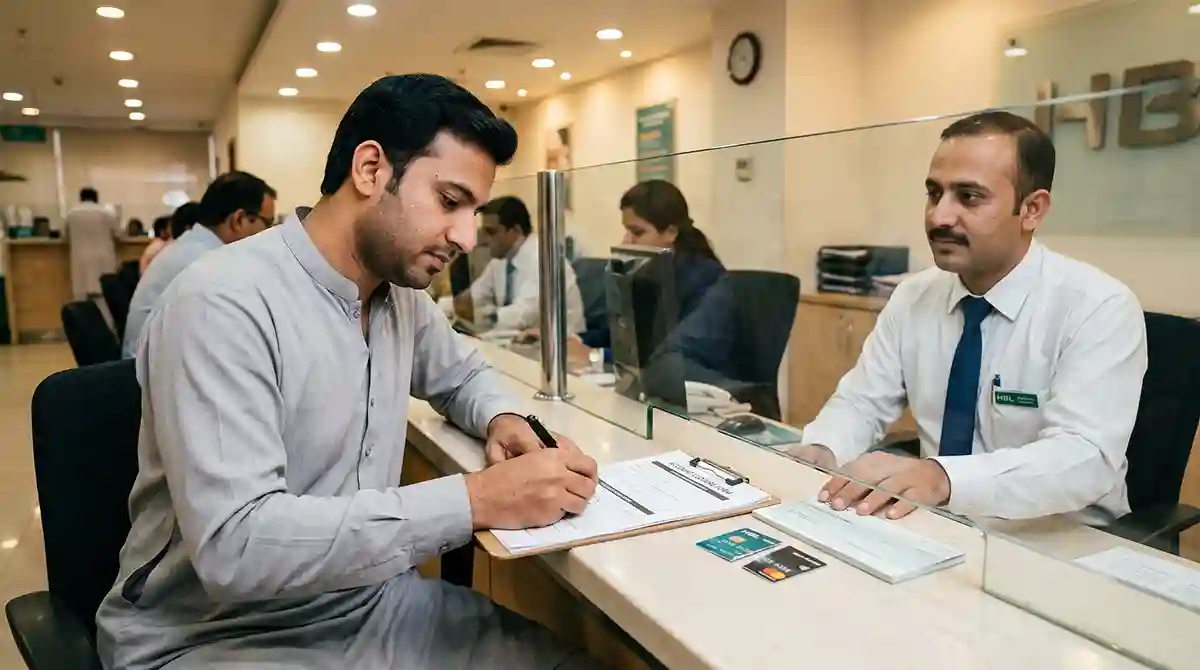
Step 5: Submit a formal closure request. For most Pakistani banks, including Islamic banking accounts such as Faysal Bank’s Digital Current Account, this requires visiting your branch in person with your original valid CNIC for identity verification, since the bank must perform its mandatory closure requirements and confirm that any products, services, or facilities linked with the account are properly unwound first.
Step 6: Return your unused chequebook and debit card. Most banks require you to physically surrender any unused cheque leaves and cut up or return your debit card as part of the closure formalities, both to prevent any future fraudulent use and to formally confirm the account is being deliberately closed rather than merely abandoned.
Step 7: Obtain written confirmation of closure. Request a closure confirmation letter or receipt from the branch. This is your evidence that the account was formally closed on a specific date, which matters if any dispute or dormancy-related question arises later.
What Happens to Linked Products When You Close an Account
| Linked Product | What to Do Before Closing |
|---|---|
| Salary credit | Update your employer’s payroll records with your new account details |
| Loan/credit card auto-debit | Redirect the repayment account with your bank first, to avoid a missed payment and credit history damage |
| Mutual fund SIP | Update the linked bank account directly with your AMC |
| Bank locker | Close the locker first, or link it to a different eligible account, and clear any outstanding locker rent |
| Standing instructions/utility bills | Cancel or redirect each one individually; they generally do not transfer automatically |
| Debit card | Return or destroy the card as part of the closure formalities |
| Unused chequebook | Return unused leaves to the branch |
Reactivating a Dormant Account (If You Change Your Mind)
If your account has already gone dormant and you decide you want to keep it rather than close it, reactivation is generally simpler than the eventual unclaimed-deposit scenario, but it still requires a branch visit.
You must present your original, valid identity document (a current CNIC; an expired one must be renewed first), and the branch must be satisfied with its Customer Due Diligence checks on you before lifting the dormancy restriction.
For overseas Pakistanis, several banks accept a scanned, attested request through your registered email or post, along with attested copies of your CNIC or NICOP, passport pages, visa, and proof of residence status, without requiring an in-person visit, though this varies by bank and should be confirmed directly.
Common Mistakes Pakistanis Make When Closing (or Abandoning) an Account
Assuming an account with a near-zero balance simply “closes itself” over time. As explained above, it does not; it moves into dormancy, continues accruing maintenance charges against whatever balance remains, and eventually risks being surrendered to SBP as an unclaimed deposit after 15 years of continuous inactivity.
Closing an account before redirecting linked loan repayments. This is the single most damaging version of this mistake, since a missed installment because the auto-debit account no longer exists can generate late payment penalties and a negative entry on your ECIB credit history.
Not checking for an early-closure fee. Some banks charge a closure fee if the account is shut within a defined early window after opening, commonly ranging from 14 days to a full year depending on the institution; confirm your specific bank’s policy rather than assuming closure is always free.
Losing access to old bank statements after closure. Requesting your statement history before, not after, closure saves considerable difficulty if you need that record for a future loan application or tax filing.
Assuming a closure request submitted online is complete without in-person verification. Most Pakistani banks, including Islamic banking accounts, still require a branch visit with your original CNIC to finalize closure, even where some preliminary steps can be initiated through internet or mobile banking.
Final Verdict
Properly closing a bank account in Pakistan takes one branch visit, a handful of documents, and perhaps thirty minutes of your time. Abandoning it instead can quietly cost you years of accumulated maintenance charges, complicate a future loan application when an unexplained dormant account shows up in your financial history. The most extreme and rarely understood scenario, eventually result in your own money being surrendered to the State Bank of Pakistan as an unclaimed deposit under a formal legal process that is considerably harder to reverse than a simple closure would have been.
If you genuinely have no further use for an account, close it properly. If you might use it again occasionally, a small transaction every few months costs you nothing and keeps the entire dormancy question from ever coming up.
Further reading and official sources:
- State Bank of Pakistan: Banking Companies Ordinance 1962 and unclaimed deposits framework: sbp.org.pk
- Banking Mohtasib Pakistan: independent complaint resolution for account closure disputes: bankingmohtasib.gov.pk