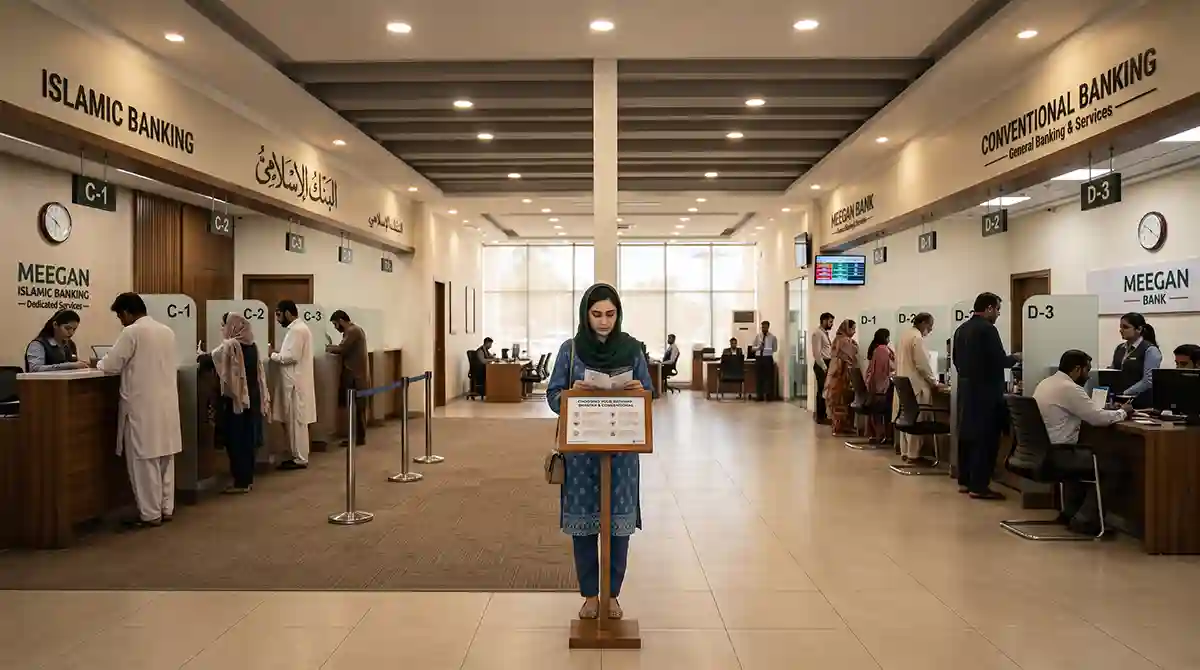
A cousin of mine opened what he believed was an Islamic account at a large conventional bank, assuming the whole institution operated on Shariah principles simply because his specific branch had a sign reading “Islamic Banking” above one of the counters. It took a conversation with a more financially literate friend for him to realize that the bank he was using was, in fact, a conventional bank with an Islamic banking window, a distinct and separately governed division operating inside the same building, with its own Shariah Board, its own segregated funds, and its own set of products, sitting alongside an entirely conventional, interest-based banking operation next door. Here you will learn about the real difference of Islamic Banking Windows vs Full-Fledged Islamic Banks in Pakistan.
This distinction is genuinely important, and it is one that most Pakistani banking customers, even those who deliberately seek out Islamic banking, do not fully understand. As of May 2026, Pakistan’s Islamic banking network comprised 22 institutions: six full-fledged Islamic banks and 16 conventional banks operating dedicated Islamic banking windows alongside their conventional services. Understanding what actually separates these two models, structurally, financially, and in terms of Shariah governance, changes how you should evaluate where to put your money if Shariah compliance matters to you.
The Basic Structural Difference
A full-fledged Islamic bank is licensed by the State Bank of Pakistan to operate exclusively on Islamic principles across its entire business. Every branch, every account, every financing product, and every rupee on its balance sheet operates under Shariah governance. Meezan Bank, BankIslami Pakistan, Dubai Islamic Bank Pakistan, Al Baraka Bank Pakistan, MCB Islamic Bank, and Faysal Bank are the institutions operating this way in Pakistan, with Faysal Bank having completed its full conversion from a conventional bank to a fully Islamic one.
An Islamic Banking Window (IBW), sometimes referred to as an Islamic Banking Branch (IBB) or Islamic Banking Division (IBD) depending on the specific structural level, is a dedicated Shariah-compliant division operating within a conventional bank. Banks including HBL (through HBL Islamic Banking), UBL (through UBL Ameen), Bank Alfalah (through Bank Alfalah Islamic), Allied Bank (through Allied Aitebar), and Standard Chartered (through Saadiq) all operate this way: the bank as a whole remains a conventional institution, but it maintains a clearly separated Islamic division that offers Shariah-compliant deposits and financing alongside the bank’s regular conventional products.
As of mid-2026, Pakistan’s Islamic banking sector overall comprised 4,159 full-fledged Islamic banking branches, 3,473 Islamic banking windows, and 166 sub-branches, reflecting genuinely rapid growth across both structural models in recent years.
Why the “Window” Structure Requires Genuinely Separate Fund Segregation
This is the part of the distinction that carries the most practical weight, and it is the reason a well-run Islamic banking window is not simply a marketing label slapped onto conventional operations.
Under SBP’s regulatory framework, a conventional bank’s Islamic Banking Division must be established at the Head Office level and is responsible for the segregation of funds, meaning money deposited into Islamic accounts must be tracked, invested, and managed entirely separately from the bank’s conventional deposits and lending activity. An Islamic Banking Fund is placed under the control of this division specifically to fund the operations of its Islamic branches and windows, and the bank is required to maintain separate procedure manuals, separate accounting policies, and separate records for disclosure of the assets, liabilities, expenses, and income attributable specifically to its Islamic operations.
A real, recent example of this being actively enforced: in June 2026, SBP directed Islamic banks to stop placing funds with conventional banks through loan-based arrangements, explicitly stating that such fund placements are not permissible under current Shariah governance standards, and instructed the affected institutions to withdraw any funds already deployed this way without delay. This is not a theoretical rule sitting quietly in a regulatory document; it is SBP actively intervening to correct a specific instance where the boundary between Islamic and conventional fund flows had been breached, which is precisely the kind of segregation failure the entire IBW framework exists to prevent.
For a customer, the practical takeaway is this: the segregation between an Islamic banking window and its parent conventional bank is a genuine, actively regulated structural requirement, not a cosmetic distinction, but it depends entirely on the bank’s own internal controls functioning correctly, and SBP’s willingness to intervene when they do not, exactly as it did in this case.
Shariah Governance: The Requirement That Applies to Both
Whether a bank is fully Islamic or operates only a window, it is classified as an Islamic Banking Institution (IBI) under SBP’s Shariah Governance Framework (SGF), and the same core governance requirements apply to both structural models.
Every IBI, full-fledged bank or conventional bank’s Islamic division alike, must maintain a Shariah Board with at least three members, including a Resident Shariah Board Member (RSBM) who works within the institution on a dedicated basis. This board is responsible for reviewing and approving every product, every contract template, and every transaction structure to confirm genuine Shariah compliance, and it is required to meet with the institution’s Board of Directors and hold its own dedicated meetings at least quarterly, with each member expected to attend at least two-thirds of the year’s meetings.
A meaningful independence requirement is being phased in as well: from January 1, 2028, Shariah Board members will no longer be permitted to serve on the Shariah Board of more than one Islamic Banking Institution simultaneously, a change specifically designed to prevent the kind of governance overlap that could weaken independent oversight across the industry, particularly among smaller windows that have historically shared scholars with other institutions.
How SBP Has Recently Accelerated Window Conversions
In June 2026, SBP made a significant regulatory change: conventional banks can now establish Islamic Banking Windows within their existing conventional branches without requiring prior SBP approval, provided the specific branch is part of an approved annual branch conversion plan or a separately submitted conversion request. This is explicitly designed as an interim structure, meaning a window established this way operates from the start of that branch’s conversion process until its complete transformation into a fully Islamic branch, at which point the window designation ends and the branch becomes a genuine Islamic Banking Branch outright.
As part of this same regulatory update, SBP also revised the technical connectivity requirement for these windows: rather than requiring real-time connectivity specifically with the nearest Islamic banking branch or hub, a window can now connect with a controlling branch, a centralized hub, or a data center instead, a change intended to make the fund segregation itself more efficient and technically robust as the network scales rapidly.
The practical implication for a customer is that Pakistan’s Islamic banking window network is expanding quickly and, in many cases, represents a genuine, active conversion in progress toward becoming a fully Islamic branch, rather than a permanent side operation bolted onto a conventional bank indefinitely.
A Practical Comparison for Choosing Between Them
| Factor | Full-Fledged Islamic Bank | Islamic Banking Window |
|---|---|---|
| Example institutions | Meezan Bank, BankIslami, Dubai Islamic Bank Pakistan, Al Baraka, MCB Islamic, Faysal Bank | HBL Islamic, UBL Ameen, Bank Alfalah Islamic, Allied Aitebar, Standard Chartered Saadiq |
| Entire institution Shariah-compliant | Yes, across every branch and product | No; only the Islamic division/window is Shariah-compliant, the rest of the bank remains conventional |
| Shariah Board requirement | Applies to the whole bank | Applies specifically to the Islamic Banking Division |
| Fund segregation | Not applicable; all funds are Islamic by default | Required and actively regulated, with SBP enforcement, as shown by the June 2026 directive above |
| Typical branch network | Dedicated Islamic branches only | Both conventional branches (with a window) and, over time, fully converted Islamic branches |
| Best suited for | Customers who want zero exposure to any conventional banking relationship, even indirectly | Customers who value the parent bank’s broader branch/ATM network or specific conventional products (e.g., certain international banking services) alongside Islamic accounts |
Common Mistakes Pakistani Banking Customers Make
Assuming “Islamic Banking” signage on a branch means the entire bank is Islamic. As my cousin’s experience shows, a single branch, or even a single counter within a branch, can represent an Islamic Banking Window operating inside an otherwise fully conventional institution. Ask specifically whether the account you are opening is with the bank’s Islamic Banking Division or its conventional operations.
Not checking whether the specific product is genuinely reviewed by the institution’s Shariah Board. As covered in the Sukuk and Islamic investment articles in this series, every Shariah-compliant product, whether a savings account, a Diminishing Musharakah home finance facility, or an Ijarah car finance product, should have gone through the Shariah Board’s review and approval. If a bank cannot clearly point you to that governance, that is worth questioning regardless of which structural model the bank uses.
Believing that fund segregation is automatic and requires no oversight. The June 2026 SBP directive on loan-based placements is a useful reminder that segregation is a genuinely enforced regulatory requirement, not a passive design feature; it depends on both the bank’s internal controls and SBP’s active supervision.
Overlooking that a window can be a genuine, temporary step toward full conversion. Some customers assume a window is a permanent, secondary arrangement. In many current cases in Pakistan, it is explicitly an interim structure on the path to that specific branch becoming a fully converted Islamic branch, reflecting the broader industry-wide push described above.
Conclusion
The difference between a full-fledged Islamic bank and an Islamic banking window in Pakistan is not primarily about which one is “more Islamic” in a simple sense; both operate under the same Shariah Governance Framework, both require an independent Shariah Board, and both are subject to SBP’s active regulatory oversight, including direct intervention when fund segregation rules are breached, as the June 2026 case demonstrates.
The genuine difference is structural: a full-fledged Islamic bank has no conventional operations to segregate from in the first place, while a window’s Shariah compliance depends on the ongoing integrity of the segregation between it and its conventional parent. For most Pakistani customers, either model provides a genuinely regulated, Shariah-governed banking relationship. The practical step worth taking is simply asking, directly and explicitly, which structure you are actually opening an account with, and confirming that the specific product you are using has gone through that institution’s own Shariah Board review, rather than assuming either fact from branch signage alone.
Further reading and official sources:
- State Bank of Pakistan: Islamic Banking Department and Shariah Governance Framework: sbp.org.pk/ibd
- State Bank of Pakistan: Islamic banking data and regulatory circulars: sbp.org.pk
- Individual bank Islamic banking divisions (e.g., Meezan Bank, HBL Islamic, UBL Ameen): product-specific Shariah compliance documentation available on each bank’s official website