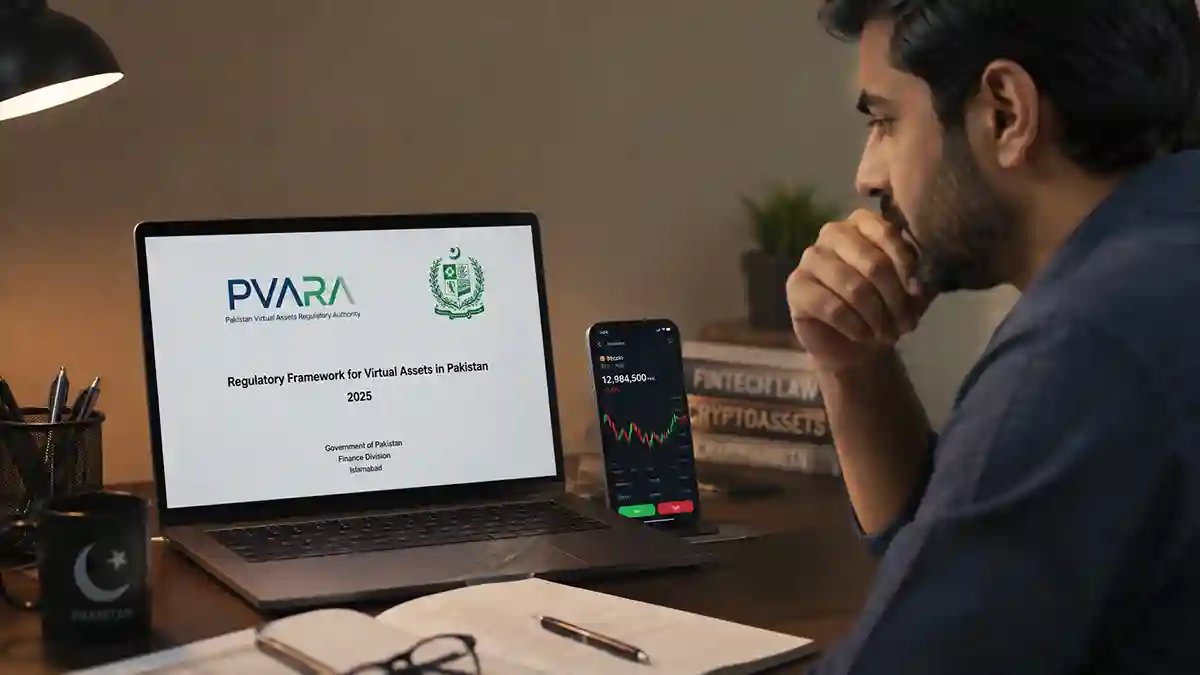
For seven years, the honest answer to “is crypto legal in Pakistan” was genuinely complicated: not explicitly banned by any single law, but the State Bank of Pakistan had instructed every bank and payment provider in the country not to touch it, which made actually using crypto through the formal financial system effectively impossible. That changed dramatically in April 2026, when Pakistan legalized virtual assets through a new law and created a dedicated regulator. This is one of the most significant financial regulatory shifts in Pakistan’s recent history, and it deserves a clear, sober explanation rather than either panic or hype. So, here you will learn about crypto regulation in Pakistan 2026.
This article walks through exactly what changed, what is legal today, what is still genuinely risky, and the specific things a Pakistani reader should understand before treating crypto as anything resembling a mainstream investment option, because as of mid-2026, it very much is not yet one.
Table of Contents
The Short Answer
As of April 2026, owning and trading cryptocurrency in Pakistan is legal. What remains tightly restricted, and in most practical cases still unavailable, is doing so through a formally licensed, regulated Pakistani exchange or service provider, because as of the time of writing, no crypto exchange has yet completed the full licensing process required under the new law. This distinction, legal to own versus not yet possible to access through a licensed local platform, is the single most important thing to understand about crypto in Pakistan right now.
How We Got Here: A Brief Regulatory History
2018: The effective ban begins. SBP issued BPRD Circular 03/2018 and FE Circular 03/2018, formally directing all financial institutions in Pakistan not to process any virtual currency transactions. This did not make owning crypto a criminal act for an individual, but it cut off every formal banking bridge between the rupee and any crypto exchange, driven by concerns over unregulated capital flight, fraud, and Pakistan’s foreign exchange position at a time when the country was also under FATF grey-list monitoring.
2025: The policy reversal begins. The government established the Pakistan Crypto Council (PCC), led by CEO Bilal Bin Saqib and reportedly advised by Binance founder Changpeng Zhao, to coordinate a new policy approach across SBP, SECP, and other bodies. In July 2025, the government issued the Virtual Assets Ordinance, creating the Pakistan Virtual Assets Regulatory Authority (PVARA) on a temporary basis.
April 2026: Legalization becomes permanent law. Parliament passed the Virtual Assets Act 2026, converting PVARA into a permanent, autonomous federal regulator. On April 15, 2026, SBP formally announced that virtual assets had been legalized in Pakistan, and on April 14, 2026, issued SBP Circular No. 10 of 2026, authorizing banks to open accounts specifically for PVARA-licensed virtual asset service providers, ending the seven-year blanket restriction, but only for entities that hold a valid PVARA license.
What PVARA Actually Regulates
The Pakistan Virtual Assets Regulatory Authority is now the statutory body responsible for licensing, supervising, and regulating every category of virtual asset business operating in or targeting Pakistan. This includes crypto exchanges (platforms where you buy, sell, or swap coins), custodians (companies that hold crypto on your behalf), wallet operators, token issuers, and investment platforms offering virtual-asset-based products.
Under the Act, any business offering these services to people in Pakistan must obtain a PVARA license before operating. Operating without one is not a minor paperwork violation; it is a criminal offense. The penalties are genuinely severe: unlicensed operation of a virtual asset service can carry fines of up to PKR 50 million and imprisonment of up to five years, while unauthorized promotional activity or unlicensed token offerings carry a separate penalty of up to PKR 25 million and three years’ imprisonment.
A worked example of what this means practically: if a Pakistani-based platform, or an individual running a crypto “investment group” on social media, is soliciting deposits or offering trading services without a PVARA license, they are operating illegally under the new law regardless of how professional their marketing looks, and anyone found promoting such a scheme without authorization faces the same criminal exposure as the operator.
What’s Legal Today vs What Is Still Restricted
| Activity | Current Status (mid-2026) |
|---|---|
| Personally owning cryptocurrency | Legal |
| Trading on an international exchange from Pakistan | Legal grey area; the exchange itself may not be PVARA-licensed |
| A Pakistani bank opening an account for a PVARA-licensed VASP | Permitted under SBP Circular No. 10 of 2026 |
| A Pakistani bank trading, investing in, or holding crypto with its own funds or customer deposits | Explicitly still barred |
| Operating a crypto exchange or wallet service in Pakistan without a PVARA license | Illegal; criminal penalties apply |
| Promoting an unlicensed token offering or investment scheme | Illegal; separate criminal penalty applies |
| A fully PVARA-licensed exchange operating domestically | Not yet available; no exchange had completed full licensing as of the time of writing, though NOC applications were being accepted |
The Licensing Framework: Why “Legal” Doesn’t Yet Mean “Accessible”
PVARA’s draft Pakistan Virtual Asset Services Regulations 2026 define ten separate VASP license categories, each with its own minimum paid-up capital requirement set out in the regulation’s schedule. Full licenses are issued only after an applicant demonstrates it meets requirements including sufficient minimum capital, recognition from a major regulator abroad such as those in the US, EU, or Singapore, and compliance with Shariah finance principles, which is separately checked by a dedicated scholars’ committee for platforms seeking that certification.
As the first step toward full licensing, PVARA began accepting No Objection Certificate (NOC) applications, with detailed full-licensing steps to follow. Several major global exchanges, including names like Binance and HTX, have reportedly initiated compliance procedures under the new framework, but as of mid-2026 the practical reality for an ordinary Pakistani reader is this: there is not yet a fully licensed, locally regulated exchange you can use with full legal certainty and bank-backed on- and off-ramps.
This gap between “the law now permits this” and “the licensed infrastructure to actually do it safely exists” is the most important nuance in this entire topic, and it is exactly the kind of gap that unlicensed platforms and scam operators are most likely to exploit while it remains open.
Tax Treatment of Virtual Assets in Pakistan
The Federal Board of Revenue has introduced specific tax compliance provisions for virtual assets under Section 285BAA, bringing crypto transactions and holdings into Pakistan’s formal tax reporting framework alongside PVARA’s regulatory oversight. As covered in the tax benefits article in this series, any income or gain, once formal reporting mechanisms are fully operational, is expected to be taxable in a manner broadly consistent with how other capital gains and investment income are treated under Pakistani tax law. Because this framework is still actively being finalized alongside PVARA’s licensing rollout, anyone holding or transacting in crypto should consult a qualified tax advisor directly rather than assuming any specific treatment, and should keep detailed personal transaction records regardless, since retroactive reporting requirements are a realistic possibility as the framework matures.
Ambitious Government Plans Still in Early Stages
Beyond the licensing framework itself, the government has announced several larger initiatives connected to this policy shift, though most remain at the planning or exploratory stage rather than being implemented. These include plans to allocate surplus electricity toward Bitcoin mining and AI data centres, exploration of a proposed Strategic Bitcoin Reserve, discussion of tokenizing government assets, cooperation on dollar-linked stablecoin frameworks for remittances, and preparation for a possible central bank digital currency (CBDC) pilot. PVARA has also been granted authority to establish special “virtual asset zones” intended to attract blockchain companies, though specific zones had not yet been designated as of mid-2026.
None of these initiatives are relevant to an individual reader’s near-term decision-making. They are worth being aware of as context for where Pakistan’s policy direction is heading, but they do not change the practical risk profile of crypto activity for an ordinary Pakistani investor today.
Why Crypto Remains a Genuinely High-Risk Category, Regardless of Legal Status
Legalization is a regulatory status change, not a risk rating. It is worth being direct about this, because “now legal” is easily and dangerously misread as “now safe.”
No licensed local exchange yet means no formal consumer protection infrastructure yet. Every other investment vehicle covered in this series, PSX stocks, mutual funds, National Savings, Sukuk, comes with an established complaint and recourse mechanism, whether through SECP, the Banking Mohtasib, or SBP. A crypto transaction on an unlicensed or foreign platform currently has no equivalent Pakistani consumer protection body standing behind it if something goes wrong.
Price volatility remains extreme by any standard used elsewhere in this series. Even the most volatile PSX sector corrections discussed in the long-term stock investing article in this series are modest compared to the swings routinely seen in major cryptocurrencies over weeks or even single trading days.
Scam risk is specifically elevated during this exact transition period. As covered in the investment scam and banking fraud articles in this series, fraudulent schemes tend to cluster around genuine regulatory news, since a real headline like “Pakistan legalizes crypto” gives a fake platform instant, borrowed credibility. Any platform, individual, or WhatsApp group claiming to be PVARA-licensed, offering guaranteed returns, or pressuring you to deposit quickly should be treated with the same skepticism covered in the investment scam checklist elsewhere in this series, verified directly against PVARA’s own published licensee list rather than taken at their word.
Common Mistakes Pakistanis Are Already Making With This News
Assuming “legal” means a platform is automatically trustworthy. Legality under the new Act depends entirely on whether a specific platform actually holds a PVARA license, not on whether crypto in general is now permitted. Always check PVARA’s own published list of licensed entities directly rather than trusting a platform’s own claims.
Confusing “banks can now open accounts for VASPs” with “my personal bank account can freely fund crypto trading.” SBP’s Circular No. 10 of 2026 specifically permits banks to service PVARA-licensed virtual asset service providers; it does not mean an ordinary personal or business account can move funds to any crypto platform without restriction, and banks remain barred from trading or holding crypto with customer deposits themselves.
Treating early government enthusiasm (Bitcoin reserves, mining plans, tokenization) as investment advice. These are national policy exploratory initiatives, not a signal about what any individual reader should do with their own savings.
Ignoring the tax reporting obligation because the framework still feels unfinished. As covered above, Section 285BAA already exists in the tax code. Waiting for a perfectly finished framework before keeping honest personal records is a decision that tends to look worse in hindsight, not better.
Summing Up
Pakistan’s shift from a seven-year effective crypto ban to a formal licensing regime under the Virtual Assets Act 2026 is a genuinely significant policy change, and it reflects a broader global trend of governments moving toward regulation rather than prohibition. For a Pakistani reader, the practical takeaway in mid-2026 is narrower than the headlines suggest: owning crypto is legal, but the licensed, regulated, consumer-protected infrastructure that would make it comparable in safety to the PSX, mutual fund, or National Savings products covered elsewhere in this series simply does not exist yet.
If you are curious about this space, the single most useful habit is patience combined with direct verification: check PVARA’s own published licensee list before trusting any platform, treat any unsolicited crypto investment pitch with the same scrutiny covered in the investment scam checklist in this series, and recognize that a law changing overnight does not mean the surrounding safety infrastructure changes at the same speed.
Further reading and official sources:
- Pakistan Virtual Assets Regulatory Authority (PVARA): official licensing and regulatory information: pvara.gov.pk
- State Bank of Pakistan: Circular No. 10 of 2026 and virtual asset banking guidance: sbp.org.pk
- Federal Board of Revenue: virtual asset tax compliance under Section 285BAA: fbr.gov.pk