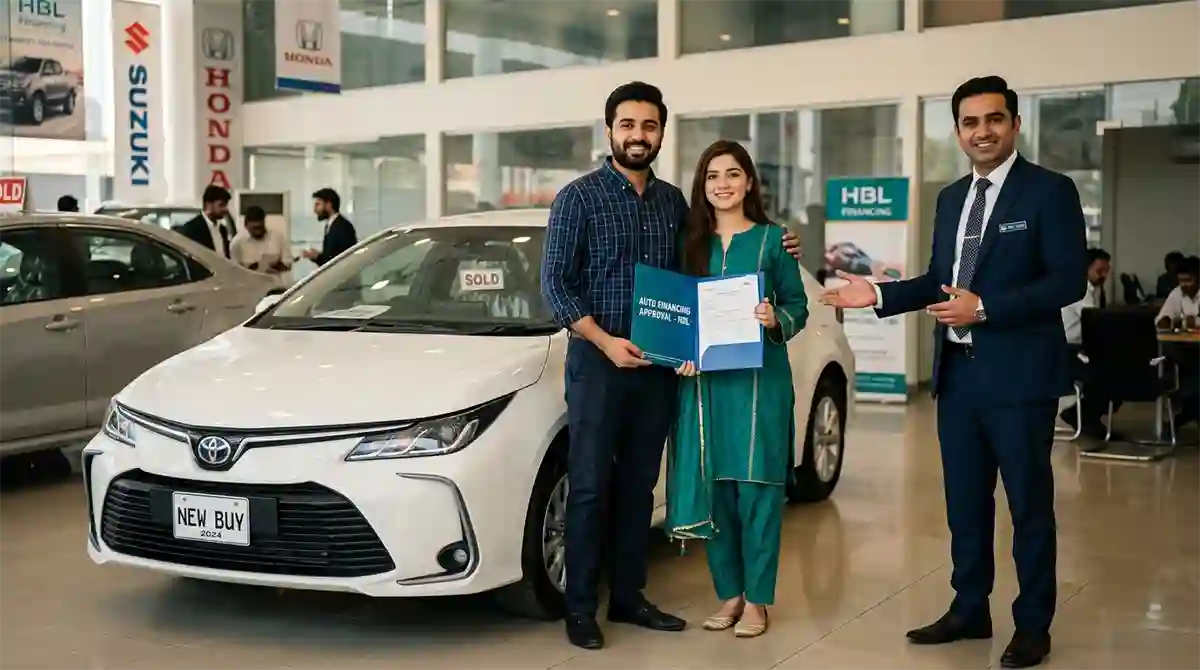
A cousin of mine went to book a Suzuki Cultus on installments in 2023, right when interest rates in Pakistan were at their historic peak. His monthly installment came out so high that he walked away from the booking entirely. Two years later in 2025, he tried again. The car’s price had gone up, but interest rates had come down significantly, and to his surprise the actual monthly installment was more manageable than what he had calculated in 2023, despite the higher sticker price.
This single experience captures something important about car financing in Pakistan that most first-time buyers do not fully appreciate: the monthly installment is not just a function of the car’s price. It is a function of the price, the down payment, the tenure, and crucially, the prevailing KIBOR rate at the time you book the loan. Understanding how these pieces fit together is the difference between confidently choosing the right financing plan and being caught off guard by numbers that do not match your expectations.
This guide walks through exactly how car financing works in Pakistan in 2026, what it actually costs with real worked examples, which banks offer what, and how to avoid the mistakes that trap so many first-time car buyers.
Table of Contents
How Car Financing Works in Pakistan
Car financing, also called auto financing or in Islamic banking terms Car Ijarah, allows you to buy a car without paying the full purchase price upfront. You pay a portion of the price as a down payment, and the bank finances the remainder, which you repay through fixed monthly installments over an agreed tenure, along with markup or profit.
Car financing in Pakistan is regulated by the State Bank of Pakistan, which sets prudential limits on loan tenure, maximum financing amounts, and debt burden ratios that banks must follow. Per SBP regulations, the maximum aggregate auto financing limit for a single individual is currently PKR 3,000,000 for standard schemes, though some banks offer higher limits up to PKR 7.5 million through specific products such as those designed for Roshan Digital Account holders.
Understanding KIBOR and How Your Markup Rate Is Calculated
This is the single most important concept to understand before financing a car in Pakistan, because it directly determines your monthly installment.
Most banks in Pakistan calculate your car loan markup using a floating rate model tied to KIBOR, the Karachi Interbank Offered Rate, which is the benchmark rate at which banks lend to each other. Your actual rate is calculated as the 1-Year KIBOR plus a bank spread, which is the bank’s profit margin on top of the benchmark rate, typically ranging from 2.5% to 4%.
As of early 2026, the 1-Year KIBOR has been fluctuating around 11.8% to 12%, a significant decline from the historic highs of over 22% seen during 2023. With a typical bank spread of 2.5% to 4%, this puts most conventional car loan markup rates in Pakistan in the range of 14% to 16% per annum in early 2026, though specific rates vary by bank, applicant profile, and whether the loan is for a new or used vehicle.
The critical thing to understand about floating rate car loans is that your installment is not fixed for the entire tenure. The KIBOR component resets annually on your loan anniversary date, based on the prevailing 1-Year KIBOR at that time. If KIBOR falls between your loan booking and your anniversary date, your installment may decrease. If KIBOR rises, your installment increases. Some banks, including Bank Alfalah and HBL, also offer fixed-rate options where your markup stays the same for the life of the loan, trading the possibility of a future rate decrease for the certainty of predictable payments.
A Real Worked Example: What a Car Loan Actually Costs in 2026
Let us walk through an actual calculation using current 2026 figures to make this concrete.
Suppose you want to finance a Suzuki Cultus VXL, currently priced at approximately PKR 4.59 million. You decide on a 30% down payment, which is PKR 1,377,000, leaving a financed amount of PKR 3,213,000. You choose a 5-year tenure with a markup rate of 14.5%, reflecting the current 1-Year KIBOR of approximately 11.84% plus a bank spread of around 2.5% to 3%.
Using the standard reducing balance EMI formula that Pakistani banks apply, where the markup for each month is calculated on the remaining outstanding balance rather than the original loan amount, your estimated monthly installment on this PKR 3,213,000 financed amount over 5 years at 14.5% works out to approximately PKR 75,500 per month.
Over the full 5-year tenure, your total repayment would be approximately PKR 4,530,000, meaning the total cost of borrowing, the markup paid over the life of the loan, is approximately PKR 1,317,000 above the amount you actually borrowed.
This is the number that catches many first-time car buyers off guard. The markup over a 5-year tenure can add nearly 40% to the financed amount. This is precisely why understanding the trade-off between tenure length and total cost matters so much.
A second example with a shorter tenure: If the same buyer chose a 3-year tenure instead of 5 years, on the same PKR 3,213,000 financed amount at 14.5%, the monthly installment rises to approximately PKR 110,500, a meaningfully higher monthly commitment. But the total repayment over 3 years comes to approximately PKR 3,978,000, meaning total markup paid drops to roughly PKR 765,000, a savings of over PKR 550,000 compared to the 5-year option.
The lesson from this comparison is direct: a longer tenure reduces your monthly burden but significantly increases your total cost of ownership. A shorter tenure costs more per month but saves substantially on total interest paid. Choosing the shortest tenure your monthly budget can comfortably support is almost always the financially smarter decision.
Also read: How to Invest in Real Estate in Pakistan: A Beginner’s Guide (2026)
Down Payment Requirements in 2026
Down payment requirements vary by bank and by financing product, but the general range across the Pakistani market in 2026 is between 15% and 35% of the vehicle’s price.
Most conventional bank products require a minimum down payment of 30% to 35%. Allied Bank’s car finance product requires a minimum down payment of 30% of the car’s price. Some platforms note that the standard minimum across most lenders sits at 35%.
A smaller number of specialized products offer significantly lower entry points. Bank Alfalah’s Roshan Apni Car facility, designed specifically for Roshan Digital Account holders among overseas Pakistanis, offers down payments as low as 15%, or even 0% equity for lien-based financing where the loan amount is secured against funds already held in the applicant’s Roshan Digital Account or Naya Pakistan Certificate investment rather than requiring additional collateral.
The maximum down payment, on the other end of the spectrum, can go up to 70% for buyers who want to minimize their financed amount and therefore their total markup cost, which directly reduces both the monthly installment and the total interest paid over the loan’s life.
A higher down payment is almost always the financially smarter choice when you can afford it, since it directly reduces both your monthly installment and your total markup cost over the tenure. The trade-off is tying up more of your savings upfront in an asset, your car, that depreciates over time rather than keeping that capital available or invested elsewhere.
Conventional vs Islamic Car Financing: Key Differences
Pakistani buyers have two structurally different financing paths available, and understanding the difference matters both for religious considerations and for understanding what you are actually signing up for.
Conventional Auto Loans
Banks like HBL, UBL, MCB, Bank Alfalah, and Allied Bank offer conventional auto loans structured as interest-based lending. You borrow the financed amount, and you repay it with markup calculated as KIBOR plus the bank’s spread. UBL Drive and HBL offer competitive conventional rates in the range of approximately 10% to 14% per annum as of early 2026, while MCB’s Car4U product offers financing up to 70% of the car’s value for mid to high-income buyers.
Islamic Car Ijarah Financing
Islamic banks structure car financing through a contract called Ijarah, which is essentially a lease-to-own arrangement, or through Diminishing Musharakah, a co-ownership structure where the bank’s share in the vehicle reduces progressively as you make payments. Meezan Bank’s Car Ijarah product is one of the most established Shariah-compliant options in Pakistan, with profit rates in the range of approximately 13.45% to 13.70% as of early 2026. Faysal Bank’s Islamic car finance product uses a Diminishing Musharakah structure and notably charges no markup until formal approval is granted. Bank Islami’s AutoFinance is another widely used Islamic option offering competitive profit-sharing rates.
The practical day-to-day experience for the customer, in terms of monthly payments and the overall process, is broadly similar between conventional and Islamic financing. The underlying legal structure of the contract differs meaningfully, with Islamic financing avoiding interest in favor of a lease or co-ownership arrangement with profit sharing. For buyers who want to avoid riba entirely, Islamic Car Ijarah provides a genuine, fully functional alternative without sacrificing access to financing or competitive rates.
Best Banks for Car Financing in Pakistan in 2026: A Comparison
HBL
One of Pakistan’s largest banks with a strong car loan program. HBL finances both new and used vehicles, offers both fixed and floating rate options, and provides financing up to PKR 10 million for qualifying applicants. HBL is a strong option for salaried individuals, self-employed applicants, and overseas Pakistanis with Roshan Digital Accounts.
UBL Drive
UBL’s dedicated car financing product offers markup rates in the range of approximately 10% to 13% on a floating basis, with quick processing that makes it particularly attractive for salaried individuals seeking fast approval and a straightforward process.
Bank Alfalah
Offers both fixed and floating rate car financing with notable flexibility, including a Residual Value product that allows a balloon payment at the end of the tenure to reduce monthly installments throughout the loan period, and a Vehicle Replacement option allowing customers to upgrade their car without incurring pre-adjustment penalties.
Meezan Bank
Pakistan’s leading Islamic bank offers Car Ijarah financing with profit rates around 13.45% to 13.70%, fully Shariah-compliant with no interest involved, structured on a transparent profit-sharing basis.
MCB Car4U
Offers flexible plans with financing up to 70% of the car’s value, positioned for mid to high-income buyers seeking a higher financed amount relative to their down payment.
Allied Bank
Allied Car Finance offers financing up to PKR 3 million with a minimum down payment of 30%, requiring a minimum net monthly salary of PKR 40,000 for salaried applicants and PKR 60,000 for self-employed applicants.
Faysal Bank
Faysal Islami Car Finance uses Diminishing Musharakah with the distinctive feature of no markup charged until the loan is formally approved.
Eligibility Criteria for Car Financing in Pakistan
While specific requirements vary by bank, the general eligibility framework across the Pakistani market in 2026 follows a consistent pattern.
Age: Most banks require applicants to be between 21 and 65 years old at the time the loan matures, meaning if you are 60 years old, you may only qualify for a 5-year tenure rather than a longer one.
Income: Salaried applicants typically need a minimum gross monthly income in the range of PKR 30,000 to PKR 80,000 depending on the specific bank and product. Self-employed applicants generally face a higher minimum income threshold, often PKR 60,000 to PKR 100,000, reflecting the bank’s additional scrutiny of less predictable income streams.
Employment and Documentation: Salaried applicants need to provide salary slips, an employment letter, and bank statements showing salary credits. Self-employed applicants need business registration documents, tax returns, and bank statements demonstrating consistent income.
Credit History: As with personal loans, your ECIB credit report is checked as part of the application. A clean repayment history significantly improves your approval odds and may lead to more favorable terms.
Debt Burden Ratio: Per SBP Prudential Regulations, your total monthly debt obligations including the new car installment must not exceed the bank’s defined Debt Burden Ratio threshold, generally around 40% to 50% of your net monthly income. This is a protective measure to ensure you are not over-extending yourself financially.
New Cars vs Used Cars: How Financing Differs
Most banks including HBL, UBL, Bank Alfalah, and Allied Bank finance both new and used locally manufactured vehicles, though the terms differ meaningfully between the two categories.
Used car financing typically carries a markup rate that is 1% to 1.5% higher than new car financing, reflecting the bank’s additional risk assessment for an asset that depreciates faster in percentage terms and carries more uncertainty about condition and remaining useful life.
A widely applied industry rule in 2026 is that the car’s age plus the financing tenure should not exceed 10 years. This means a car that is already 7 years old at the time of financing would only qualify for a maximum 3-year tenure, since the vehicle would otherwise be 10 years old by the time the loan matures.
For buyers focused on minimizing total cost, financing a well-maintained used vehicle reduces the total loan size and therefore the total markup paid, even though the per-rupee markup rate is slightly higher than for new vehicles.
Engine Capacity and Tenure Restrictions
A detail that surprises many first-time car buyers in Pakistan is that the maximum financing tenure depends partly on the vehicle’s engine capacity. Vehicles with an engine capacity above 1000cc, which includes popular models like the Honda City and Toyota Corolla, are often restricted to a maximum tenure of 3 years under many banks’ policies, which significantly increases the monthly installment compared to financing a 1000cc or below vehicle over a longer term.
This is an important detail to confirm with your specific bank before falling in love with a particular vehicle, since the tenure restriction can substantially change your monthly affordability calculation even if the car’s price itself is within your budget.
Hidden and Additional Costs to Budget For
Beyond the down payment and monthly installment, several additional costs apply to car financing in Pakistan that buyers often underestimate.
Processing Fee: Banks charge a processing fee on loan approval, typically a percentage of the financed amount or a flat fee, which varies by bank. Some Islamic banks waive processing fees during promotional periods such as Ramadan or year-end sales.
Insurance: Comprehensive vehicle insurance, often structured as Takaful for Islamic financing products, is mandatory for the duration of the loan since the vehicle remains hypothecated to the bank. The first year’s insurance premium is typically paid upfront at the time of loan booking, and this cost is separate from and in addition to your down payment.
Registration and Excise Charges: Vehicle registration with the Excise and Taxation Department, along with applicable taxes, are payable alongside the down payment at the time of loan booking and are not included in the financed amount in most cases.
Lien Charges: A lien is placed on the vehicle with the Excise and Taxation Department for the duration of the financing, meaning you cannot sell or transfer the vehicle without bank clearance until the loan is fully repaid.
Budgeting for these additional costs, which can easily add 5% to 10% on top of your down payment, prevents the unpleasant surprise of being short on funds at the time of loan booking even after you have saved what you believed was sufficient for your down payment.
Smart Strategies for Car Financing in 2026
Always ask about zero-percent prepayment penalty options. Several Islamic banks offer the ability to pay off your car loan early without penalty, typically after the first year of financing. If you anticipate having extra funds in the future, choosing a loan with this flexibility allows you to reduce your total markup cost by paying down the principal faster.
Compare at least three to four lenders before committing. Markup rates, processing fees, and specific terms vary meaningfully across banks even when the headline rate looks similar. A thorough comparison, ideally using an online car loan calculator to standardize the comparison across different banks’ rate structures, can reveal meaningful savings.
Choose the shortest tenure your budget genuinely supports. As demonstrated in the worked example earlier in this article, the difference in total cost between a 3-year and 5-year tenure on the same loan amount can exceed PKR 500,000. Resist the temptation to extend your tenure purely to reduce the monthly installment if you can realistically afford the higher payment.
Consider a fixed rate if you value payment certainty. With KIBOR having fluctuated dramatically over the past several years, from over 22% in 2023 to roughly 12% in early 2026, a fixed-rate option removes the uncertainty of your installment changing on your loan anniversary, at the cost of potentially missing out if rates continue to decline.
Factor in total cost of ownership, not just the loan. Insurance, maintenance, fuel, and registration costs continue throughout your ownership period regardless of your financing structure. Calculating your complete monthly car-related budget, not just the loan installment, prevents financial strain after the purchase.
Key Takeaways
Car financing in Pakistan in 2026 sits in a meaningfully more favorable position than it did during the painful high-rate period of 2023, when markup rates pushed monthly installments beyond what many middle-income buyers could realistically afford. With KIBOR having declined substantially and banks once again actively competing for car finance customers, the environment is more accessible, though still requiring careful, informed decision-making.
The mathematics of car financing are not complicated once you understand the moving pieces: your financed amount, your markup rate, and your tenure together determine your monthly installment and your total cost. A larger down payment and a shorter tenure both reduce your total cost meaningfully, even though they may feel less comfortable in the short term than a smaller down payment and a longer tenure.
Compare your options across multiple banks, understand whether you prefer the certainty of a fixed rate or the potential upside of a floating KIBOR-based rate, and budget honestly for the full cost of ownership beyond just the monthly installment. A car bought through financing that you understood and planned for properly is a genuinely useful tool. A car financed without understanding these mechanics is how many Pakistani families end up financially strained by a purchase that should have brought them convenience, not stress.