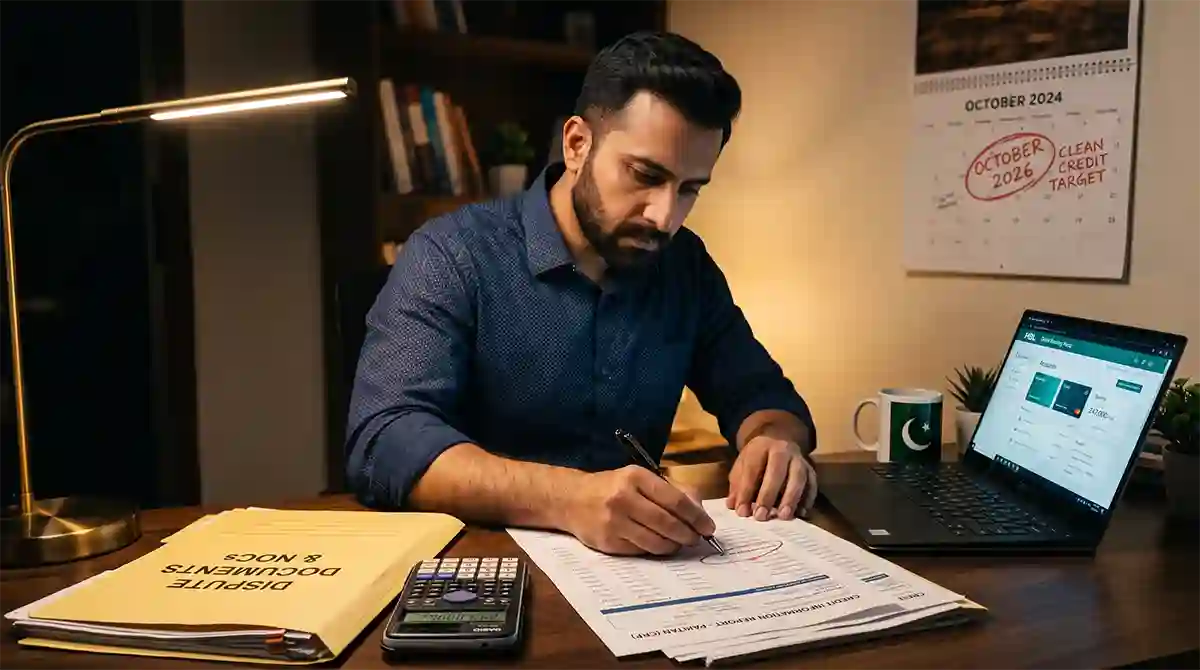
A relative of mine was turned down for a car loan two years ago. The bank officer told him his credit profile was not clean but refused to elaborate much beyond that. He had a good salary, no recent debt, and genuinely believed his financial history was fine. He had no idea that a credit card he had gotten years earlier, used a handful of times, and then essentially forgotten about, had been accumulating late payment entries because of an annual fee he never noticed being charged on a card he thought was inactive. So in this article, you will learn how to improve your credit score in Pakistan in 2026.
Those quiet missed payments had created a damaged credit profile that was costing him access to financing he was otherwise fully eligible for.
He is far from alone. A significant number of Pakistanis discover they have credit history problems only when they apply for a loan or credit card and get rejected. By that point, the damage is already done and the question shifts from prevention to repair.
If you are in this situation, or if you want to proactively build a strong credit history before you need it, this guide covers exactly how Pakistan’s credit reporting system works in 2026, what damages your profile, what actually improves it, and a realistic timeline for recovery from different types of credit problems.
Table of Contents
Understanding Pakistan’s Credit Reporting System in 2026
Before you can learn how to improve your credit score in Pakistan, you need to understand how it is built and maintained.
Pakistan’s credit information system operates through two parallel structures.
The primary system is the Electronic Credit Information Bureau, known as eCIB, operated by the State Bank of Pakistan. Established in 1992 and digitized in 2003, the eCIB today maintains over four million borrower records across nearly 100 member institutions including all commercial banks, microfinance banks, development finance institutions, and leasing companies. Every loan, credit card, financing facility, and installment plan you have ever held with any member institution is reported to eCIB monthly.
The secondary structure consists of licensed private credit bureaus operating under the Credit Bureaus Act 2015. The SBP has authorized private entities including Aequitas Information Services Limited, known as AISL, and Data-Check Limited to operate as licensed credit information providers. These private bureaus offer additional services beyond the basic eCIB system including credit scoring, portfolio monitoring, and fraud detection tools. Tasdeeq, a platform providing official credit history reports in partnership with licensed credit bureaus, allows individuals to check their credit information report, or CIR, directly through a digital process.
Your credit profile at eCIB is not expressed as a single three-digit score the way the FICO system works in the United States. Instead, lenders access a detailed Credit Information Report showing your full credit history across all member institutions, the current status of each facility, your repayment behavior, any defaults or settlements, and your total outstanding obligations. Lenders use this report alongside their own internal scoring models to make credit decisions.
The eCIB is updated monthly by member institutions. This means that a late payment made in June will appear on your report from July’s update, and a payment that corrects a previous overdue status will similarly update within the following month’s cycle.
Also read: Islamic Banking Pitfalls: What I Wish I Knew Before Opening an Account
Step 1: Check Your Current Credit Status
You cannot improve what you do not understand, and the first step in any credit improvement journey is getting a clear picture of where you currently stand.
There are two ways to access your credit information in Pakistan in 2026.
Through the Tasdeeq app and platform
Tasdeeq provides official credit history reports in partnership with licensed credit bureaus. The app is available on both Android and iOS and allows individuals to request their Credit Information Report digitally. The process requires your CNIC and biometric or digital verification. There is a fee for accessing your report through Tasdeeq. The report you receive shows your current credit facilities, their status, payment history, and any adverse entries.
Through the SBP’s eCIB consumer access
The State Bank of Pakistan provides a mechanism for consumers to access information about their credit history. Under SBP’s Consumer Protection framework, you have the right to know about and dispute incomplete or inaccurate information in your eCIB record. Contact the SBP Banking Services Corporation or the Consumer Protection Department for guidance on how to request your report directly.
When you review your report, look specifically for the following. Are there any credit facilities listed that you do not recognize? Are there any facilities showing overdue or default status that you believed were paid and closed? Are there any entries that are factually incorrect in terms of dates, amounts, or status? Are there any facilities you were a guarantor for that are showing negative entries?
Understanding exactly what is on your report, and distinguishing between accurate negative entries that require time and behavioral change to address, versus errors that can be disputed and corrected, is the critical first step.
Step 2: Dispute Any Errors Immediately
Errors on credit reports are more common than most people expect. Banks sometimes fail to update a status in eCIB after a loan is fully repaid. A facility can be reported as overdue for a payment that was actually made. A guarantor’s record can carry entries from a primary borrower’s default. An account that was closed can continue showing as active.
These errors are worth disputing because they can be corrected and removed, unlike genuine adverse history which takes time to recover from.
The process for disputing eCIB errors in Pakistan works as follows.
Contact the financial institution that reported the incorrect data. If your loan is showing as overdue when it was repaid, contact the bank or lender that issued the loan. Provide your proof of repayment, whether a final payment receipt, a No Objection Certificate from the bank, or your bank statement showing the payment, and formally request them to update your status in the eCIB database. Put this request in writing, either by email or through the bank’s official complaint channel, so you have a record.
The institution is required to investigate and, if the correction is warranted, update the eCIB record. eCIB data is updated monthly by member institutions, so a correction submitted by the institution to SBP will appear on your record in the following month’s cycle.
If the institution does not cooperate or fails to correct a genuine error, escalate through the following channels in order.
The bank’s own Complaint Management Unit, which every bank is required to maintain under SBP regulations. If unresolved, escalate to the Banking Mohtasib Pakistan, an independent statutory body that handles consumer complaints against banks at no cost to the complainant. You can file a complaint with the Banking Mohtasib online or at any of their offices. For issues specifically related to eCIB data, the SBP Banking Services Corporation maintains a CIB helpdesk that can be contacted directly.
One important limitation: the dispute process only works for genuine errors. No person or agency can legally delete accurate negative history from the eCIB database. If anyone claims they can remove genuine defaults or late payment records from your report for a fee, it is a scam. Do not engage with such services. The only way to address genuine negative history is through time and demonstrated improved behavior.
Step 3: Settle All Outstanding Defaults and Overdue Amounts
If your report shows genuine overdue or defaulted credit facilities, these must be resolved before any meaningful improvement in your credit profile is possible. Outstanding defaults continue generating negative monthly updates every time the institution reports to eCIB, meaning the problem gets more entrenched the longer it remains unresolved.
Contact every institution with which you have an overdue or defaulted facility and discuss resolution.
For facilities that are overdue but not yet formally defaulted
Pay the outstanding amount including any late payment charges as quickly as possible. Once paid, request a payment confirmation or NOC from the institution and keep this document permanently. The overdue status will update to current in the following monthly eCIB cycle after the institution reports the correction.
For facilities that are formally in default
A formal default means the institution has reported you as having failed to repay a facility after it became due and recovery proceedings may have been or may be initiated. Resolving a default typically requires either full repayment of the outstanding amount or negotiating a settlement with the bank.
If you cannot repay the full outstanding amount, banks will sometimes negotiate a partial settlement where you pay an agreed reduced amount and the bank writes off the remainder. When this happens, your eCIB status is updated to Settled rather than Clean. A Settled status is significantly better than a Default or Overdue status, but it is not as strong as a Clean status and some lenders, particularly for government-backed schemes like the PM Youth Business Loan, prefer applicants with fully clean histories.
Once any default or overdue facility is resolved, request an NOC or settlement letter from the institution explicitly and keep it filed safely. This document is your evidence of resolution if any dispute arises later.
Learn more: Risk and Return in Investing: What Every Beginner Must Know
How Long Does Negative History Stay on Your eCIB Record?
This is one of the most practically important questions for anyone with a damaged credit history, and the answer is more specific than most people realize.
For consumer loans, including personal loans, credit cards, and auto loans, a negative record generally stays visible on your eCIB report for two years after you have fully settled the debt. For business loans, the history can remain visible for a longer period.
This means that if you resolve a default or overdue status today, the negative entry does not disappear immediately. It updates to a Settled or Closed status but remains on your report for approximately two years. During that time, lenders can see the historical issue even though it is resolved. After the two-year period, the entry typically ages off the report, leaving a cleaner history.
The practical implication is that if you have recently resolved credit problems, you may need to wait before applying for significant new credit. Applying immediately after resolution, while the settled entry is still recent, is likely to result in rejection or unfavorable terms. Planning your major credit applications, such as a home loan or car loan, for two or more years after resolving all negative entries gives your history time to strengthen before it is scrutinized.
Some government loan schemes specifically consider the timing of settlements. A settled entry from more than a year ago is treated more favorably under some schemes than a recently settled entry, even if both are fully resolved.
You can also check this loan and EMI calculator.
Step 4: Build Positive Credit History Consistently
With any errors disputed and any genuine negative entries resolved or in the process of being resolved, the active improvement phase begins. Building positive credit history is not fast, but it is straightforward if you understand what actually creates it.
Pay every existing obligation on time, every month, without exception
This is the single most important factor in credit improvement. On-time payments are the foundation of a positive credit profile. Every month that passes with all your active credit facilities showing current and paid on time adds a positive layer to your history.
Set up automatic payments or standing instructions for every loan, credit card, and financing facility you have so that payments happen on the due date regardless of what else is going on in your life. A payment missed because you were traveling or busy has exactly the same negative impact as one missed for financial reasons. Automation prevents accidental misses.
Manage your existing credit facilities actively
If you have a credit card, use it regularly for purchases you would make anyway and pay the full outstanding balance every month before the due date. This pattern, regular usage followed by prompt full repayment, is one of the most consistently positive behaviors that builds credit history over time. It demonstrates that you can manage revolving credit responsibly.
If your credit card has an annual fee, monitor your statement monthly to ensure the fee has not been charged to an account you are not actively monitoring. Missed annual fee payments are a surprisingly common source of credit problems in Pakistan for people who consider a card inactive but have not actually closed it.
Avoid opening multiple new credit facilities in a short period
Every time a lender pulls your eCIB report for a new credit application, it generates an inquiry on your record. Multiple inquiries in a short period signal to lenders that you may be experiencing financial stress or are taking on too much new credit simultaneously. Space out your credit applications and only apply for credit when you genuinely need it.
Keep your oldest credit accounts open where possible
The length of your credit history contributes to the overall quality of your credit profile. An account that has been maintained positively for five or more years is a more valuable positive signal than a new account. Unless an account carries costs that outweigh its benefit, keeping long-standing credit relationships active and current strengthens your profile over time.
Step 5: Build Credit From Scratch if You Have No History
A significant segment of Pakistanis have no credit history at all because they have never taken a loan or used a credit card. For this group, lenders have nothing to evaluate and are often unwilling to extend credit without some track record.
The most practical ways to build credit history from zero in Pakistan in 2026 are the following.
Apply for a secured credit card
Several Pakistani banks offer secured credit cards where your credit limit is backed by a fixed deposit you place with the bank. Because the bank holds your deposit as collateral, approval is straightforward even without any prior credit history. Using the secured card regularly and paying it in full every month creates a consistent, positive payment history that builds your eCIB record.
Start with a small loan product
Microfinance institutions including Akhuwat, Khushhali Microfinance Bank, and FINCA offer small loan products with simpler qualification criteria than commercial banks. Taking and repaying a small loan completely creates your first positive credit entry. A postpaid mobile connection from a telecom company is also reported to some credit bureaus and can contribute to your credit history.
Consider a joint facility with a creditworthy co-borrower
Some banks allow you to take a loan or financing facility jointly with a family member who has an established positive credit history. While this adds risk for the co-borrower if you default, it provides a pathway to establishing your own credit entry that begins building your independent history.
Use your savings account actively and maintain a healthy balance
While savings account behavior is not directly reported to eCIB, a long-standing relationship with a bank, demonstrated through consistent account activity and healthy average balances, is a positive signal when you apply for credit with that bank. Banks have their own internal scoring models that consider your banking relationship history even beyond what appears on your eCIB report.
A Realistic Timeline for Credit Improvement
Credit improvement is not a quick fix but the timeline is more manageable than most people expect when they take a systematic approach.
Month 1 to Month 3: Foundation work
Check your credit information report, dispute any errors, resolve any outstanding defaults or overdue amounts, and set up automatic payments on all active facilities. This phase is about stopping further damage and beginning the groundwork for recovery.
Month 3 to Month 12: Consistent positive behavior
Pay every facility on time every month. If you are building from scratch, begin your secured credit card or small loan facility. Avoid applying for new credit unless genuinely necessary. During this phase, each month of clean payment history is adding positive data to your record.
Month 12 to Month 24: History strengthening
Your recent payment history is becoming stronger relative to any older negative entries. If you resolved defaults twelve or more months ago, those entries are aging and lenders are beginning to weight your recent positive behavior more heavily than the older problems.
Month 24 and beyond: Profile maturity
Two years of consistent, clean repayment history fundamentally changes how your credit profile reads to lenders. Negative entries from two or more years ago have either aged off the report or are far outweighed by the volume of recent positive activity. This is the point at which most borrowers with previously damaged credit find themselves able to access financing again at reasonable terms.
Scams to Avoid When Trying to Repair Your Credit
The anxiety around credit problems creates a market for predatory services that claim to fix your credit quickly. Pakistani consumers need to be aware of the following.
No agency or individual can legally remove accurate negative history from your eCIB record. Anyone promising to delete defaults, late payments, or other genuine entries for a fee is running a scam. Do not pay them anything.
Credit repair services that ask for large upfront fees before doing anything should be treated with extreme suspicion. Legitimate financial advisors and tax consultants charge for their time and expertise. They do not charge upfront fees for results they promise but cannot guarantee.
Be cautious of services that claim to create a new credit identity for you or to dispute all negative items on your report regardless of whether they are accurate. Fraudulent dispute submissions can create legal problems for you and achieve nothing positive for your credit profile.
The only legitimate credit repair is time combined with consistent positive financial behavior. It is slower than anyone wants but it is the only approach that actually works.
Common Mistakes That Prevent Credit Recovery
Applying for new credit too soon after resolving defaults. Even a resolved default creates hesitation among lenders when the settlement is recent. Give your history time to rebuild before applying for significant new credit.
Settling a debt but not obtaining a written NOC. Without documentation proving the settlement, disputes can arise years later when you apply for financing and the bank asks you to prove the old facility was closed.
Closing all credit accounts to avoid any credit risk. Having no active credit facilities means no positive payment history is being generated. A single, actively used and promptly paid credit facility consistently generates better credit profile improvement than having no credit activity at all.
Not following up after disputing an error to confirm the correction was made. Disputes submitted verbally or without follow-through sometimes stall in the bank’s systems without being actioned. Follow up on every dispute in writing and confirm the eCIB record has actually been updated.
Conclusion
Your credit history in Pakistan is a financial asset that most people ignore until it costs them something they wanted. A clean, strong credit profile is the difference between getting a home loan at a reasonable rate and being turned down, between qualifying for a car financing plan and having to find a private seller, between accessing the PM Youth Business Loan to expand your business and being told your profile does not meet the criteria.
The good news is that credit profiles can be repaired. Errors can be corrected. Defaults that were resolved years ago eventually age off the record. Consistent positive behavior over one to two years genuinely rebuilds the picture that lenders see.
The approach is straightforward: know your current status, dispute errors immediately, resolve every outstanding obligation, pay everything on time going forward, and give the system time to reflect your improved behavior. There are no shortcuts that work, but the legitimate path is entirely accessible to anyone willing to follow it consistently.