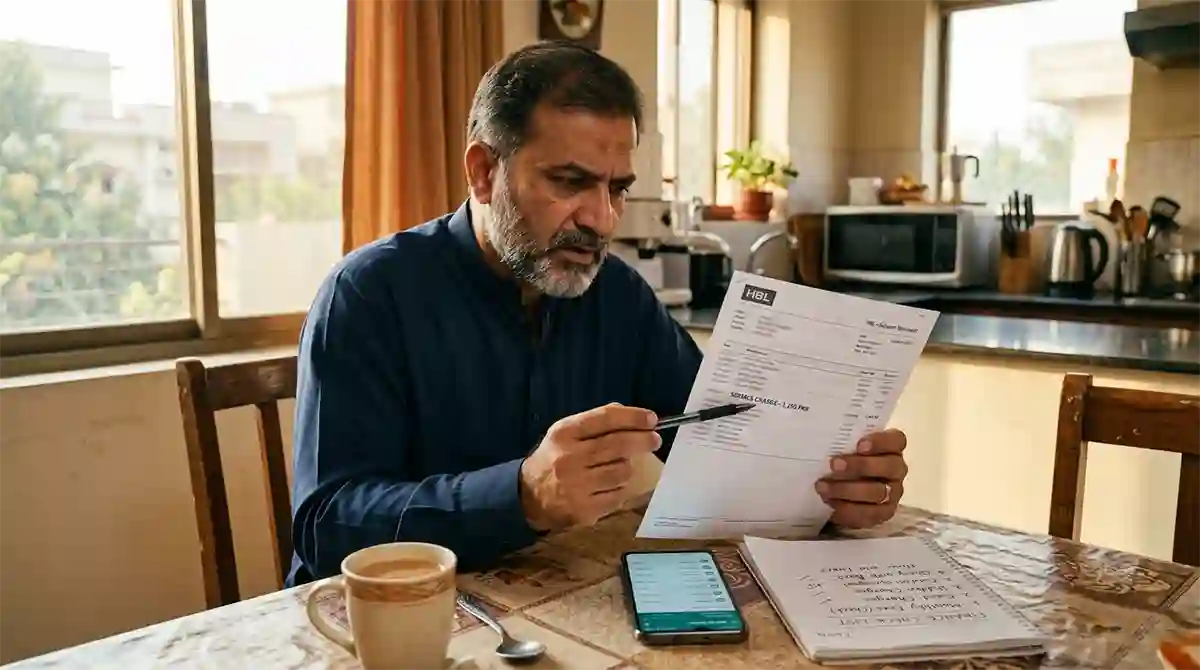
A friend of mine once noticed his bank account was about PKR 3,200 lighter than he expected at the end of a month where he had barely touched his account. He called the bank, was put on hold for twelve minutes, and was eventually told he had been charged for SMS alerts, a below-minimum-balance penalty, an ATM withdrawal at a competitor’s machine, and an annual debit card fee that had silently come due. None of it had been clearly communicated. All of it was technically in the Schedule of Bank Charges document he had been given when he opened the account three years earlier and never looked at since. So here you will learn how to avoid bank charges and hidden fees in Pakistan.
The total was PKR 3,200 in a single month. Multiplied over a year, avoidable bank charges at that rate add up to PKR 38,400 annually, paid for nothing except not knowing the rules.
Bank charges in Pakistan are not hidden in a dishonest sense. Every bank is required by the State Bank of Pakistan to maintain a publicly available Schedule of Bank Charges, updated twice yearly, that lists every fee they can charge and under what conditions. The problem is not transparency in principle. It is that most account holders never read the document, do not know what triggers each charge, and end up paying quietly for years without realizing it.
This guide covers every major charge Pakistani bank customers encounter in 2026, how each one works, and the specific habits and choices that reduce your total banking cost to near zero for most routine banking needs.
Table of Contents
What the Schedule of Bank Charges Actually Is
Before getting into specific fees, understanding the Schedule of Bank Charges, commonly abbreviated as SOC or SOBC, is important because it is your single most useful tool for managing banking costs.
Every bank in Pakistan is required by SBP regulations to publish its Schedule of Bank Charges twice annually, covering January to June and July to December. The SOC lists every fee the bank is permitted to charge, including minimum balance requirements, transaction fees, ATM withdrawal charges, SMS alert fees, card fees, and dozens of other charges.
You can download your bank’s current SOC from their official website, usually found under the Customer Service or Legal Documents section. It is a PDF document, sometimes lengthy, but the sections relevant to your personal account type, savings or current, are typically a small portion of the total.
Under SBP’s Vision 2026 guidelines, all commercial and Islamic banks updated their Schedule of Charges effective June 1, 2026, with revised rules on digital transfers, biometric cash withdrawals, and account balance requirements. If you have not reviewed your bank’s SOC since before June 2026, reviewing the updated version is worthwhile.
Reading the SOC for your account type once takes approximately fifteen minutes and can save you thousands of rupees annually. It is genuinely one of the most financially impactful fifteen minutes you can spend.
Learn more: What Are Fixed Deposits and Are They Worth It in Pakistan?
Charge 1: Minimum Balance Penalties
This is the charge that catches the most Pakistani bank customers off guard and costs the most money cumulatively.
Most savings accounts in Pakistan require you to maintain a minimum average monthly balance. If your balance falls below this threshold at any point during the month, or if your average balance across the month is below the required level, the bank charges a penalty.
Minimum balance requirements vary significantly by bank and account type. Premium accounts at major banks may require monthly average balances of PKR 25,000 to PKR 100,000. Standard savings accounts typically require PKR 5,000 to PKR 10,000. Basic Banking Accounts and Asaan Accounts, as covered in earlier articles in this series, have no minimum balance requirement.
The penalty for falling below the minimum is equally varied. Some banks charge a flat monthly fee. Others charge a percentage of the shortfall. Either way, for an account with a PKR 10,000 minimum balance requirement and a customer who regularly dips below it, the monthly penalty can run from PKR 200 to PKR 800 depending on the bank and the degree of shortfall.
How to avoid it: Choose an account type whose minimum balance requirement matches your typical account balance realistically. If you consistently maintain PKR 8,000 in your account, do not open an account with a PKR 10,000 minimum. Ask specifically about the minimum balance requirement and the penalty structure before opening any account. If you already have an account with a minimum balance you struggle to maintain, visit the branch and ask to be switched to a Basic Banking Account or Asaan Account, both of which carry no minimum balance requirement under SBP regulations.
Charge 2: ATM Withdrawal Fees
Pakistani banks provide a defined number of free ATM withdrawals per month and charge for transactions beyond that limit. The fee structure in 2026 generally works as follows.
Withdrawals at your own bank’s ATM network are free with no transaction limit. Withdrawals at another bank’s ATM or shared network ATMs are typically free for a defined number of transactions per month, after which a per-transaction charge applies.
SBP regulations require banks to provide at least a minimum number of free interbank ATM transactions. Beyond the free limit, charges vary by bank but are typically in the range of PKR 15 to PKR 25 per cash withdrawal and PKR 3 to PKR 5 per balance inquiry at another bank’s ATM.
How to avoid it: Plan your cash withdrawals to use your own bank’s ATM network wherever possible. Use your bank’s ATM locator in their mobile app to find the nearest in-network machine before withdrawing. When withdrawing cash, take what you need for a few days rather than making multiple small daily withdrawals, each of which costs a transaction count. If you find yourself consistently using competitor ATMs, consider whether switching your primary account to a bank with a more convenient ATM network near your home and workplace would reduce your total charges.
Charge 3: IBFT and Digital Transfer Fees
Interbank Fund Transfers, where you send money from your account at one bank to an account at a different bank, are subject to specific SBP regulations in 2026 that every Pakistani bank customer should know.
Under SBP directives, all intrabank transfers, meaning transfers between accounts within the same bank, are completely free regardless of the amount or frequency.
For interbank transfers through IBFT channels, banks are required to provide free digital fund transfer services to individual customers up to a minimum aggregate sending limit of PKR 25,000 per month per account. Once the account exceeds this monthly limit, banks are legally permitted to charge a fee of 0.1% of the total transaction value or PKR 200, whichever is lower.
Critically, all person-to-person transfers processed through the government’s official Raast instant payment system remain completely free with zero transactional fees or hidden taxes.
How to avoid it: Use Raast for all person-to-person transfers rather than traditional IBFT channels. Raast is available through most major Pakistani banks’ mobile apps and transfers are instant and permanently free. For transfers within the same bank, use the bank’s own app or internet banking for zero-cost intrabank transfers. If you do need to make multiple interbank transfers beyond PKR 25,000 per month, the maximum charge is capped at 0.1% or PKR 200, whichever is lower, so the cost is modest even when it applies.
Charge 4: SMS Alert Fees
This is one of the most debated and frequently misunderstood charges in Pakistani banking.
Under SBP regulations effective in 2026, following any digital transfer, financial transaction, or ATM withdrawal, banks are legally required to send an immediate SMS alert, email notification, or in-app pop-up to the client’s registered contact information without charging an alert fee. These automated receipts must clearly separate the principal transaction amount from the exact service fees deducted.
What this means is that the transaction alerts you receive immediately after completing a banking transaction must be provided free of charge by your bank. Banks cannot charge for these mandatory transaction confirmation alerts.
However, some banks charge for additional optional SMS services beyond the mandatory alerts, such as periodic balance notifications, marketing alerts, or non-transaction-related updates. These optional services are typically disclosed in the SOC and can usually be deactivated if you do not want them.
How to avoid it: Check your bank’s SOC to see whether your bank charges for any SMS services beyond the mandatory transaction alerts. If you are being charged for optional SMS services you did not knowingly subscribe to, contact your bank and request they be deactivated. Ensure you have the bank’s mobile app installed and notifications enabled, as app-based notifications are always free and replace SMS alerts for most banking activities.
Charge 5: Annual Debit Card Fees
Most Pakistani banks charge an annual fee for maintaining a debit card on your account. The fee varies by card tier and bank, generally ranging from PKR 300 to PKR 1,200 per year for standard debit cards and higher for premium card tiers.
This charge is typically deducted automatically from your account once a year without any specific notification, which catches many customers by surprise when they see an unexplained debit on their statement.
How to avoid it: Check your SOC for your debit card’s annual fee and note when it falls due. Some banks waive the annual card fee for accounts maintaining a minimum average balance above a certain level or for premium account holders. Ask your bank relationship manager whether your account qualifies for a fee waiver based on your average balance or account package. If you have multiple accounts at different banks and do not actively use certain cards, canceling unused cards eliminates the annual fee on those cards while also reducing your exposure surface for fraud.
Also read: How to Manage Business Finances: A Practical Guide for Small Business Owners in Pakistan
Charge 6: Account Dormancy Fees
If a savings account has no customer-initiated transactions for a period of twelve consecutive months, most Pakistani banks classify it as dormant. Dormant accounts may be subject to a monthly maintenance fee deducted from the remaining balance.
This is a charge that often depletes accounts that were opened and then forgotten, particularly secondary accounts people set up for specific purposes and then stopped using. It is not uncommon for someone to discover a long-forgotten account has been reduced to near zero by dormancy charges over several years.
How to avoid it: If you have any accounts you do not actively use, either close them properly at the bank branch, or make at least one small customer-initiated transaction every six to twelve months to keep the account active. Depositing PKR 100 or making a small transfer once a year is sufficient to prevent dormancy classification. If you discover an account has already been classified as dormant, visit the branch with your CNIC to reactivate it and confirm whether any charges can be waived given the circumstances.
Charge 7: Cheque Book and Stop Payment Fees
Banks typically charge for issuing cheque books, though the first book is often provided free upon account opening. Subsequent cheque books carry a per-leaf charge that varies by bank.
Stop payment instructions, where you ask the bank to refuse payment on a specific cheque you have already issued, typically carry a flat fee per instruction of PKR 200 to PKR 500 depending on the bank.
How to avoid it: If you primarily transact digitally and rarely use cheques, simply not requesting a new cheque book after your first one is used eliminates this cost entirely. For most personal banking needs in 2026, cheques have been largely replaced by digital transfers, IBFT, and Raast. If you do need to issue a stop payment instruction, this is unavoidable when necessary, but knowing the fee in advance helps you factor it into your decision-making.
Charge 8: Branch and Over-the-Counter Transaction Fees
Banks in Pakistan have been actively incentivizing customers to use digital channels over branch visits, and one of the mechanisms they use is charging for certain over-the-counter transactions at branches that are free when done digitally.
Cash deposits above a certain monthly threshold, branch-initiated fund transfers that could be done through the app, and certain account maintenance requests done at the counter rather than online may all carry fees that their digital equivalents do not.
How to avoid it: Use your bank’s mobile app and internet banking for all transactions that can be completed digitally. Fund transfers, bill payments, mobile top-ups, statement requests, cheque book requests, and many account maintenance activities are all available through digital channels at no charge. Reserve branch visits for transactions that genuinely cannot be completed digitally, such as large cash withdrawals or deposits, account opening, or document submission.
Charge 9: Foreign Currency and International Transaction Fees
For account holders who transact in foreign currencies or use their Pakistani debit card for international purchases or ATM withdrawals abroad, foreign transaction fees apply. These are typically a percentage of the transaction value covering the currency conversion and international processing cost. Rates vary by bank but generally fall in the range of 2% to 4% of the transaction amount.
How to avoid it: For online subscriptions and purchases in foreign currency, using a Payoneer card or a credit card with lower foreign transaction fees may be more cost-effective than using a standard Pakistani debit card. If you travel internationally, withdrawing local currency at your destination’s ATM rather than exchanging at a foreign exchange counter is generally more cost-efficient, though the international ATM fee and conversion margin combined still represent a meaningful cost per transaction.
Charge 10: Account Closure Fees
Closing a bank account in Pakistan sometimes carries a fee, particularly if the account is being closed shortly after opening. Some banks waive the closure fee for accounts that have been maintained for more than a certain period.
How to avoid it: Check the account closure terms in your SOC before opening a new account. If you decide to switch banks, timing your closure after any minimum period required for fee waiver eligibility reduces this cost. Always close accounts you no longer need properly rather than simply stopping to use them, to avoid dormancy fees that accumulate on inactive accounts.
The Most Powerful Strategy: Read Your SOC Once a Year
All of the charges described above are publicly disclosed in your bank’s Schedule of Bank Charges. None of them are secret. The reason they cost customers collectively billions of rupees annually in Pakistan is not because banks hide them, but because almost nobody reads the document that lists them all.
A practical annual routine that costs nothing and saves thousands is this: every January, when banks release their updated SOC for the first half of the year, spend fifteen minutes downloading and reviewing the charges applicable to your account type. Pay particular attention to minimum balance requirements, ATM and IBFT fees, debit card charges, and any new fees that were not present in the previous period.
If anything in the updated SOC represents a new or increased charge that changes your decision about where to bank, you now have time to make that change before the charge takes effect.
Read more: How to Build an Investment Portfolio in Pakistan
When to Negotiate With Your Bank
Pakistani bank customers rarely negotiate their charges, but it is more possible than most people assume, particularly for customers who have maintained a long-term relationship with their bank.
Banks value customers with stable, long-term deposit relationships. If you have been banking with the same institution for several years, maintain a consistently healthy average balance, and have a clean account history, asking for waiver of specific charges is a reasonable request that relationship managers have discretion to accommodate.
Specific scenarios where negotiation often works include annual debit card fee waivers for long-term customers, reduced minimum balance requirements for temporarily lower-income periods, waiver of one-off fees for mistakes made in good faith, and fee-free cheque books for premium account holders.
The approach that works best is a simple, direct conversation with your relationship manager at the branch: explain your situation, your history with the bank, and what specifically you are requesting. Being a polite, direct, informed customer who knows what they are asking for is far more effective than a complaint made in frustration.
The Zero-Charge Banking Setup for 2026
For most Pakistani banking customers, it is genuinely possible to conduct all routine banking activities with zero monthly charges by making a small number of informed choices.
Open a Basic Banking Account or Asaan Account at a bank with a wide ATM network in your area, eliminating minimum balance charges and most account maintenance fees. Use Raast for all person-to-person transfers, which are permanently free. Use your own bank’s ATM network for cash withdrawals. Use mobile banking for all transactions possible, including bill payments, mobile top-ups, and account inquiries. Enable transaction alerts through the bank’s app rather than SMS where possible. Keep all accounts active with at least one transaction per twelve months to avoid dormancy classification.
This setup, once established, can reduce your total annual banking costs to effectively zero for all routine personal banking needs while maintaining full access to every digital banking service you actually use.
Final Thoughts
Bank charges in Pakistan in 2026 are regulated, disclosed, and genuinely avoidable for most routine banking activities. The customers who pay the most in charges are not the ones with the most transactions or the most complex needs. They are usually the ones who have never read their Schedule of Bank Charges and therefore do not know which specific behaviors trigger which specific costs.
Fifteen minutes with your bank’s SOC, a switch to Raast for person-to-person transfers, and a debit card withdrawal habit that favors your own bank’s ATM network will eliminate the majority of avoidable charges for most Pakistani banking customers.
Your bank is not going to call you and explain how to avoid paying them fees. That knowledge is your responsibility and your advantage. Now you have it.