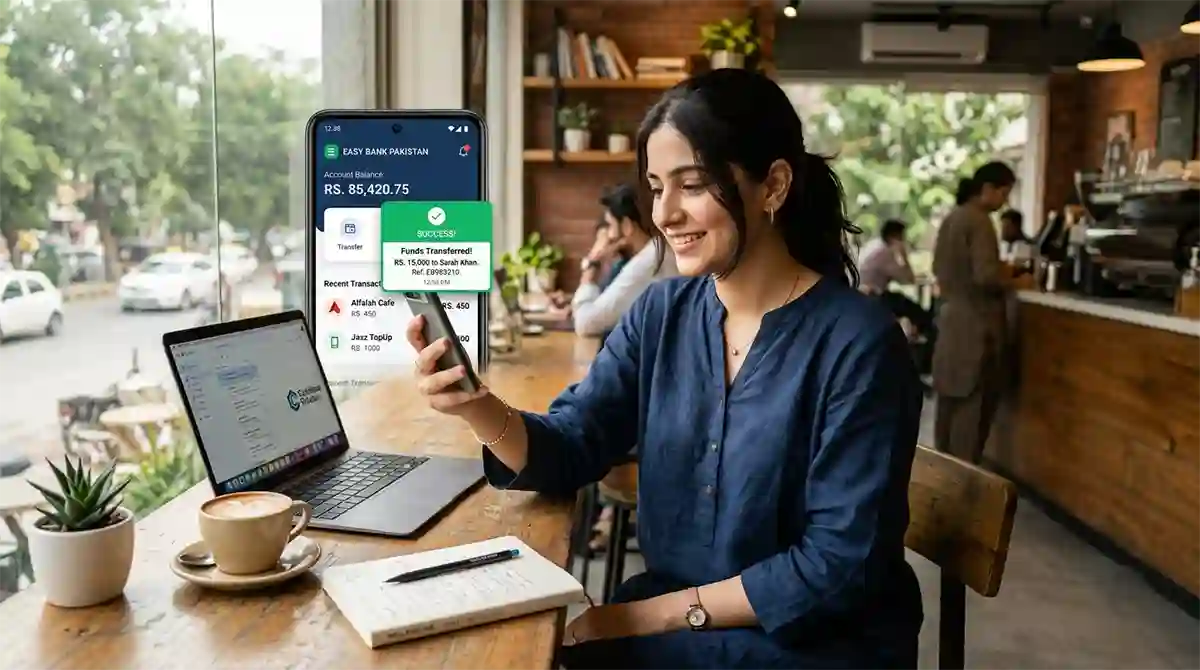
Banking apps in Pakistan have transformed from a convenience into a genuine replacement for the branch visit for the vast majority of everyday banking needs. Digital transactions in Pakistan surged by 45% since 2025, largely driven by the freelance and gig economy alongside increasingly sophisticated banking apps from both traditional commercial banks and new digital-first institutions. This article helps you understand how banking Apps work in Pakistan.
Yet most people who have a banking app on their phone use a fraction of what it actually offers. They check their balance, maybe transfer some money, and leave dozens of genuinely useful features untouched simply because nobody explained what was there or how to use it.
This guide covers every major feature category available in Pakistani banking apps in 2026, how each one works, which banks do it particularly well, and the habits that make digital banking faster, cheaper, and more secure than most people currently experience it.
Table of Contents
What a Banking App Actually Is
Before you learn about how banking apps work in Pakistan you need to know what a banking app actually is. A banking app is a mobile application provided by your bank that gives you secure access to your account and a full range of banking services directly from your smartphone. It connects to your bank’s servers over an encrypted internet connection, authenticates your identity through your PIN, password, biometric login, or a combination, and allows you to perform transactions and access account information in real time.
The shift toward banking apps in Pakistan has been driven by two simultaneous forces. From the demand side, Pakistani consumers, particularly in urban areas, increasingly expect the convenience of managing their finances without branch visits. From the supply side, the State Bank of Pakistan has actively pushed banks toward digital channels through regulatory frameworks including the Digital Bank Regulatory Framework introduced in recent years, which has led to significant investment in app infrastructure across almost every major bank.
In 2026, Pakistan’s banking app landscape spans mature traditional bank apps that have been refined over years, newer digital-native bank offerings, and entirely branchless digital banks that exist exclusively as apps with no physical branch network at all.
Getting Started: Setting Up Your Banking App Properly
Before getting into specific features, setting up your app with the right security configuration from the beginning saves significant time and protects you from the fraud scenarios that increasingly sophisticated scammers attempt.
Download only from official stores. Your bank’s app should be downloaded exclusively from the Google Play Store or Apple App Store, verified against the official developer name that matches your bank. Fake banking apps have appeared in Pakistan and represent a genuine risk to your account credentials.
Enable biometric login immediately. Every major Pakistani banking app in 2026 supports fingerprint or face recognition login. Enable this from the first time you set up the app. It is both more convenient and more secure than a PIN alone, since your biometric cannot be shoulder-surfed or shared the way a PIN can.
Set up transaction alerts. Under SBP regulations effective 2026, banks are required to send immediate alerts following any transaction. Ensure your registered mobile number is current and that app notifications are enabled so you receive alerts in real time rather than checking your balance periodically.
Set a strong password or PIN. Your banking app login credentials should not be your birth date, CNIC last digits, or any obvious sequence. Use something genuinely random that you do not use for any other account.
Register multiple beneficiaries carefully. Most apps allow you to register frequent transfer recipients as saved beneficiaries to speed up future transfers. Take time to set these up correctly initially, verifying every account number character by character, to prevent future errors.
Feature 1: Account Management and Balance Checking
The most basic function of any banking app is letting you see your account information instantly. In 2026, Pakistani banking apps go well beyond a simple balance display.
You can view real-time account balances across all your accounts with the same bank, including current accounts, savings accounts, term deposits, and in some cases investment accounts linked through the same bank. Mini-statements showing your last 10 to 20 transactions are available immediately. Full downloadable account statements covering any date range can typically be generated as PDF documents directly from the app without any branch visit or paper request.
For users with multiple accounts, the dashboard view consolidates all balances in one screen. For home loan and car loan customers, the outstanding balance, next installment date, and payment history are usually visible within the same app ecosystem.
Meezan Bank’s mobile app allows transfers up to PKR 5 million daily between your own accounts, PKR 2 million to other Meezan accounts, and PKR 1 million to other banks via IBFT, with limits that are generous enough for the vast majority of personal banking needs.
Feature 2: Fund Transfers
Fund transfers are where the practical power of a banking app becomes most obvious. What once required a branch visit and a fill-out form is now done in under a minute from anywhere in the world with a mobile signal.
Own Account Transfers: Moving money between your own accounts at the same bank is instant, free, and available 24 hours a day including public holidays. This is useful for managing between a current account used for daily expenses and a savings account where you maintain your monthly budget balance.
Intrabank Transfers: Sending to another account holder at your own bank is equally instant and free regardless of the amount.
IBFT (Interbank Fund Transfer): Sending to an account at a different bank. Per SBP regulations, banks must provide free digital fund transfers up to PKR 25,000 per month per account through IBFT channels. Above this threshold, charges of 0.1% or PKR 200, whichever is lower, may apply. Transfers are settled within the same business day or instantly depending on the time and the receiving bank’s processing.
Raast Transfers: The most important transfer method to know and use. Raast is Pakistan’s instant payment system operated by SBP and is now integrated into every major bank’s app. Raast transfers are permanently free with zero charges regardless of amount, instant 24/7 including weekends and holidays, and fully interoperable across all banks and mobile wallets. Always look for the Raast option first when transferring money, since it is both faster and cheaper than standard IBFT for cross-bank transfers.
Feature 3: Bill Payments
Bill payment through banking apps has reached a level of maturity in Pakistan in 2026 that makes the previous experience of standing in a queue at a utility company or a bank branch feel genuinely archaic.
Pakistani banking apps support payment of electricity bills for all major distribution companies including LESCO, IESCO, MEPCO, FESCO, HESCO, QESCO, SEPCO, and PESCO, gas bills for SNGPL and SSGC, water bills for city authorities in major cities, internet and telephone bills for PTCL, telecom company postpaid bills for Jazz, Telenor, Zong, and Ufone, cable television bills, and educational institution fees through the 1Bill integration that allows over 4,000 billers to be paid through a single consumer number system.
The practical process is simpler than most first-time users expect. Navigate to the bill payment section, select the relevant service category, enter your consumer number or reference number from your bill, the app retrieves the outstanding amount from the biller’s system and displays it for your confirmation, you confirm and the payment is processed immediately. You receive a payment confirmation on screen and a transaction alert, and the biller’s system is updated.
This eliminates due date anxiety. Saved billers in your app mean that checking and paying your monthly bills takes under two minutes for a household with three or four regular bills.
Feature 4: Mobile Top-Ups
Every major Pakistani banking app allows you to add credit to any mobile number in Pakistan for Jazz, Telenor, Zong, Ufone, and SCOM directly within the app. You enter the mobile number, select the amount, and the credit is added instantly. Saving frequently topped-up numbers reduces the process to two or three taps.
This eliminates the need for a separate EasyLoad transaction at a retailer and ensures you always have credit available regardless of your location or time of day.
Feature 5: Debit and Credit Card Management
Banking apps in 2026 give you significantly more control over your cards than was previously possible without a branch visit or call center interaction.
Card blocking and unblocking: If you misplace your card or suspect unauthorized use, you can block it instantly through the app. Once you find the card or resolve the concern, you can unblock it yourself equally instantly, without any branch visit or extended call center interaction.
PIN management: Most apps now allow you to change your debit card PIN directly within the app rather than requiring an ATM visit. This is both more convenient and more secure since you control the process end to end.
Transaction limits: Several banks allow you to set daily spending or withdrawal limits on your debit card through the app, below the bank’s maximum limits. This is a useful security feature if you want to reduce the potential damage of unauthorized card use.
Credit card statements: If you hold a credit card with your bank, the statement, payment due date, current outstanding balance, minimum payment, available credit, and reward points balance are all typically accessible within the same banking app. Payment of your credit card bill directly from your bank account is done within the app as well.
Virtual card generation: Some more advanced banking apps including those from digital-first banks allow you to generate virtual card numbers for specific online transactions, reducing your fraud exposure on international platforms significantly.
Feature 6: Cheque Services
While cheque usage is declining in Pakistan as digital payments mature, banking apps still offer cheque-related services that are relevant for users who occasionally need them.
You can request a new cheque book directly from the app without visiting a branch. You can view cheque status to confirm whether a specific cheque you have issued has been presented and cleared. You can place stop payment instructions on a specific cheque through the app if needed, though this typically carries a charge as covered in the banking charges article in this series. Cheque book dispatch to your registered address is the default for most banks, though some allow collection at a designated branch.
Feature 7: Account Opening and Financial Product Applications
One of the most significant 2026 developments in Pakistani banking apps is that opening new accounts and applying for financial products no longer requires a branch visit at most major banks.
New account opening: Several banks including Meezan Bank, HBL through its Konnect digital platform, Bank Alfalah’s Alfa app, SadaPay, NayaPay, and Mashreq Pakistan offer fully digital account opening through a process involving CNIC scanning, a live selfie for biometric verification, and video KYC or automated identity verification, with accounts activated within one to two business days entirely through the app.
Term deposit booking: Most banking apps allow you to book a new term deposit or fixed deposit directly within the app by specifying the amount, choosing your preferred tenor, selecting profit payment frequency, and confirming. The funds are transferred from your linked savings account instantly and the deposit confirmation is available within the app.
Loan and financing applications: Preliminary applications for personal loans, car financing, and home loans can be initiated through several banking apps in 2026, with the final stages requiring documentation submission either digitally or at a branch depending on the specific product and amount.
Investment products: Several banks have integrated investment account access within their main banking app. UBL Funds Smart Savings app, HBL’s integration with mutual fund investment, and Meezan Bank’s access to Al Meezan fund products allow customers to invest in mutual funds without leaving their primary banking relationship.
Feature 8: QR Payments and Contactless Features
QR payments have become a genuinely widespread and useful feature across Pakistan’s retail landscape in 2026, and most banking apps now support them with varying levels of merchant network coverage.
Scanning merchant QR codes: Navigate to the payment section of your app, tap the QR scanner, point your camera at the merchant’s QR code, confirm the payment amount, and the transaction completes instantly. For customers of banks with strong merchant QR networks, particularly HBL, which offers up to 40% off when paying via Konnect QR scans and 25% off with HBL Mobile QR scans, this generates meaningful savings on everyday purchases.
NFC contactless payments: HBL, Easypaisa, and UBL Mobile support NFC tap-to-pay at equipped POS terminals. Where the terminal supports NFC, simply holding your phone near the terminal reader completes the payment without any app opening or QR scanning. This is the fastest possible payment experience for low-value retail transactions.
Generating your own QR to receive payment: Most apps allow you to display a QR code representing your account details, which another person can scan to send you money. This is particularly useful for freelancers, small vendors, or anyone who regularly needs to receive transfers from multiple people without verbally sharing their account number.
Feature 9: Investment and Savings Features Within Banking Apps
The boundary between banking apps and investment platforms has blurred significantly in 2026.
Goal-based savings: Several banks have introduced in-app savings goal features where you name a specific savings goal, such as a house deposit or a wedding fund, set a target amount and date, and the app calculates the required monthly saving and optionally automates transfers toward the goal.
Mutual fund investment: Bank Alfalah’s Alfa app and HBL Mobile both offer access to mutual fund investment products within the banking app itself. You can view available funds, their performance, and invest directly without needing a separate AMC app or website.
Profit maximizing accounts: Apps increasingly display the current profit rate on savings accounts and offer one-tap switching between account products to maximize your balance return.
Zakat calculation: Several Islamic banking apps including Meezan Bank’s app provide in-app Zakat calculation tools that help you calculate your Zakat obligation based on your account balance on a given date and directly process payment to approved charitable causes.
Feature 10: Customer Service and Support Within the App
Traditional banking customer service meant a call center or a branch visit. Banking apps in 2026 increasingly bring support directly into the app.
In-app chat: Several banks offer live chat support within the app, allowing you to resolve account queries, report unauthorized transactions, or get product information without leaving the app or waiting on a call center queue. AI chatbot functionality for routine queries is becoming more common, with human escalation for complex issues.
Complaint registration: Apps allow you to formally log a complaint about a transaction dispute, service failure, or charge discrepancy directly through the app. This creates a documented record and triggers the bank’s formal complaint resolution process.
ATM locator: Every major banking app includes an ATM locator using your phone’s location to find the nearest in-network ATMs, helping you avoid out-of-network withdrawal charges by always finding your own bank’s machines first.
Schedule of Charges access: Several banks make their current Schedule of Charges accessible directly within the app’s help section, so you can check any fee without having to navigate to the bank’s website.
Banking Apps at Pakistan’s Top Banks: What Makes Each One Notable
HBL Mobile is one of the most full-featured apps in the market, covering account management, payments, QR and NFC transactions, credit card management, personal loan applications, and investment access. HBL’s strong merchant network makes its QR payment functionality particularly useful for retail spending with consistent cashback and discount offers.
Meezan Bank App is the leading Shariah-compliant banking app and has won consecutive Best Bank of Pakistan awards in 2023, 2024, and 2025. No information is stored on your mobile phone, meaning your credentials are never exposed even if your phone is lost or stolen. The app is usable globally wherever internet access is available, which is important for Pakistani expatriates and travelers.
Bank Alfalah Alfa App has positioned itself as more than a banking app, integrating lifestyle features including movie ticket booking, travel bookings, hotel reservations, food ordering, and in-app shopping through Alfa Mall alongside full banking functionality. Its QR and NFC payment support alongside IBFT and Raast integration makes it one of the most comprehensive lifestyle-finance hybrid apps in Pakistan.
UBL Digital App has consistently been recognized for its user interface and experience. UBL cards provide exclusive discounts at over 300 outlets, and the app’s clean interface makes navigation intuitive even for less tech-savvy users. UBL’s daily cash withdrawal limit of PKR 200,000 on internationally accepted cards is among the higher limits in the market.
SadaPay is widely considered the best option for international transactions due to its low forex markup of 1.5% to 2% compared to the 4% charged by traditional banks, making it particularly valuable for online shoppers using international platforms and for freelancers spending in foreign currency. Free IBFT transfers are another major differentiator.
Mashreq Pakistan is a newer entrant that has built a reputation in 2026 for genuinely frictionless digital account opening, with users noting that processes that require multiple branch visits at traditional banks are completed in the Mashreq app in minutes. Free ATM withdrawals at 19,000 ATMs across Pakistan is a significant practical advantage.
Raqami is a notable 2026 newcomer, positioned as Pakistan’s first pure-play Islamic digital bank focused on ethical finance and SME growth. Operating entirely without physical branches, it represents the leading edge of Pakistan’s digital-only banking movement.
Staying Secure: The Most Important Habits for Banking App Users
The convenience of banking apps creates corresponding risks if basic security habits are not maintained consistently.
Never share your app password, PIN, OTP, or any credential with anyone. This cannot be overstated. No legitimate bank representative, call center agent, or any other individual representing your bank will ever ask for these details. Anyone who asks for them is attempting fraud.
Log out of your banking app after completing transactions if you are using a shared or less secure device. Most apps have an auto-logout timer for inactive sessions, but manually logging out adds an additional layer of protection.
Update your app whenever updates are available. Banking app updates frequently include security patches that address newly discovered vulnerabilities. Running outdated versions leaves you exposed to risks that have already been fixed.
Review your transaction history at least weekly. Catching an unauthorized transaction quickly allows you to report it while the dispute window is open and increases the likelihood of recovery.
Contact your bank immediately if your phone is lost or stolen. Most banks have a procedure for remotely deactivating your banking app access tied to the specific device, preventing unauthorized use even if your phone PIN is compromised.
Be cautious about using banking apps on public WiFi networks. Switch to mobile data before accessing your banking app if you are connected to any public or shared network.
Summing Up
Banking apps in Pakistan in 2026 represent one of the most significant improvements in everyday financial convenience that has happened in the country in a generation. The ability to pay bills, transfer money, manage cards, book investments, check balances, and resolve banking queries from a device in your pocket, at any hour of any day, has genuinely removed most of the friction from routine banking life.
Most of the people who complain about banking in Pakistan are using their app for only two or three of the fifteen to twenty features it actually contains. Spending thirty minutes exploring your bank’s app properly, setting up your security features correctly, registering your frequent billers and transfer recipients, and understanding the Raast transfer option will change your daily banking experience more than any other single action you can take.
The branch visit is not dead. For complex transactions, document submissions, and some account changes, you will still need to go in person. But for the 95% of banking interactions that are routine and transactional, the app should be your first stop, not your last resort.