
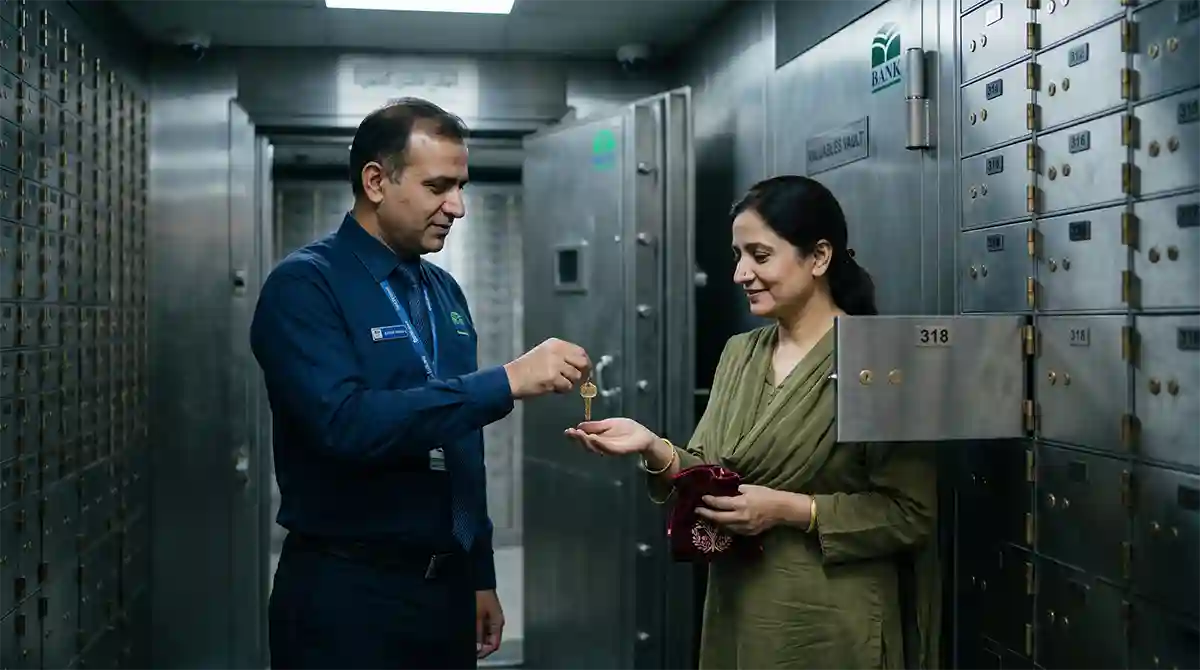
A relative of mine kept her wedding jewelry at home for years, moving it between a steel almirah and, during travel, a hiding spot behind a false bottom in a suitcase. After a break-in in her neighborhood in 2023, one that did not even target her house directly, she finally rented a locker at her branch of Meezan Bank. The whole process took under an hour, cost her a one-time refundable deposit and a modest annual rent, and she has not thought about where her jewelry is sitting since. In this article, you will learn about bank locker facilities in Pakistan in 2026.
This is the story of most Pakistanis who eventually get a bank locker: they knew it existed, assumed it was expensive or complicated, and only acted after a scare. It is neither expensive nor complicated in most cases, and understanding exactly how the process, costs, and rules work across Pakistan’s major banks removes the last excuse for delaying it.
Table of Contents
What a Bank Locker Actually Is
Before I discuss deep about the bank locker facilities in Pakistan, you need to know what a bank locker actually is. A bank locker, formally called a safe deposit box, is a small individually secured compartment inside a bank’s vault that you rent to store valuables: jewelry, property documents, prize bonds, passports, wills, and other items too important to risk keeping at home.
The defining feature of a bank locker is dual-key access. The locker requires both your key and the bank’s master key to open, meaning neither you nor the bank alone can access the contents. This is different from a bank account, where the bank has full custodial control over your money. With a locker, the bank does not know what you have stored inside, does not have the ability to open it alone, and generally accepts no liability for the contents unless a specific insurance or Takaful arrangement is in place, which is worth confirming explicitly before you assume your valuables are automatically protected.
Current Locker Charges Across Major Pakistani Banks (2026)
Locker rent varies meaningfully by bank, by branch location, and by locker size. Below is what the actual rate structures look like at some of Pakistan’s largest banks as of 2026, based on their published fee schedules.
Meezan Bank Locker Charges (2026)
| Item | Charge |
|---|---|
| Key deposit (one-time, refundable) | Rs. 5,000 |
| Small locker (annual rent) | Rs. 6,000/year |
| Medium locker (annual rent) | Rs. 7,500/year |
| Large locker (annual rent) | Rs. 9,000/year |
| Broken locker charge | At actual cost |
Meezan Bank’s locker service, structured under Islamic banking principles, is one of the most straightforward and affordably priced in the market, with a transparent, size-based rent structure and no hidden charges beyond the deposit and annual rent.
HBL Locker Charges (2026)
| Item | Charge |
|---|---|
| Standard locker annual rent (medium to large) | Approx. Rs. 15,000–20,000/year |
| Security/key deposit (standard) | Approx. Rs. 35,000–50,000 |
| Prestige (fully automated, biometric) annual rent | Approx. Rs. 40,000–50,000/year |
| Prestige key deposit | Rs. 60,000–100,000 |
| Late payment fee | ~10% of annual rent after due date |
HBL offers two distinct tiers: a standard branch-based locker and its premium “Prestige” digital lockers, which provide 24/7 automated access with biometric security at a significantly higher price point. If you specifically need access outside normal branch hours, this is the main product in the market built for that use case, but it costs several times more than a standard locker at HBL or the equivalent product at Meezan.
Other Major Banks
MCB Bank and MCB Islamic Bank offer lockers at selected branches nationwide, with rates disclosed directly at the branch rather than published in a fixed national schedule, since availability and pricing vary by branch and locker size. Bank AL Habib’s Islamic Banking division offers lockers on an Ujrah (rental) basis, with the notable feature that lockers are covered under Takaful, Islamic insurance, and can be jointly leased by up to four account holders. HabibMetro Bank has historically offered rent-free lockers to eligible long-standing account holders at select branches, a feature worth specifically asking about if you already bank there. UBL offers locker facilities at select branches, generally requiring an active UBL account as a prerequisite.
Practical comparison at a glance:
| Bank | Entry-Level Annual Rent | Deposit Required | Notable Feature |
|---|---|---|---|
| Meezan Bank | Rs. 6,000 (small) | Rs. 5,000 | Simplest, most affordable published structure |
| HBL (standard) | Rs. 15,000–20,000 | Rs. 35,000–50,000 | Wide branch network |
| HBL (Prestige) | Rs. 40,000–50,000 | Rs. 60,000–100,000 | 24/7 biometric access |
| Bank AL Habib (Islamic) | Varies by branch | Varies by branch | Takaful-covered; up to 4 joint holders |
| HabibMetro | Sometimes free | Varies | Rent-free for eligible long-standing customers |
A note on why the range is so wide: Locker rent in Pakistan is not centrally regulated the way, say, bank account minimum balance rules are guided by SBP. Each bank sets its own schedule, and even within one bank, rates differ meaningfully by branch and by city, with lockers in Karachi, Lahore, and Islamabad’s premium branches typically costing more than the same size locker at a smaller-city branch of the same bank. Always confirm the exact current rate at your specific branch rather than assuming a nationally quoted figure applies exactly where you live.
How to Open a Bank Locker: Step by Step
Step 1: Have an active account at the bank first. Most banks in Pakistan, including HBL, UBL, Meezan, and MCB, require you to already hold, or simultaneously open, an account at the same branch before renting a locker. The locker is treated as an ancillary service tied to your banking relationship, not a standalone product.
Step 2: Check locker availability at your preferred branch. Locker availability varies significantly by branch. Larger, older branches in commercial areas tend to have more locker capacity than newer, smaller branches. It is common to be placed on a waiting list at popular branches, particularly for larger locker sizes. Calling ahead before visiting saves a wasted trip.
Step 3: Submit the locker application form along with your documents. You will need your original CNIC and a photocopy, recent passport-sized photographs, and your existing account details. HBL, for example, uses a standard Safe Deposit Locker Application Form available on its website that can be filled out in advance of your branch visit.
Step 4: Choose your locker size and pay the required deposit and rent. Sizes are generally categorized as small, medium, and large, with pricing scaling accordingly as shown in the tables above. You pay the refundable key deposit and the first year’s rent upfront.
Step 5: Complete the signature and access authorization process. You will sign a locker agreement specifying the terms of access, and if you want a joint holder (a spouse, for instance) to also have access, their details and signature are recorded at this stage. Bank AL Habib’s Islamic locker service explicitly allows up to four joint holders on a single locker.
Step 6: Receive your key and begin using the locker. Access is generally available during the bank’s normal business hours, except for premium digital lockers like HBL’s Prestige tier, which offer extended or 24/7 access.
What You Should (and Shouldn’t) Store in a Bank Locker
Good candidates for a locker: Original property ownership documents, gold and jewelry not worn regularly, prize bonds and physical share certificates, passports and other rarely-needed identity documents, wills and other legal documents, and foreign currency or cash reserves you do not need frequent access to.
Poor candidates for a locker: Cash or valuables you need frequent, same-day access to, since locker access is limited to the bank’s business hours for standard lockers. Perishable or illegal items, which most bank locker agreements explicitly prohibit and which void any insurance coverage if discovered. Items you need to access outside business hours regularly, unless you have specifically opted for a 24/7 digital locker product like HBL’s Prestige tier.
Insurance and Liability: The Detail Most People Get Wrong
Here is something worth being direct about, because it is the single most misunderstood aspect of bank lockers in Pakistan: most standard bank lockers do not come with automatic insurance covering the value of what you store inside.
The bank is responsible for the physical security of the vault and the locker mechanism itself. It is generally not liable for the value of the contents unless you have specifically arranged supplementary insurance or, in the case of Islamic banking lockers like those offered by Bank AL Habib, unless the product is explicitly structured with Takaful coverage as part of the offering.
When I explain this to people renting their first locker, I tell them to ask their branch manager directly and in writing: “Is my locker’s contents insured, and if so, up to what value?” If the answer is no or unclear, and you are storing something genuinely valuable like significant gold holdings, it is worth separately purchasing a home or valuables insurance policy that specifically extends to bank-locker-stored items, or confirming this coverage exists through a Takaful-inclusive Islamic locker product like Bank AL Habib’s.
Common Mistakes Pakistanis Make With Bank Lockers
Assuming the contents are automatically insured. As covered above, this is the single most common and most costly misunderstanding. Confirm explicitly rather than assuming.
Not documenting what is stored inside. In the rare event of a dispute, whether about loss, damage, or inheritance after death, having a personal written inventory (with photos, ideally kept separately from the locker itself) of what you have stored protects you far better than relying on memory.
Losing both keys. Most standard lockers require both your key and the bank’s master key. If you lose your key, the bank typically must break the locker at your cost, which can run into a meaningful expense depending on the bank, sometimes disclosed as “actual cost” rather than a fixed fee, as Meezan Bank’s schedule states explicitly. Keep a spare key in a genuinely secure secondary location, not simply a drawer at home.
Not naming a joint holder or nominee. If something happens to the sole locker holder, accessing the locker’s contents can become a genuinely complicated legal process involving succession certificates and court processes. Adding a trusted joint holder, as Bank AL Habib and several other banks explicitly allow, avoids this entirely.
Choosing a locker size based on current need rather than likely future need. Gold and important documents tend to accumulate over the years, particularly around life events like weddings. Renting a locker one size larger than your immediate requirement, for a modest annual cost difference, saves the hassle of upgrading or renting a second locker later.
Conclusion
A bank locker is one of the least glamorous but most practically valuable financial services available in Pakistan, and the barrier to using one is genuinely lower than most people assume. At Meezan Bank, a small locker costs a one-time Rs. 5,000 refundable deposit and Rs. 6,000 a year, less than many people spend on a single family dinner out. At HBL, the range extends up to premium 24/7 biometric access for those who need it.
The right approach is simple: identify what you are storing at home that would be genuinely difficult to replace if lost or stolen, check locker availability and pricing at a bank where you already hold or are willing to open an account, confirm the insurance situation explicitly before assuming coverage exists, and set up a joint holder if the locker will store items relevant to your family’s future rather than just your own.




that’s really awesome. it is good if you have one.
Sure.