A tailor in a small Lahore neighborhood needed PKR 80,000 to buy a second sewing machine and expand from a one-person operation to a small shop employing his brother. A commercial bank would have wanted collateral he did not have, a credit history he had never built, and an interest rate that would have made the expansion barely worthwhile in the first two years. Instead, he walked into a mosque-based Akhuwat branch, brought two guarantors from his own community, and walked out with an interest-free loan that he repaid in easy monthly installments, paying back only exactly what he borrowed. In this article, you will about interest-free loans in Pakistan
This is not an unusual story in Pakistan. It is the story of over six million similar loans disbursed by Akhuwat alone since 2001, and it represents a genuinely distinctive model of finance that exists at a meaningful scale almost nowhere else in the world quite the way it does in Pakistan.
Islamic microfinance in Pakistan sits at the intersection of two ideas that are individually well understood but rarely combined at national scale: microfinance, which provides small loans to people excluded from formal banking, and Islamic finance, which prohibits interest entirely. Akhuwat is the most prominent example of this combination, but it is not the only one, and understanding how this sector actually works, who qualifies, and how to access it is genuinely useful knowledge for a large segment of Pakistan’s population that formal commercial banking does not serve well.
Table of Contents
What Makes Islamic Microfinance Different From Conventional Microfinance
Before I talk about interest-free loans in Pakistan, you need to learn about what makes Islamic microfinance different from conventional. Conventional microfinance banks in Pakistan, including institutions like Khushhali Bank, NRSP Bank, and Telenor Microfinance Bank, provide small loans to underserved borrowers but still charge interest or markup on those loans, following a standard commercial lending model at a smaller scale and with more flexible collateral requirements than large commercial banks.
Islamic microfinance institutions operate on fundamentally different principles rooted in Islamic finance, primarily through the concept of Qarz-e-Hasna, meaning a benevolent loan. Under this model, the borrower repays only the exact principal amount borrowed, with no interest, markup, or hidden charges of any kind. The lender’s motivation is not commercial profit but social welfare, community upliftment, and religious merit.
| Feature | Conventional Microfinance Bank | Islamic Microfinance (Akhuwat Model) |
|---|---|---|
| Interest/Markup | Charged (typically 20–40% APR range) | Zero — Qarz-e-Hasna principle |
| Collateral | Sometimes required or group guarantees | Social collateral (community guarantors) |
| Regulator | State Bank of Pakistan | Registered as NGO/nonprofit; SBP-supported oversight |
| Funding source | Deposits, commercial capital, investors | Donations, Zakat, philanthropy, government grants |
| Loan purpose | Business, personal, agriculture | Business, education, health, housing, agriculture |
| Repayment model | Principal + interest in installments | Principal only, in easy installments |
| Disbursement venue | Bank branches | Often at mosques, churches, and community centers |
Akhuwat Foundation: Pakistan’s Largest Interest-Free Lender
Akhuwat was established in 2001 in Lahore by Dr. Amjad Saqib, a former civil servant who left government service to build an organization based on the principle of Mawakhat, an Islamic concept of brotherhood and mutual support. What began as a small initiative disbursing interest-free loans from a single mosque has grown into one of the largest Islamic microfinance organizations in the world.
The scale of Akhuwat’s operations
Since its founding, Akhuwat has disbursed millions of interest-free loans, cumulatively worth well over a billion dollars, reaching several million families across Pakistan, with loan recovery rates consistently reported above 99 percent, a figure that is genuinely remarkable for any lending institution anywhere in the world, let alone one lending without collateral to low-income borrowers.
How the mosque-based disbursement model works
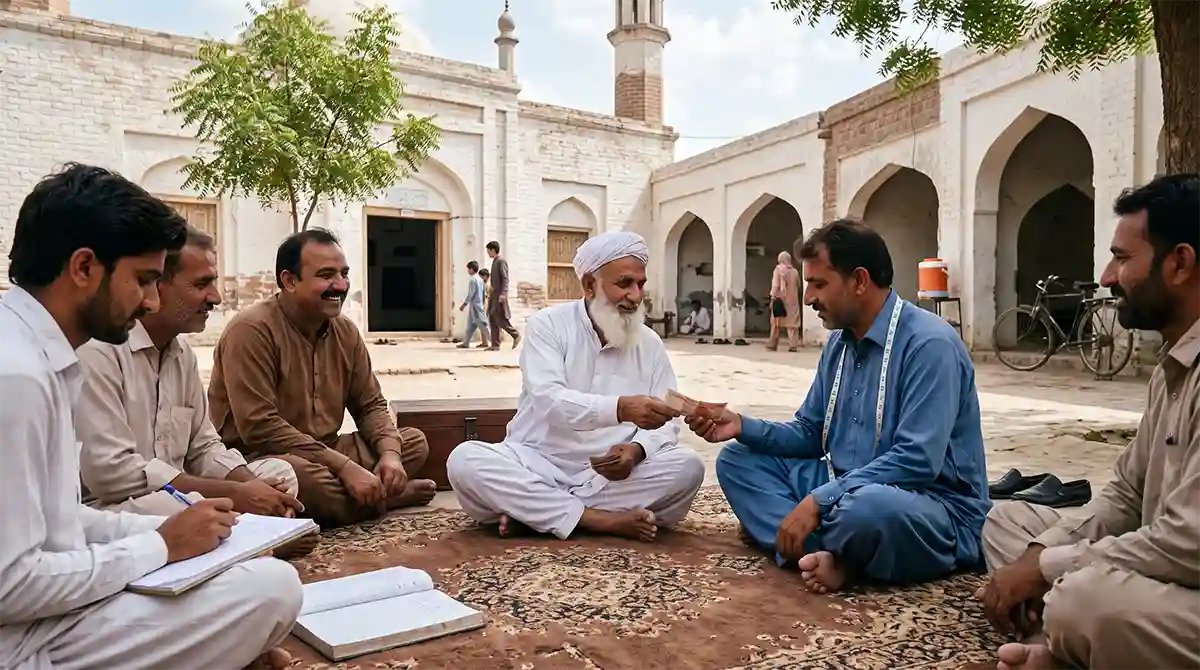
Akhuwat’s most distinctive operational feature is its use of mosques, and in some cases churches and other community religious institutions, as loan disbursement venues rather than conventional bank branches. This is a deliberate choice rooted in the philosophy that a place of worship carries moral weight that reinforces the borrower’s commitment to honest repayment, and that community visibility around the loan process creates social accountability that substitutes for the physical collateral a commercial bank would otherwise require.
Social collateral instead of physical collateral
This is the mechanism that makes Akhuwat’s model accessible to people who would never qualify for a conventional bank loan. Rather than requiring property, gold, or other assets as security, Akhuwat requires the borrower to bring two guarantors from their own community who vouch for their character and their intent to repay. This social collateral system, combined with the religious and community weight of mosque-based disbursement, has produced the extraordinarily high repayment rates the organization consistently reports.
Akhuwat’s Loan Categories
Akhuwat offers several distinct loan categories under its Islamic Microfinance Muakhat program, each designed for a specific type of need.
| Loan Category | Typical Purpose | Example Use Case |
|---|---|---|
| Family Enterprise / Business Loan | Starting or expanding a small business | Buying a second sewing machine, stocking a shop, purchasing a rickshaw |
| Education Loan | School, college, or vocational fees | Paying a semester’s tuition or vocational training course fees |
| Health Loan | Medical treatment and emergencies | Covering surgery or hospitalization costs |
| Housing Loan | Home construction or repair | Building an additional room or repairing a roof after damage |
| Agriculture Loan | Farming inputs and livestock | Purchasing seeds, fertilizer, or a milking animal |
Worked example: A small shopkeeper wants to expand inventory ahead of Ramadan and needs PKR 60,000. Under Akhuwat’s Qarz-e-Hasna model, he borrows exactly PKR 60,000, agrees on a repayment period (commonly structured over 12 to 24 months depending on the loan size and category), and repays in equal monthly installments of PKR 5,000 to PKR 2,500 respectively, with the total repayment across the entire loan term equal to exactly PKR 60,000.
Compare this to a conventional microfinance loan of the same amount at a typical 30 percent annual markup, where total repayment over a similar period could reach PKR 75,000 to PKR 85,000. The difference, PKR 15,000 to PKR 25,000, remains entirely in the borrower’s pocket rather than being paid as financing cost.
Eligibility and Application Process
Basic eligibility criteria
Applicants must be Pakistani citizens holding a valid CNIC issued by NADRA. Most programs are open to applicants aged 18 and above. There is generally no restriction based on religion, caste, or gender, consistent with Akhuwat’s stated mission of serving all Pakistanis regardless of background. The core requirement is genuine financial need combined with a credible plan for how the loan will be used and repaid.
Documents typically required
A valid CNIC is the primary document required. For business loans, a simple business plan or description of the intended use of funds is generally requested. For education loans, proof of admission or enrollment is required. Two guarantors from the applicant’s own community, who are willing to vouch for the applicant’s character and repayment intent, must be arranged as the social collateral substitute for physical assets.
The application steps
Visit your nearest Akhuwat branch or the mosque-based disbursement point in your area, which can be located through Akhuwat’s official website or helpline. Meet with a loan officer to discuss your need and the appropriate loan category. Complete the application form with your CNIC details and the purpose of the loan. Undergo Akhuwat’s social appraisal process, where the organization typically visits or verifies the applicant’s circumstances and confirms the credibility of the guarantors. Once approved, attend the disbursement, which for many loan categories takes place at a designated mosque or community event, often alongside other borrowers from the same community. Begin repayment according to the agreed monthly installment schedule.
A note on scams
Akhuwat has publicly warned that fraudulent individuals and pages on social media have impersonated the organization to deceive people seeking loans, sometimes asking for upfront fees before disbursing a loan that does not exist. A genuine Akhuwat loan never requires any upfront payment, processing fee, or “guarantee deposit” before disbursement. Always verify any loan offer through Akhuwat’s official website or by visiting a physical branch directly, and treat any request for advance payment as a certain sign of fraud.
Other Islamic and Interest-Free Microfinance Options in Pakistan
Akhuwat is the largest and most well-known name in this space, but it is not the only option. Several other institutions provide interest-free or Shariah-compliant microfinance in Pakistan, each with a somewhat different focus.
| Institution | Focus | Notable Feature |
|---|---|---|
| Akhuwat Foundation | General interest-free lending nationwide | Largest network; mosque-based Qarz-e-Hasna model |
| Akhuwat Islamic Microfinance Bank | Regulated Islamic microfinance banking arm | Combines Akhuwat’s model with SBP-regulated banking structure |
| Kashf Foundation | Women-focused microfinance | Over 96% of loans deployed to women-owned micro-enterprises |
| NRSP Microfinance Bank | Rural and agricultural lending | One of the oldest and largest MFIs by active borrowers |
| Khushhali Microfinance Bank | Broad-based microfinance banking | Largest gross loan portfolio among microfinance banks |
For borrowers specifically seeking interest-free financing on religious grounds, Akhuwat and its affiliated Islamic Microfinance Bank remain the most established and accessible route, while institutions like Kashf and NRSP, though not all interest-free, remain relevant for readers researching Pakistan’s broader microfinance ecosystem, particularly women entrepreneurs who may specifically benefit from Kashf’s dedicated focus.
Why This Matters for Pakistan’s Financial Inclusion
Millions of Pakistanis, particularly in rural areas and lower-income urban neighborhoods, remain outside the formal banking system entirely, unable to access commercial credit due to lack of collateral, lack of documented income, or simply lack of a nearby bank branch. Islamic microfinance institutions like Akhuwat have filled a genuine and significant gap in this landscape, bringing formal, structured, and interest-free credit directly into communities through mosques and local networks that people already trust.
The scale achieved, over 99 percent repayment on loans given without traditional collateral to some of Pakistan’s most financially excluded citizens, is a genuinely remarkable proof of concept for community-based, faith-aligned lending. For readers of this site researching financial options for themselves, a family member, or a small business, understanding that this option exists, how it works, and how to access it responsibly is valuable practical knowledge that sits outside what conventional banking guides typically cover.
In Summary
Islamic microfinance in Pakistan, led by Akhuwat’s mosque-based Qarz-e-Hasna model, represents one of the most distinctive and successful financial inclusion stories in the country’s recent history. It combines religious principle, community accountability, and practical financial need into a lending model that has reached millions of families who would otherwise have no access to affordable formal credit.
For anyone eligible and in genuine need of small-scale financing for a business, education, health, or housing purpose, and for whom interest-based borrowing is either unaffordable or religiously unacceptable, Akhuwat and similar Islamic microfinance institutions deserve serious consideration as a first stop before more expensive commercial alternatives.