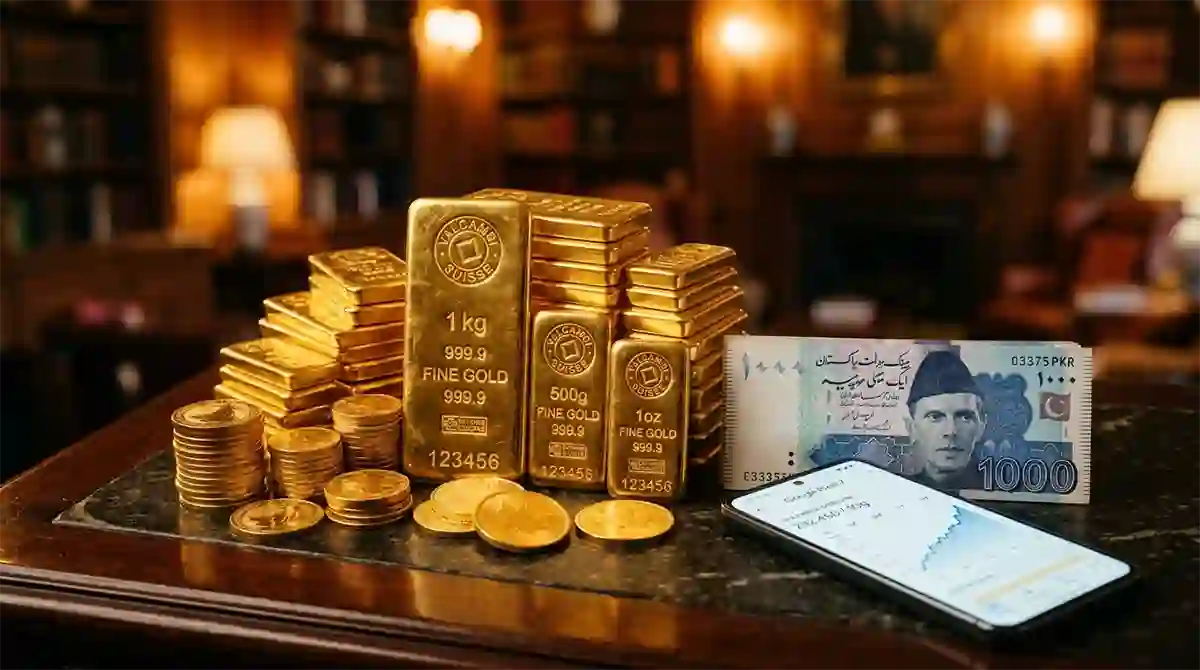
Gold investment in Pakistan has always carried a weight that goes beyond finance. It sits at the intersection of culture, emotion, and economics in a way that almost no other asset class does. Mothers save gold for their daughters’ weddings. Families store it as a backup for difficult times. And for decades, it has quietly served as one of the most reliable hedges against the rupee’s persistent depreciation and Pakistan’s recurring bouts of inflation.
But in 2026, the conversation around gold investment has changed significantly. Prices have surged to historic highs. New ways to invest in gold without physically buying or storing it have emerged. And a growing number of Pakistani investors are asking a question that would have seemed almost disrespectful a generation ago: is gold still actually worth it as an investment, or are there better options available now?
This article gives you an honest, updated answer.
Where Gold Prices Stand in 2026
To have an informed conversation about gold investment, you need to understand where prices actually are right now.
As of mid-May 2026, gold prices in Pakistan have reached approximately PKR 492,000 per tola, with international gold trading near $4,700 per ounce. The gold market has continued its strong bullish momentum through 2026, extending the powerful uptrend that began in late 2025. This sustained strength has been driven by safe-haven demand, increasing expectations of interest rate cuts by the US Federal Reserve, and ongoing geopolitical tensions globally.
To put this in perspective, gold in Pakistan was trading at roughly PKR 100,000 per tola just five years ago. The near fivefold increase in rupee terms reflects both the genuine global rise in gold prices and the continued depreciation of the Pakistani rupee against the dollar over the same period.
Gold prices in Pakistan are updated twice daily by the All Pakistan Sarafa Gems and Jewellers Association, with variations of PKR 200 to 500 per gram being common between morning and evening rates. If you are a serious gold investor in 2026, tracking prices through the Sarafa Association or a reliable platform before buying or selling is essential.
Why Pakistanis Have Always Trusted Gold
Before evaluating gold as an investment in today’s context, it is worth understanding why it has held such a central place in Pakistani financial life.
Pakistan has experienced significant inflation across multiple decades. The rupee has lost a substantial portion of its purchasing power over the long term. Bank deposit rates have frequently lagged behind real inflation. Real estate, while popular, requires large capital and is illiquid. In that environment, gold served a very practical role: it held its value in real terms when almost everything else was eroding.
Gold is also universally recognized and accepted. You can walk into any sarafa market across Pakistan, from Lahore’s Urdu Bazaar to Karachi’s Johar Market, with gold and convert it to cash within minutes. That liquidity, combined with its cultural acceptability as a store of value, made gold the default savings instrument for millions of Pakistani households who had limited access or trust in formal financial institutions.
None of those underlying reasons have disappeared in 2026. If anything, they remain as valid as ever.
Read more: Islamic Banking Pitfalls: What I Wish I Knew Before Opening an Account
The Different Ways to Invest in Gold in Pakistan
This is where things have changed most significantly. Gold investment in Pakistan is no longer just about buying jewelry or physical gold from a jeweler. In 2026, you have several distinct options, each with different trade-offs around cost, convenience, liquidity, and risk.
Physical Gold: Jewelry
Buying gold jewelry is what most Pakistani families have historically done. It serves a dual purpose as both an ornament and a store of value.
The problem with jewelry as a pure investment is the making charges. When you buy gold jewelry, you pay a premium above the raw gold price that covers the jeweler’s labor and craftsmanship. These charges can range from 10% to 25% of the jewelry’s total price depending on the design. When you sell the jewelry, you receive only the gold value, not the making charges. So from day one, you are already behind the actual gold price by a meaningful margin.
For investment purposes, jewelry is the least efficient form of gold. It makes sense when you want gold for cultural or social purposes alongside its value as a store of wealth. As a pure financial investment, there are better ways.
Physical Gold: Coins and Bars
Instead of jewelry with making charges, you can buy pure gold bars or coins. Banks like HBL, UBL, and Meezan Bank sell certified gold, as do established jewelers. These come in denominations such as 10 grams, 1 tola, or more, stamped with a purity mark, sealed in protective packaging, and certified. This is typically 24K gold at 99.9% purity with no design or artistry, just pure investment gold.
Gold coins from banks typically cost the spot gold price plus a 2% to 4% premium. This is significantly lower than jewelry making charges and means you start much closer to the actual gold price. When you want to sell, certified coins and bars from recognized sources are easy to liquidate at any reputable sarafa dealer.
The main downside of physical gold in any form is storage and security. Keeping significant amounts of physical gold at home creates genuine risk from theft. A bank locker is a safer solution but adds an annual cost and means the gold is not instantly accessible.
Meezan Gold Fund
The Meezan Gold Fund, managed by Al Meezan Investment Management Limited, is a Shariah-compliant open-end commodity scheme that focuses on gold investments through deliverable contracts on the Pakistan Mercantile Exchange. It has a minimum investment of PKR 5,000 and charges a management fee of up to 1.5% per annum.
The fund has delivered a one-year return of approximately 26.71% and a year-to-date return of around 32.66% as of mid-2026, with Assets Under Management of over PKR 10 billion.
The Meezan Gold Fund is one of the most accessible and well-regulated ways to gain gold exposure in Pakistan without physically buying or storing gold. You invest through Al Meezan’s mobile app or website, your money tracks the price of gold through the fund’s NAV, and you can invest and redeem with relative ease without the security concerns of physical gold.
For investors who want Shariah-compliant gold exposure, this is currently one of the best structured options available in Pakistan’s regulated market.
Pakistan Mercantile Exchange (PMEX)
The Pakistan Mercantile Exchange allows trading in gold futures contracts. This is a more sophisticated and higher-risk option that involves trading contracts based on future gold prices rather than owning gold directly.
PMEX gold trading is not appropriate for beginner investors. It involves leverage, margin requirements, and the complexity of futures contract mechanics that require real expertise and active monitoring. Losses can exceed your initial investment if positions move against you. Mention it here for completeness, but for most readers of this article, the Meezan Gold Fund or physical coins and bars are far more suitable entry points.
Learn more: How to Start Investing with a Small Amount of Money in Pakistan
Digital Gold Platforms
The gold investment landscape in Pakistan has expanded significantly in 2026 beyond traditional physical purchases, with digital platforms offering diverse exposure methods. Digital gold lets you buy gold online in small amounts. It is backed by physical gold in vaults but requires trusting the platform’s legitimacy.
Several fintech platforms now offer digital gold investment in Pakistan. The appeal is obvious: you can invest small amounts, track prices in real time, and buy or sell without visiting a jeweler or managing physical storage.
However, digital gold platforms in Pakistan are still at an early regulatory stage. Not all of them operate under clear SECP oversight. Before investing through any digital gold platform, verify their regulatory status carefully. If you cannot confirm SECP registration or clear custodial arrangements for the underlying physical gold, proceed with extreme caution. The Meezan Gold Fund remains the better-regulated alternative for most investors seeking paperless gold exposure.
What Drives Gold Prices in Pakistan?
Understanding what moves the price of gold helps you think about it more clearly as an investment rather than just a cultural asset.
International gold prices
Gold is a globally traded commodity priced in US dollars. Whatever happens to international gold prices flows directly into Pakistan’s local gold prices. A $10 increase in international prices typically results in a PKR 1,100 to 1,300 per tola increase in local prices, though this relationship varies with exchange rate fluctuations.
Global gold prices are driven by US interest rate policy, geopolitical tensions, inflation expectations, and the relative strength of the US dollar. When the dollar weakens or global uncertainty rises, gold tends to rise.
The PKR to USD exchange rate
This is the factor that makes gold especially powerful for Pakistani investors. Even when international gold prices are flat in dollar terms, a depreciation of the rupee against the dollar automatically increases the PKR price of gold. Over the past decade, the rupee has lost significant value against the dollar, and gold holders in Pakistan benefited from that depreciation automatically. This is gold’s most important role for Pakistani investors: it is a natural hedge against rupee weakness.
Local demand
Pakistan has high structural demand for gold driven by wedding season, cultural gifting practices, and savings behavior. Seasonal spikes in demand, particularly during wedding seasons and festivals, can push local prices above the theoretically calculated rate based on international prices alone.
Gold as Part of a Portfolio: How Much Makes Sense?
Financial experts recommend keeping 10% to 20% of your total savings in gold as a hedge against inflation and currency risk.
This is a reasonable guideline for Pakistani investors. Gold works best as a portfolio stabilizer and hedge, not as your primary wealth-building instrument.
Here is why. Over very long periods, equities, meaning stocks and equity mutual funds, have historically generated higher returns than gold in most markets including Pakistan. Gold protects your wealth from currency devaluation and provides stability during economic crises. But it does not generate dividends, rental income, or business earnings. It simply holds and sometimes grows its value in real terms.
The most sensible approach for most Pakistani investors is a portfolio that includes a meaningful allocation to gold, perhaps 15% to 20% of investable assets, alongside equity mutual funds or direct stocks for growth, and some fixed income instruments for stability. This combination gives you inflation protection through gold, long-term growth potential through equities, and income stability through fixed income.
Going all-in on gold because it has performed well recently is a common mistake. Strong recent performance is not a reason to increase allocation. It is usually a reason for more caution.
The Real Risks of Gold Investment in Pakistan
Gold is often presented as a safe investment, and in relative terms it has been. But it carries real risks that every investor should understand.
Price volatility
Gold prices can and do fall significantly. International gold has seen corrections of 20% to 30% in relatively short periods during various points in history. If you buy at a market peak and need to sell during a correction, you can incur meaningful losses.
No income generation
Unlike stocks that may pay dividends or bonds that pay interest, gold generates no income while you hold it. Your return comes entirely from price appreciation. In periods when gold prices are flat or declining, your gold investment simply sits there earning nothing.
Storage and security risks for physical gold
Theft, loss, and the cost of secure storage are real considerations for anyone holding significant physical gold. These costs and risks are eliminated with the Meezan Gold Fund but are genuine concerns for physical holders.
Making charges on jewelry
As discussed earlier, buying jewelry for investment purposes means you start at a meaningful disadvantage due to making charges that you cannot recover on resale.
Liquidity issues for large amounts
While small amounts of gold are highly liquid in Pakistan’s sarafa markets, trying to liquidate very large quantities of physical gold quickly can be more complex and may attract below-market offers from dealers aware that you are a motivated seller.
Is Gold Still Worth It in 2026?
The honest answer is yes, but with context.
Gold remains a genuinely valuable component of a Pakistani investor’s portfolio in 2026 for the same structural reasons it always has been: it hedges against rupee depreciation, provides stability during economic uncertainty, and holds its real value over long periods better than cash in a savings account.
At current prices near PKR 490,000 per tola, the entry point is historically high. Investors buying today are not getting the bargain of a decade ago. This does not mean gold will not go higher. Global conditions, including ongoing geopolitical tensions and expectations of rate cuts by major central banks, continue to support gold prices internationally. But it does mean that the risk of a short-term price correction is real, and anyone investing purely on the basis of recent momentum should be aware of that.
For long-term investors with a three to five-year or longer horizon, the structural case for holding gold as part of a diversified portfolio remains solid. The rupee’s long-term trajectory against the dollar, Pakistan’s inflation history, and gold’s role as a crisis hedge all support continued allocation to gold as part of a balanced approach.
The best way to enter in 2026 is gradually, using the same dollar cost averaging principle discussed in the previous article, rather than deploying a large lump sum at current elevated prices. Monthly contributions to the Meezan Gold Fund or periodic purchases of certified gold coins smooth out your entry price over time and reduce the risk of buying at exactly the wrong moment.
Concluding Remarks
Gold has earned its place in Pakistani financial culture through decades of practical performance in a genuinely challenging economic environment. In 2026, the ways to invest in it have expanded meaningfully, from certified physical coins to regulated mutual funds that give you gold exposure without storage headaches.
The question is not whether gold belongs in your investment strategy. For most Pakistani investors, some allocation to gold makes sense as a hedge and a stabilizer. The question is how much, through which vehicle, and at what pace you build that position.
Own gold deliberately as part of a portfolio, not entirely as a standalone savings strategy. Combine it with growth-oriented instruments for a complete approach. And do not let the recent price surge push you into a larger allocation than your overall financial plan calls for.
Gold has served Pakistani families well across generations. Approached with the right expectations and the right allocation, it still has an important role to play.