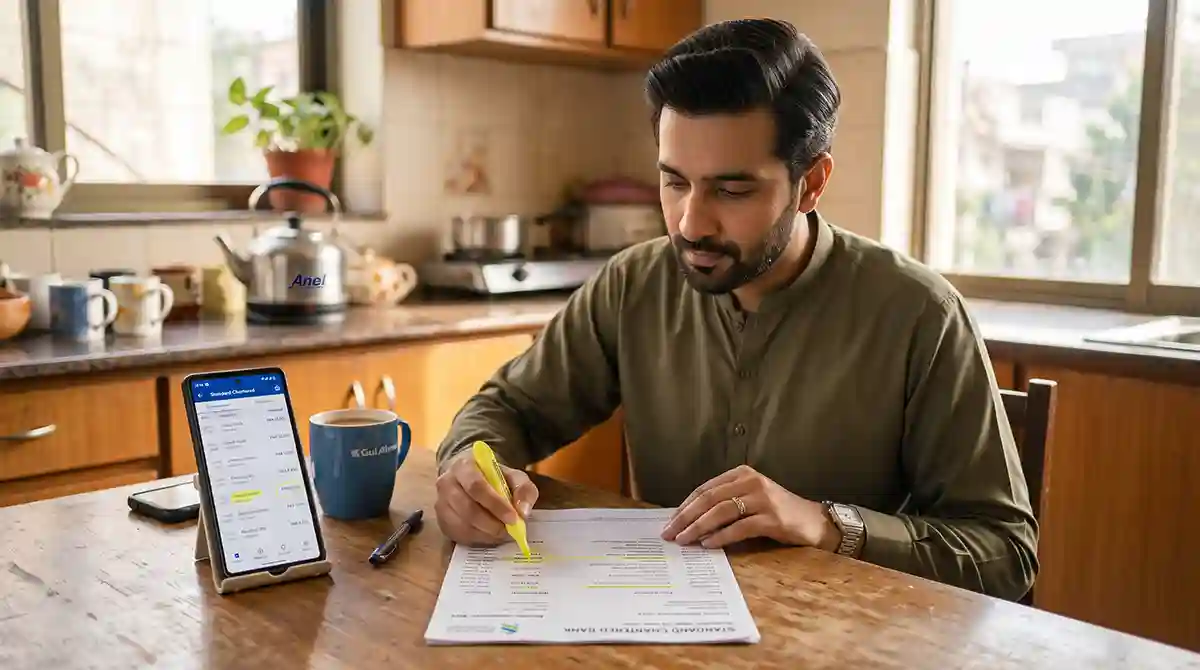
A cousin of mine once called me, genuinely alarmed, about a line on her statement that read “IBFT-OB DR 1,000.00 M SHAFIQ MUGHAL.” She assumed it was some kind of unauthorized charge, since she did not recognize the name and had no idea what “IBFT-OB” meant. It turned out to be a rupee-for-rupee transfer she had made herself to a relative, using a slightly different spelling of his name than she remembered, sent through the ordinary interbank transfer network every Pakistani bank uses. Nothing was wrong. She simply could not read her own statement. So, in this article you will understanding your bank statement in Pakistan.
This is a genuinely common gap, and it matters more than it seems, because your bank statement is the single most important document for spotting fraud early, tracking down a wrongly charged fee, and building the kind of clean transaction history that supports a future loan application. This guide walks through exactly how a Pakistani bank statement is structured and what every common code and abbreviation on it actually means.
Table of Contents
The Basic Structure of a Pakistani Bank Statement
Before understanding your bank statement in Pakistan, you need to know the basic structure of a Pakistnai bank statement. Whether you download it through your bank’s app or receive a stamped copy from a branch, most Pakistani bank statements follow the same basic layout.
The header section identifies your account: your name, account number or IBAN, branch, account type (current, savings, or foreign currency), currency, and the specific date range the statement covers.
The opening balance is what was in your account at the very start of the statement period, and the closing balance is what remained at the end. Every transaction listed in between should reconcile these two figures exactly; if they do not, that discrepancy itself is worth querying with your bank directly.
The transaction table is the body of the statement, with a row for every debit or credit. Each row typically shows a date, a description or narration column (where the codes and abbreviations covered below appear), a debit column, a credit column, and a running balance column showing your account balance immediately after that specific transaction posted.
Posting date vs value date, a distinction Allied Bank’s own customer guidance specifically flags, is worth understanding: the posting date is when the bank recorded the transaction in its own books, while the value date is when it actually affects your available balance. For the vast majority of everyday transactions these are identical, but for certain transfers they can differ by a day, which occasionally explains why a transaction appears to have been “backdated” slightly on your statement.
The Codes and Abbreviations You’ll Actually See
Pakistani bank statements combine internationally standard banking abbreviations with several codes specific to Pakistan’s own payment infrastructure. Here is a practical glossary covering both.
| Code | Meaning |
|---|---|
| IBFT | Inter Bank Funds Transfer: money moved between your account and an account at a different Pakistani bank |
| 1LINK | The shared national switch network that routes interbank ATM withdrawals and many IBFT transfers between Pakistani banks |
| RAAST | SBP’s instant payment system; transfers routed through Raast are typically free and settle immediately |
| RTGS | Real Time Gross Settlement: used for large-value transfers between banks, typically settled the same business day |
| TFR | A transfer between two of your own accounts at the same bank |
| POS | Point of Sale: a debit or credit card purchase made at a retail store, restaurant, or merchant terminal |
| ATM | A cash withdrawal, deposit, or balance inquiry made at an ATM |
| DR | Debit: money leaving your account |
| CR | Credit: money entering your account |
| CHQ | A cheque transaction, either one you deposited or one that cleared against your account |
| OD | Overdraft: indicates your account balance has gone negative, or a specific overdraft facility transaction |
| WHT | Withholding Tax: deducted at source on profit, dividends, or certain transaction types |
| ML / PLS | Markup or Profit and Loss Sharing: the profit credited to your savings account, or the markup charged on a financing facility |
| ZKT / ZAKAT | The compulsory Zakat deduction applied on eligible savings balances |
| STL | Standing instruction: an automated recurring payment or transfer you have set up |
| REV | Reversal: a transaction that corrects or cancels a previous entry, commonly seen after a disputed or failed transaction is resolved |
| SWIFT | Indicates an international wire transfer routed through the SWIFT messaging network |
| FX / FCY | Indicates a transaction involving foreign currency conversion |
| B/F and C/F | Balance Brought Forward and Balance Carried Forward: the opening and closing balances linking one statement page or period to the next |
A Worked Example: Reading a Real Statement Line
Consider a line reading: 28-08-2026 | IBFT DR 5,000.00 | M SHAFIQ MUGHAL VIA 1LINK | BAL 45,000.00
Reading this line piece by piece tells you: on August 28, 2026, PKR 5,000 was transferred out of your account (DR, a debit) to a person named M Shafiq Mughal, held at a different bank (IBFT, since this moved between banks rather than within your own), routed through the 1LINK network, and your balance immediately after this transaction was PKR 45,000.
Compare this against a line reading: 28-08-2026 | RAAST CR 10,000.00 | SALARY XYZ COMPANY | BAL 55,000.00, which tells you the opposite: PKR 10,000 came into your account (CR, a credit) from a source labelled as your salary, arriving through Raast, SBP’s instant payment rail, bringing your balance to PKR 55,000.
Once you can parse a handful of lines this way, an entire month’s statement takes only a few minutes to review properly, rather than remaining an intimidating wall of codes.
Using Your Statement to Check What You’re Actually Being Charged
This is where reading your statement carefully pays off directly in rupees. SBP requires banks to send an immediate transaction alert after every financial transaction, with the principal amount and any service fee clearly separated rather than bundled into a single figure. Your monthly statement is where you can double-check that this separation was applied correctly.
Scan your statement specifically for standalone fee line items, commonly labelled with codes such as SC (service charge), MB FEE (mobile banking fee), or SMS CHG, alongside your regular transactions. If you see a fee you do not recognize or cannot connect to a specific service you knowingly used, that specific line, with its date and exact amount, is precisely what you need when raising a query with your bank’s complaint desk.
Using Your Statement to Spot Fraud
Your bank statement is one of your most direct fraud-detection tools, particularly for catching unauthorized transactions early enough to dispute them.
Review your statement, not just the instant SMS or app alerts, at least once a month, specifically looking for unfamiliar IBFT or POS entries you do not recognize, small “test” transactions of an unusual, oddly specific amount (a tactic sometimes used to verify a card is active before a larger unauthorized transaction follows), and any transaction dated during a period you know your card or phone was out of your possession. If anything on the statement does not match your own memory of the period, treat it with genuine urgency and contact your bank’s helpline immediately, rather than waiting for your next statement to confirm the pattern.
How to Get Your Statement From Major Pakistani Banks
Most major Pakistani banks now offer several ways to access your statement, and it is worth knowing all of them since some situations call for a specific format.
Mobile app or internet banking is the fastest route for most customers: log in, navigate to the statements or account activity section, select a date range, and download a PDF directly to your phone. As Allied Bank’s own customer guidance notes, statements accessed this way are typically available for up to a full year through the app, with older records requiring a formal branch request.
A stamped physical copy from a branch carries an official bank stamp and signature, which is specifically what most institutions, such as embassies processing a visa application or a lender reviewing your income history, require rather than a self-downloaded PDF.
Email or SMS-based statement requests, available at several banks through their call centre or registered email address, are useful when you need a specific historical period beyond what your app displays.
Common Mistakes Pakistanis Make When Reading Their Own Statement
Panicking over an unfamiliar code before checking what it actually stands for. As my cousin’s IBFT experience shows, a code you don’t recognize is very often a transaction you made yourself, described in a format you’re simply not used to reading.
Only checking instant SMS alerts and never reviewing the full monthly statement. A single alert tells you about one transaction; the full statement lets you see patterns, recurring fees, and small discrepancies across an entire month that individual alerts do not surface on their own.
Not reconciling the opening and closing balance against the listed transactions. If these figures don’t add up correctly once you total every debit and credit, that mismatch itself is worth raising with your bank rather than assuming your own arithmetic is simply wrong.
Discarding old statements immediately after reviewing them. A clean, multi-year transaction history is genuinely valuable evidence when applying for future loans or financing, and it is far easier to keep than to reconstruct later.
Conclusion
A Pakistani bank statement is not designed to be confusing; it simply uses a shorthand vocabulary, IBFT, 1LINK, Raast, WHT, ML, that nobody ever formally explains to account holders. Once you can read the basic structure, distinguish a debit from a credit at a glance, and recognize the dozen or so codes that cover the overwhelming majority of everyday transactions, your statement becomes what it was always meant to be: your own, personal, month-by-month record of exactly where your money went and exactly what your bank charged you for it.
Review it properly at least once a month. It is the cheapest fraud detector and fee auditor you have.
Further reading and official sources:
- State Bank of Pakistan: transaction alert and fee disclosure requirements: sbp.org.pk
- Banking Mohtasib Pakistan: for disputing an unrecognized statement entry: bankingmohtasib.gov.pk