
A few years back, a friend of mine inherited some money after his father passed away. Not a life-changing amount, but enough to matter. He wanted to invest it wisely, so he started asking around. One person told him to put it all in stocks. Another said bonds were safer. A third person told him to “just buy gold” and ignore both.
He ended up doing nothing with it for almost a year because he didn’t understand the difference and didn’t want to make the wrong move. That money sat in a regular savings account, losing value to inflation the entire time.
I’ve seen this happen more times than I can count. People get stuck not because they’re careless, but because nobody explains these things in a way that actually makes sense. So let’s fix that.
Table of Contents
The Simple Version First
Think of it this way.
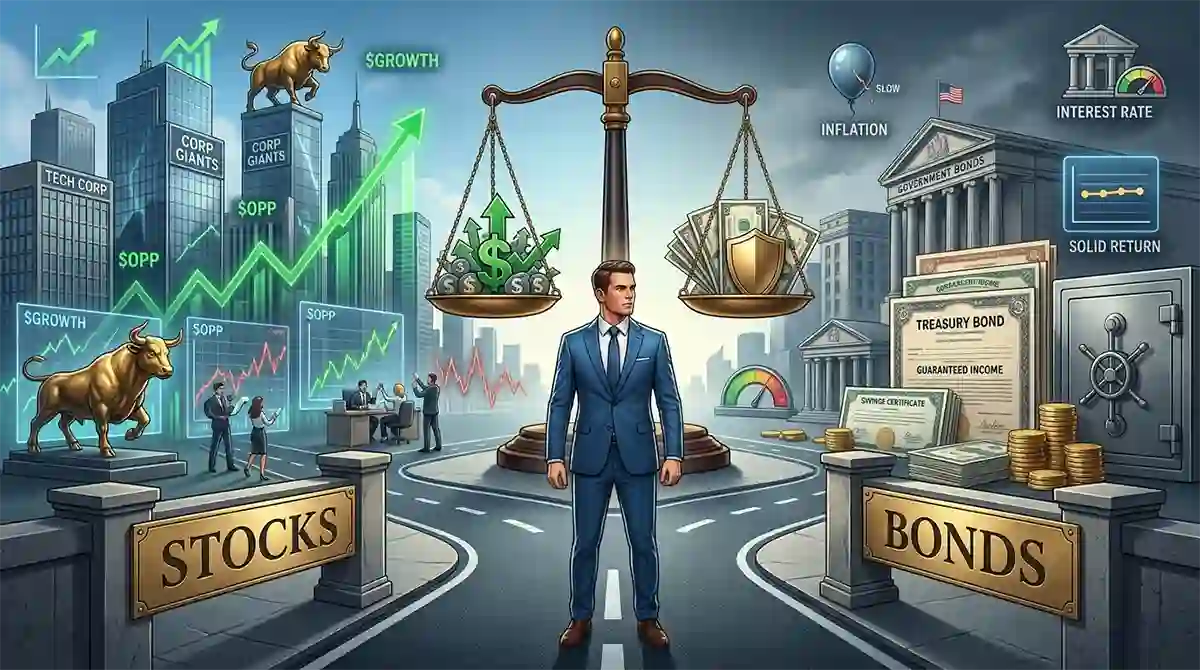
When you buy a stock, you’re buying a piece of a company. You become a part-owner, even if it’s a tiny fraction. If the company grows and does well, your piece becomes more valuable. If it struggles, your piece loses value. The potential reward is higher, but so is the risk.
When you buy a bond, you’re lending money to a company or a government. They promise to pay you back after a fixed period, along with regular interest payments along the way. The return is more predictable, but it’s also usually lower. You’re not an owner, you’re a lender.
That’s the core difference. Ownership versus lending. Growth potential versus stability.
What Stocks Actually Are
A stock represents equity in a company. When a business wants to raise money to grow, it can issue shares and sell them to the public. When you buy those shares, you own a percentage of that business.
If the company performs well, earnings go up, and so does demand for its stock. The price rises. Some companies also pay dividends, which are regular cash payments to shareholders out of their profits. That’s a nice bonus on top of price appreciation.
But here’s the honest part. Stocks can also drop sharply. A bad earnings report, a global event, a shift in the industry, and suddenly, a stock that was doing well is down 30%. I’ve seen it happen to stocks I held personally. It’s not a pleasant feeling, especially the first time. But it’s part of the deal.
Stocks are best suited for people who have a longer time horizon, meaning they don’t need the money in the next few years, and can handle short-term volatility without panicking.
What Bonds Actually Are
A bond is essentially a loan you give to a borrower, typically a government or a corporation. In return, they agree to pay you a fixed rate of interest (called the coupon) over a set period, and then return your original amount (called the principal) when the bond matures.
For example, if you buy a government bond worth PKR 100,000 with a 10% annual coupon and a 5-year maturity, you’ll receive PKR 10,000 every year for five years, and then get your PKR 100,000 back at the end.
In Pakistan, government savings instruments like National Savings Certificates, Defence Savings Certificates, and Bahbood Savings Certificates are forms of bonds. They’re backed by the government, which makes them very low risk.
Corporate bonds exist, too, issued by companies. They typically offer higher interest rates than government bonds because the risk is slightly higher. A company can default; a government rarely does.
The predictability of bonds is what makes them appealing, especially for people who are closer to retirement or simply don’t want surprises.
Learn more: What is Investing? A Beginner’s Guide
How They Behave Differently Over Time
This is where it gets interesting, and where most beginner guides skip the real detail.
Historically, over long periods of time, stocks have outperformed bonds significantly. If you had invested in a diversified basket of stocks 20 or 30 years ago and left it alone, you would have likely seen much better returns than bonds over the same period.
But the journey with stocks is bumpy. There will be years where your portfolio drops 20%, even 40%, in a severe downturn. The 2008 financial crisis wiped out huge amounts of stock value globally. People who panicked and sold locked in those losses. People who stayed invested recovered and then some within a few years.
Bonds, on the other hand, tend to be much more stable. Their prices don’t swing wildly. The returns are lower, but they’re more consistent and predictable. During stock market crashes, bonds often hold their value or even go up because nervous investors move their money into safer assets.
The Risk Side Nobody Talks About Enough
With stocks, the main risk is market volatility and the possibility of a company doing poorly or going bankrupt. You could lose a significant portion of what you put in, at least temporarily.
With bonds, the risks are different and often misunderstood.
Interest rate risk: When interest rates rise, the value of existing bonds falls. If you need to sell a bond before it matures and rates have gone up since you bought it, you’ll likely get less than what you paid.
Inflation risk: If inflation rises above your bond’s interest rate, you’re actually losing purchasing power. Your returns are technically positive, but the real value of your money is shrinking.
Default risk: With corporate bonds, especially, there’s always a chance the company can’t repay. This is why credit ratings matter when choosing bonds.
So Which One Is Right for You?
Honestly, for most people, the answer is both, in different proportions depending on your situation.
The classic approach is to balance your portfolio between stocks and bonds based on your age and risk tolerance. A common rule of thumb is to subtract your age from 100, and that’s roughly the percentage you keep in stocks. So a 30-year-old might hold 70% in stocks and 30% in bonds. A 60-year-old might flip that closer to 40% stocks and 60% bonds.
This isn’t a rigid rule, but it captures the right idea. When you’re young, you have time to ride out market downturns. As you get older and closer to needing the money, you want more stability.
- Choose stocks if: You have a long investment horizon (5 years or more), you can handle the ups and downs emotionally, and you’re looking for higher long-term growth.
- Choose bonds if: You need more predictable returns, you’re closer to retirement, you’re risk-averse, or you want to balance out a stock-heavy portfolio.
- Consider both if: You want a balanced approach that gives you growth potential while cushioning you from extreme volatility. Most seasoned investors hold a mix of both for exactly this reason.
A Practical Example From Real Life
A relative of mine retired a few years ago and had a lump sum from his provident fund. He put 80% of it into National Savings Certificates and 20% into a diversified equity mutual fund. His reasoning was simple: the NSCs gave him a reliable monthly income to cover living expenses, and the mutual fund portion was money he didn’t need immediately, left to grow over the next decade.
It’s not the most aggressive strategy, but it was right for him. He sleeps well at night, his essential expenses are covered, and the equity portion has grown nicely.
That’s what a good allocation actually looks like in practice. It’s not about picking the best-performing asset. It’s about matching your investments to your actual life.
Common Mistakes to Avoid
Going all-in on stocks without an emergency fund. If the market drops right when you need cash, you may be forced to sell at a loss.
Thinking bonds are completely risk-free. They carry less risk, not zero risk. Inflation and interest rate changes can still hurt you.
Chasing yield on corporate bonds without checking the issuer’s creditworthiness. A higher interest rate offer from a company you’ve never heard of should raise questions, not excitement.
Ignoring bonds entirely because they seem boring. Boring can be very useful when markets are having a rough year.
Final Thoughts
Stocks and bonds aren’t competing options where you have to pick a winner. They’re tools, and like any tools, they work best when used for the right job.
Stocks are for building wealth over time. Bonds are for preserving it and generating a steady income. Most people need both at different stages of their lives, and in different proportions.
The best thing you can do right now is honestly assess where you are, how long you have before you need your money, and how you genuinely feel about risk. Not how you think you should feel, but how you actually respond when you see your balance go down.
Start from that honest place, and you’ll make a much better decision than most people do.
This article is for educational purposes only and does not constitute financial advice. Always consult a licensed financial advisor before making investment decisions.











I want to invest but don’t know exactly. but after reading this I have enough knowledge now. Thanks Sir.
Welcome.