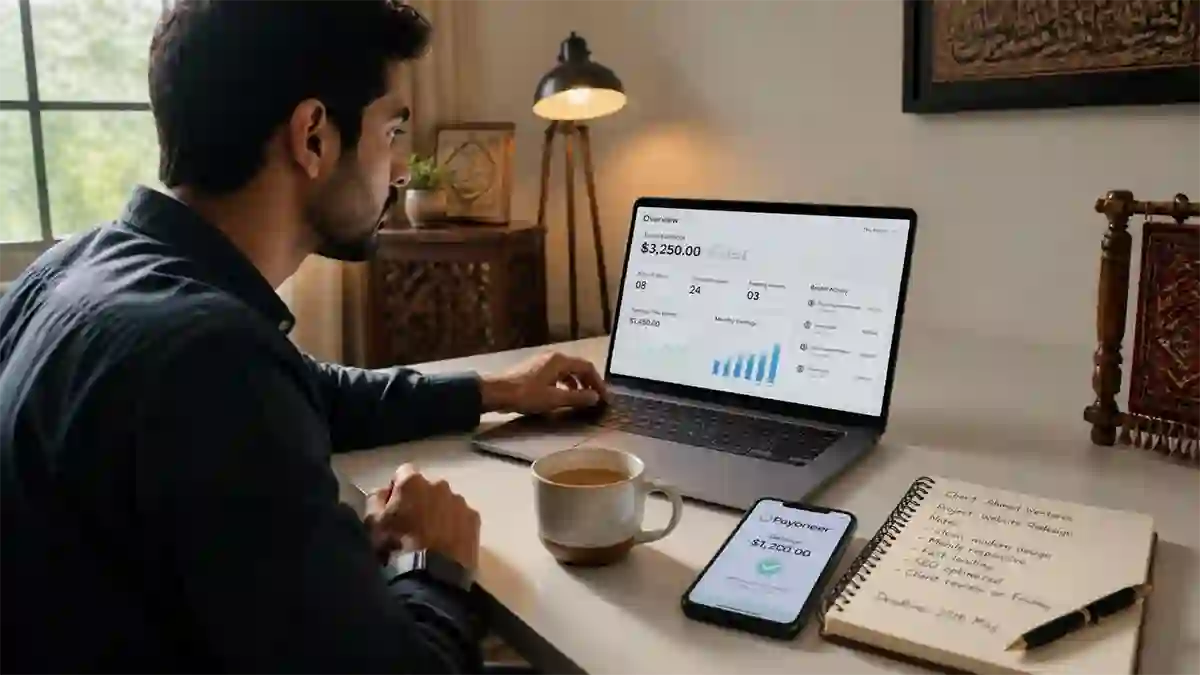
Freelancing in Pakistan has moved well past the stage of being a side hustle for students or a temporary option for the recently unemployed. In 2026, it is a legitimate, professionally recognized, and financially significant career path that is generating dollar income for hundreds of thousands of Pakistanis across every province and city size. The International Labour Organisation has ranked Pakistan among the world’s largest providers of digital labor, and that recognition is not accidental. It has been built by real people developing real skills and delivering real work to international clients, one project at a time. So, here you will learn how to start freelancing in Pakistan and earn in dollars.
If you have been thinking about starting freelancing but are not sure where to begin, which skills are worth learning, how to actually get paid in Pakistan, or how to handle taxes on foreign income, this guide covers all of it with updated information for 2026.
Table of Contents
Why Freelancing Makes Particular Sense for Pakistanis Right Now
The economic case for freelancing from Pakistan has never been stronger than it is in 2026, and the reason comes down to a straightforward exchange rate reality.
When you earn in US dollars and spend in Pakistani rupees, your purchasing power is significantly amplified. A Pakistani freelancer earning $500 per month, which is a realistic early-stage income for someone with a decent skill set, is bringing in roughly PKR 140,000 at current exchange rates. That is a competitive income by any measure in Pakistan’s current economy, and it is achievable within the first six to twelve months of seriously pursuing freelancing for many skill categories.
For freelancers earning $1,500 to $3,000 per month, which is entirely achievable for experienced specialists in development, design, or digital marketing, the rupee equivalent puts them among the higher earners in the country, working entirely from home, with no commute, no office politics, and no geographic limitation on their client base.
Beyond the income advantage, the infrastructure supporting Pakistani freelancers has improved substantially. Payment platforms, tax frameworks, training programs, and professional communities have all matured meaningfully over the past few years.
Skills That Are Actually in Demand in 2026
The most important decision in starting your freelancing journey is choosing which skill to develop. Picking something in genuine demand rather than something that seemed popular a few years ago makes an enormous difference to how quickly you start earning.
Graphic Design and Visual Content
Graphic design consistently ranks as one of the most in-demand freelance skills globally, and Pakistan has a large and growing community of designers who have built strong careers on platforms like Fiverr and Upwork. Demand comes from restaurants, e-commerce brands, real estate agents, content creators, and virtually every type of business that needs visual material.
Tools like Canva, Adobe Illustrator, and Photoshop are learnable through free resources on YouTube and platforms like Digiskills.pk. Getting to a functional working level is achievable within two to three months of consistent practice.
Web Development and WordPress
Web development remains one of the highest-earning freelance categories available to Pakistani freelancers. WordPress development specifically continues to generate strong demand because the global small business market never stops needing websites, and WordPress powers a massive share of them.
For those willing to go deeper, full-stack development using technologies like React, Node.js, and Python commands premium rates, often $30 to $100+ per hour for experienced developers. The learning curve is longer but the ceiling is significantly higher.
Content Writing and Copywriting
English-language content writing is a consistently strong earner for Pakistanis with good written English skills. Businesses around the world need blog posts, product descriptions, website copy, email sequences, and social media content, and they are willing to pay well for writers who can deliver quality work reliably.
Copywriting, which specifically involves writing persuasive content for marketing purposes, commands higher rates than general content writing and is a skill worth developing intentionally beyond basic article writing.
Digital Marketing
Businesses globally need help with Facebook and Instagram advertising, Google Ads management, search engine optimization, email marketing, and social media strategy. Digital marketing is a broad field and specialists who can demonstrate measurable results for clients build very strong freelance careers.
Video Editing
The explosion of content creation on YouTube, TikTok, Instagram Reels, and podcasting has created enormous demand for skilled video editors. Pakistani freelancers who have developed proficiency in tools like Adobe Premiere Pro, DaVinci Resolve, or even CapCut for short-form content are finding consistent work across multiple niches.
Virtual Assistance
Virtual assistance covers a wide range of administrative, organizational, and operational tasks that business owners outsource rather than hire full-time staff for. Email management, calendar scheduling, customer support, data entry, research, and social media scheduling are all common VA tasks. The earning ceiling is lower than technical skills but the barrier to entry is also lower, making it a viable starting point for beginners.
AI-Assisted Services
This is a category that barely existed two years ago but has grown dramatically in 2026. Freelancers who combine traditional skills with effective use of AI tools, whether for writing, design, coding, or research, are able to deliver work faster and at higher quality than those working without them. The freelancers capturing the highest-value projects in 2026 are increasingly those who have integrated AI tools into their workflows to multiply their output and scope.
The Best Platforms for Pakistani Freelancers in 2026
Fiverr
Fiverr remains one of the most beginner-friendly platforms for Pakistani freelancers because it is structured around gigs, predefined services that you create and list at set prices rather than bidding on individual projects. This makes it easier to get started without a track record, and Pakistan has one of the largest communities of Fiverr sellers globally.
The downside of Fiverr is that the platform is highly competitive, particularly for popular categories. Standing out requires professional profile presentation, strong gig descriptions, and consistent delivery of quality work to build early reviews.
Upwork
Upwork is the largest global freelancing marketplace and generally pays better than Fiverr once you have established a profile with positive reviews. It operates on a bidding model where you apply to client job postings with proposals. The competition for individual jobs can be high, but clients on Upwork tend to be more serious and willing to pay professional rates for quality work.
Building an Upwork profile from zero takes patience. Winning the first few projects is the hardest part because clients use your job success score and review history as their primary basis for selection. Starting with smaller projects to build reviews, even at lower rates than you would eventually charge, is an accepted strategy.
Freelancer.com
Freelancer.com is another large global marketplace with a bidding model. It covers a wide range of skill categories and can be a useful secondary platform alongside Upwork.
Jobbers.io
Jobbers is a Pakistan-specific platform worth mentioning because it does not charge commission on payments and allows direct negotiation between freelancers and clients. It is particularly useful for freelancers looking to build local relationships alongside international ones.
Direct Clients
Many experienced Pakistani freelancers eventually move toward sourcing clients directly through LinkedIn, referrals, cold outreach, and their own websites rather than relying exclusively on marketplace platforms. Direct clients typically pay more because there is no platform commission involved and the relationship is more established. This is not a starting point but it is a meaningful goal for freelancers who have built their skills and reputation.
How to Actually Get Paid in Pakistan: 2026 Update
This is the question every new Pakistani freelancer gets stuck on, and the answer has evolved in ways that make it significantly more manageable than it used to be.
Payoneer
Payoneer remains the most widely used and most reliable payment solution for Pakistani freelancers in 2026. It integrates directly with Upwork, Fiverr, Freelancer.com, and most other major platforms, allowing you to receive platform earnings into your Payoneer account and then withdraw to your Pakistani bank account. Most major Pakistani banks support Payoneer withdrawals and the funds typically arrive within one to three business days.
One practical tip worth knowing: withdrawing on a Tuesday or Wednesday rather than around weekends tends to capture better exchange rates and avoids delays from weekday processing cutoffs.
Wise
Wise, formerly TransferWise, works differently for Pakistani freelancers than many expect. You cannot open a Wise account in Pakistan to receive or hold funds. However, your international clients can send payments directly to your Pakistani bank account using their Wise account at near mid-market exchange rates. This means you benefit from Wise’s excellent conversion rates without needing a Wise account yourself. It is particularly useful for freelancers working directly with clients rather than through platforms.
Direct Bank Wire Transfer
For larger payments and long-term client relationships, direct SWIFT bank transfers to your Pakistani bank account are a reliable option. Most major Pakistani banks support international incoming wires, though processing times and fees vary.
JazzCash Integration with Payoneer
A useful development for freelancers outside major cities or those who want faster PKR access is the integration between JazzCash and Payoneer. Freelancers with a Payoneer account can now withdraw funds through any JazzCash point across Pakistan, expanding cash access significantly beyond bank branch locations.
PayPal
PayPal’s availability in Pakistan remains severely limited as of mid-2026. While some freelancers manage to use it through various workarounds, it is not a reliable primary payment solution and should not be planned around.
Taxes on Freelance Income in Pakistan: What You Need to Know in 2026
This is the area most Pakistani freelancers either ignore entirely or find the most confusing. Here is the current situation in clear terms.
Freelance income earned from international clients is considered IT export income in Pakistan under Section 10 of the Income Tax Ordinance 2001. This classification carries specific tax treatment that is significantly more favorable than regular business income. You can also learn filing income tax return for Freelancers in Pakistan.
The Key Distinction: PSEB Registered vs Non-Registered
The most important tax decision a Pakistani freelancer can make is whether to register with the Pakistan Software Export Board, commonly known as PSEB.
PSEB-registered freelancers pay a final tax of just 0.25% on their foreign earnings received through approved banking channels. This is an extremely favorable rate. On $1,000 of monthly income, the tax is just $2.50 at this rate.
Non-registered freelancers currently pay 1% of gross foreign earnings as withholding tax. This is still low by any international standard but is four times higher than the PSEB-registered rate.
To qualify for the 0.25% rate, income must be received through approved channels including Pakistani bank accounts, Payoneer linked to a local account, or direct bank transfers through proper routes. Income sitting in foreign platform wallets or accounts does not qualify for the reduced rate, which means withdrawing your earnings into Pakistani accounts regularly is not just good cash management practice but also a tax compliance requirement.
The 80% Rule
Pakistani tax law requires freelancers and IT service exporters to receive at least 80% of their foreign income through approved banking channels to qualify for the beneficial tax treatment. This is a straightforward condition but one that requires awareness and planning. Freelancers who leave large portions of their earnings in platform accounts or foreign wallets without withdrawing may inadvertently lose eligibility for the reduced rate.
NTN Registration and Annual Filing
Every freelancer in Pakistan earning above PKR 600,000 annually is required to file an income tax return with FBR. Even below this threshold, being a registered NTN holder and an active filer on FBR’s Active Taxpayers List carries meaningful practical benefits, including lower withholding tax rates on banking transactions, property purchases, and vehicle registrations.
Annual income tax returns for freelancers are due by September 30 of each year covering the previous tax year. Filing after this deadline attracts penalties.
Registering on FBR’s IRIS portal is the starting point. PSEB registration can be done through PSEB’s online portal and is strongly recommended given the significant tax rate difference it provides.
How to Get Your First Client: The Honest Reality
This is where most beginner guides become vague and unhelpful. The honest truth about getting your first freelancing client is that it is the hardest part of the entire journey, and the difficulty has nothing to do with your skill level.
The challenge is that most platforms use social proof, reviews and past work history, as the primary filter clients use when choosing between freelancers. When you have no reviews and no portfolio, you are invisible to the majority of serious clients.
The practical strategies that actually work are the following.
Build a portfolio before you apply for anything. Create sample work, even if it is speculative work for imaginary clients, that demonstrates what you can actually deliver. A graphic designer should have a portfolio of logos, social posts, and marketing materials. A writer should have a portfolio of articles and website copy samples. A web developer should have two or three example websites to show. Do not apply anywhere until you have at least five to ten pieces of solid work to show.
Start with slightly lower rates to build reviews. On Fiverr and Upwork, winning your first five to ten projects matters far more than the rate you charge for them. Price yourself competitively, not so low that you appear unserious, but low enough to remove price as an obstacle for the cautious clients who are hesitant to take a chance on a new profile. Once reviews start coming in, raise your rates systematically.
Over-deliver on every early project. For your first several clients, do slightly more than what was agreed. Deliver ahead of the deadline. Send an extra revision without being asked. Write a thoughtful message explaining what you did and why. Early clients who receive exceptional service become reviewers, repeat clients, and referrers, and all three of those outcomes are enormously valuable when you are starting out.
Use your personal network for early work. Do not overlook the businesses, professionals, and organizations you already know personally. A local restaurant that needs better social media content, a family friend’s small business that needs a website, a college alumni network connection who needs help with a presentation. These early local projects build your portfolio, generate real testimonials, and give you experience under lower pressure than an international client relationship.
What to Expect in the First Year
Managing expectations honestly matters enormously in freelancing because the gap between expectation and reality in the early months is what causes most people to give up before they actually get traction.
The first month or two will likely be slow. Profile building, learning the platforms, sending proposals, and landing those first projects takes time. Expecting immediate income leads to frustration and early abandonment.
Months three to six typically see the first consistent work coming in, assuming you are actively developing your skills, building your profile, and applying for work consistently. Income in this period is often irregular, with some good weeks and some slow ones.
Months six to twelve, for freelancers who have persisted and continued improving, often see a meaningful shift as reviews accumulate, repeat clients develop, and your platform profile begins generating inbound inquiries rather than requiring constant outbound proposals.
The income trajectory from there depends almost entirely on how aggressively you develop your skills, raise your rates, and diversify your client base. Freelancers who treat it like a profession rather than a casual side activity are the ones who build genuinely significant income streams over time.
Common Mistakes Pakistani Freelancers Make
Choosing a skill based on what seems popular rather than what they can realistically develop to a quality level. Every popular skill category is competitive. What matters is whether you can deliver genuinely good work in that category, not just whether it is in demand.
Giving up after the first slow month. The early period of freelancing requires persistence without immediate reward. The people who succeed are almost always the ones who stay consistent through the difficult early phase rather than treating it as evidence the approach does not work.
Not withdrawing earnings to Pakistani bank accounts regularly. Beyond the tax implications, leaving earnings in platform wallets creates exposure to platform policy changes and delays your ability to actually use or invest the money you have earned.
Ignoring tax registration. FBR’s scrutiny of digital income has increased significantly and the difference between PSEB-registered and non-registered tax rates makes registration a straightforward financial decision, not just a compliance one.
Underpricing indefinitely. Starting at lower rates to build reviews is sensible strategy. Staying at those rates because raising them feels risky is a trap. Systematically increase your rates as your reviews and reputation grow.
Key Takeaways
Freelancing in Pakistan in 2026 represents a genuinely significant economic opportunity. The combination of global dollar-earning potential, improving payment infrastructure, favorable tax treatment for registered freelancers, and a maturing professional ecosystem makes this arguably the most accessible path to building meaningful income available to skilled Pakistanis right now.
None of it happens automatically or quickly. Skills need to be developed to a genuinely competitive level. Profiles need to be built from scratch. The early months require persistence through uncertainty and slow periods. But the people who push through that initial phase and treat freelancing as a professional discipline rather than a casual experiment consistently build incomes that give them financial flexibility most traditional employment cannot match.
Choose a skill you can realistically develop to a quality level. Build your portfolio before anything else. Get registered with FBR and PSEB from the beginning. And then start, imperfectly if necessary, rather than waiting until everything feels perfectly ready.