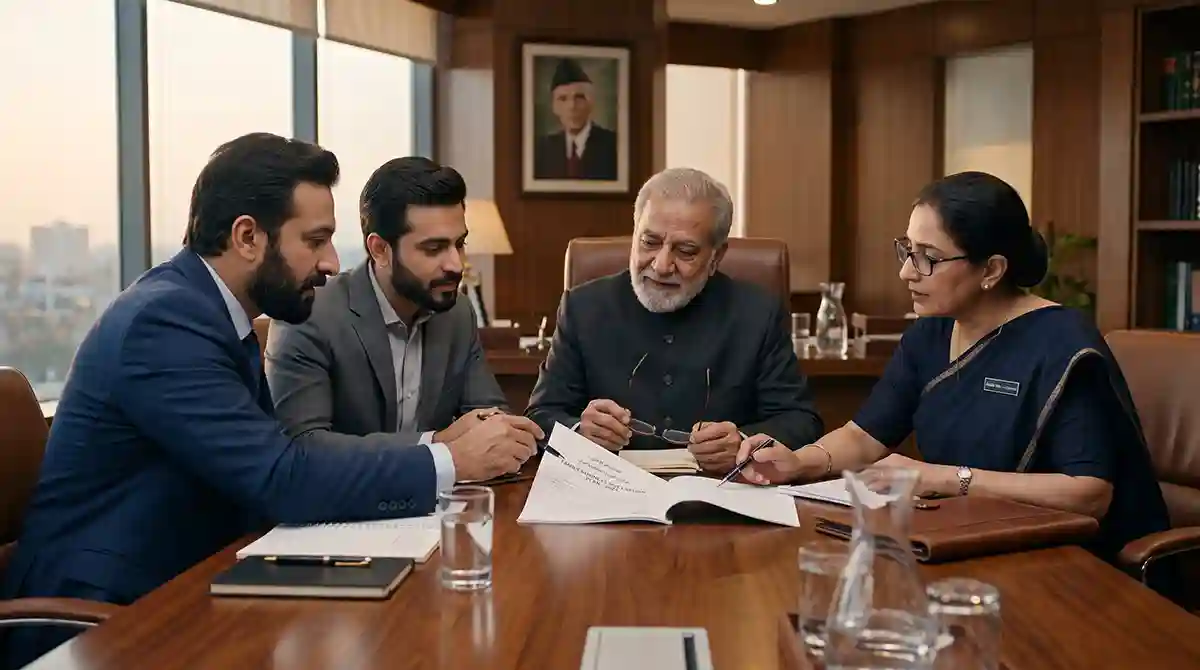
A textile trading family in Faisalabad I know of built a genuinely successful business over thirty years under its founding patriarch, who ran everything, ownership, banking relationships, supplier negotiations, from memory and instinct rather than any written structure. When he passed away suddenly, his three sons discovered the business had no shareholders’ agreement, no clarity on who was actually authorized to sign for the company, and no plan for who would lead it. What followed was not a smooth transition but eighteen months of family disputes that cost the business several of its largest clients before the brothers finally agreed on a working structure, one that could have existed years before the crisis forced it. This article guides you about business succession planning for family businesses in Pakistan.
This story is not unusual. A recent academic study examining ten Pakistani family-owned businesses across generational transitions found that proactive succession planning, formal governance mechanisms, and thorough successor training were the critical factors separating businesses that survived leadership transition smoothly from those that did not. This guide covers what that actually means in practice, and how it connects to, but is genuinely distinct from, the personal inheritance framework covered in the Wirasat article earlier in this series.
Table of Contents
Why This Matters More in Pakistan Than in Many Other Markets
Before I describe Business Succession Planning for Family Businesses in Pakistan, you need to understand why this matters more? Pakistan’s business landscape is genuinely shaped by its family and household structure in ways worth naming directly. Research on Pakistani succession dynamics notes that men head around 90 percent of Pakistani households, most families operate within a joint family system, and the elders of the family are traditionally treated with respect as wise decisionmakers, with male family members typically situated in the primary financial decision-making role.
This cultural context, combined with the fact that a substantial share of Pakistan’s private economy is genuinely family-owned and often operates informally for years before any formal corporate structure is put in place, creates a specific and recurring risk: businesses that are operationally sophisticated but structurally unprepared for the founder’s eventual death or incapacity.
The Critical Distinction: Personal Inheritance vs Business Continuity
This is the single most important concept in this entire guide, and it is where succession planning genuinely diverges from the personal inheritance framework covered in the Wirasat article in this series.
Wirasat, Islamic inheritance law, governs who legally inherits the deceased owner’s personal property, which for a business owner includes their shares or ownership stake in the company, following the fixed shares discussed in detail in that earlier article. This is a matter of religious and civil law that applies automatically upon death, regardless of what the deceased may have personally preferred.
What Wirasat does not automatically determine is who actually runs the business, makes operational decisions, or holds management authority the day after the owner dies. A daughter, a widow, or a minor grandchild may legally inherit a share of the company’s ownership under Wirasat, without that person having any operational role, experience, or even interest in running the business day to day. Confusing ownership succession with leadership succession, treating the person who inherits the largest ownership percentage as automatically the right person to lead the company, is precisely the assumption that produces the kind of dispute the Faisalabad family experienced.
Proper business succession planning addresses this gap directly, using tools that work alongside, not instead of, the Wirasat framework governing personal ownership.
The Tools That Actually Prevent Succession Disputes
Formal incorporation, rather than remaining an informal or sole proprietorship arrangement indefinitely, is the foundational step. As covered in the earlier articles on starting and registering a business in this series, incorporating as a private limited company, rather than continuing to operate as the founder’s personal sole proprietorship, creates a legal entity genuinely separate from any single individual, one that does not automatically dissolve or become legally ambiguous the moment its founder dies. Family businesses that operate informally for years, a pattern common enough in Pakistan that it is worth naming directly, are specifically the ones where incorporation becomes urgent precisely because it defines ownership, succession, management control, and liability in a way informal operation never does.
A Shareholders’ Agreement, drafted and signed while the founder is alive and of sound mind, is the single most important document most Pakistani family businesses never have. This agreement can specify exactly what happens to a shareholder’s stake upon death, including buy-sell provisions allowing remaining family shareholders the right of first refusal to purchase a deceased shareholder’s stake at a pre-agreed valuation method, preventing shares from passing, through Wirasat, to an heir who has no interest in remaining involved in the business and who might otherwise be free to sell their stake to an outside party or simply demand an immediate buyout the business cannot afford.
A written Wasiyat, within the one-third discretionary limit covered in detail in the Wirasat article in this series, can specifically address leadership succession in a way ordinary inheritance shares cannot. While the two-thirds of an estate governed by fixed Wirasat shares cannot be redirected, the founder’s discretionary third can be used, for example, to provide additional compensation to a specific family member being groomed to lead the business, addressing the practical reality that the person best suited to run the company and the person entitled to the largest inheritance share are not always the same individual.
Formal governance structures, including a properly constituted Board of Directors and, for larger family enterprises, a separate family council distinct from the company’s board, create a structure where business decisions are made through defined processes rather than through informal patriarchal authority that has no clear successor once the patriarch is gone. This is precisely the “formal governance mechanisms” factor the academic research on Pakistani family businesses identified as critical to successful transitions.
Deliberate, documented successor training, conducted over years rather than assumed to happen automatically, is the third critical factor identified in the same research. A successor who has genuinely worked through different functions of the business, built real relationships with key suppliers and clients, and been given increasing decision-making authority well before the founder’s actual departure is in a fundamentally different position than one thrust into leadership with no preparation the week after a funeral.
Why Clean Share Records Matter More Than Ever in 2026
This is a genuinely current and practically important development. SECP’s regulatory updates through 2026 have specifically tightened requirements around clean, verifiable ownership records in ways directly relevant to succession planning. Under S.R.O. 328(I)/2026, companies still maintaining physical share certificates are now required to convert those certificates into book-entry electronic form through the Central Depository Company of Pakistan, notifying shareholders and updating the company’s register of members accordingly. The updated Companies Regulations similarly reinforce the obligation to file and maintain accurate beneficial-ownership declarations, requiring companies, particularly those with more complex ownership structures, to verify the entire chain of ownership up to the natural persons who ultimately control the entity.
For a family business specifically, this regulatory push toward digitized, verifiable ownership records is genuinely useful groundwork for succession planning, not merely a compliance burden. A company whose share ownership is clearly, digitally recorded through CDC rather than existing as ambiguous physical certificates or informal family understanding is dramatically better positioned for a smooth ownership transition than one relying on paper records that can be lost, disputed, or simply never formally updated across decades of informal family arrangement, exactly the situation the Faisalabad family found itself untangling.
Practical Steps for a Pakistani Family Business Today
Assess your current legal structure honestly. If your business is still operating informally, without SECP incorporation, or as a sole proprietorship built around one individual’s personal identity, this is the foundational gap to close before any of the succession-specific tools below can genuinely function.
Draft a Shareholders’ Agreement while every current owner is alive and able to participate in the discussion, addressing buy-sell provisions, valuation methodology for a departing or deceased shareholder’s stake, and decision-making authority during any transition period.
Have the honest conversation about leadership, separate from ownership, ideally documented in some form even if informally at first, about who is genuinely being prepared to lead the business, and begin the deliberate training process the academic research identifies as critical, years before it becomes urgent.
Write a Wasiyat addressing your discretionary one-third specifically with business continuity in mind, working with both a lawyer and, where religious guidance is needed on the details, a qualified Islamic scholar, exactly as recommended in the Wirasat article in this series.
Ensure your company’s share records are properly digitized and current with CDC, both as a matter of 2026 regulatory compliance and as the practical foundation that prevents the kind of ownership ambiguity that turns a succession into a dispute.
Consider a family governance structure appropriate to your business’s size, whether a formal board with defined family and non-family member roles, or simply a documented, regularly held family meeting specifically addressing business matters separately from personal family discussions.
Common Mistakes Pakistani Family Businesses Make
Treating succession planning as a conversation to have “when the time comes” rather than proactively, years in advance. The academic research is specific and consistent on this point: proactive planning, not reactive crisis management after a death or incapacity, is what separates smooth transitions from disputed ones.
Assuming the largest inheritance shareholder is automatically the right business leader, conflating the Wirasat ownership framework with operational leadership capability, precisely the confusion this article opened by distinguishing.
Operating without a written Shareholders’ Agreement for years or decades, relying instead on informal family understanding that has no legal enforceability the moment a genuine disagreement arises among the next generation.
Never formally training or preparing a successor, assuming that family involvement in the business informally over the years is equivalent to genuine, deliberate leadership preparation.
Maintaining outdated or physical share records that do not reflect current SECP requirements, creating exactly the kind of ownership ambiguity that becomes a genuine legal problem the moment a succession event actually occurs.
In Summary
Business succession planning in Pakistan sits at the intersection of Islamic inheritance law, which the Wirasat article in this series covers in detail, and genuine corporate governance, which requires its own distinct set of tools: formal incorporation, a Shareholders’ Agreement, deliberate successor training, and, as of 2026, clean, digitized share records that meet SECP’s tightened compliance standards. Confusing the two, assuming that Wirasat alone resolves what happens to a business when its founder dies, is precisely the gap that turned the Faisalabad family’s thirty years of successful trading into eighteen months of disputes that cost them real clients and real money.
The businesses that survive generational transition are not the ones that avoided the difficult conversation about succession. They are the ones that had it early, documented the answers formally, and treated leadership preparation as a deliberate, years-long process rather than something that would simply sort itself out once it became necessary.
Further reading and official sources:
- Securities and Exchange Commission of Pakistan: company incorporation, shareholders’ rights, and beneficial ownership requirements: secp.gov.pk
- Journal of Family Business Management: “Exploring business succession dynamics in family-owned businesses: lessons from Pakistani case studies” (Shahzad, Akhlaq, Ghaffar, 2025)