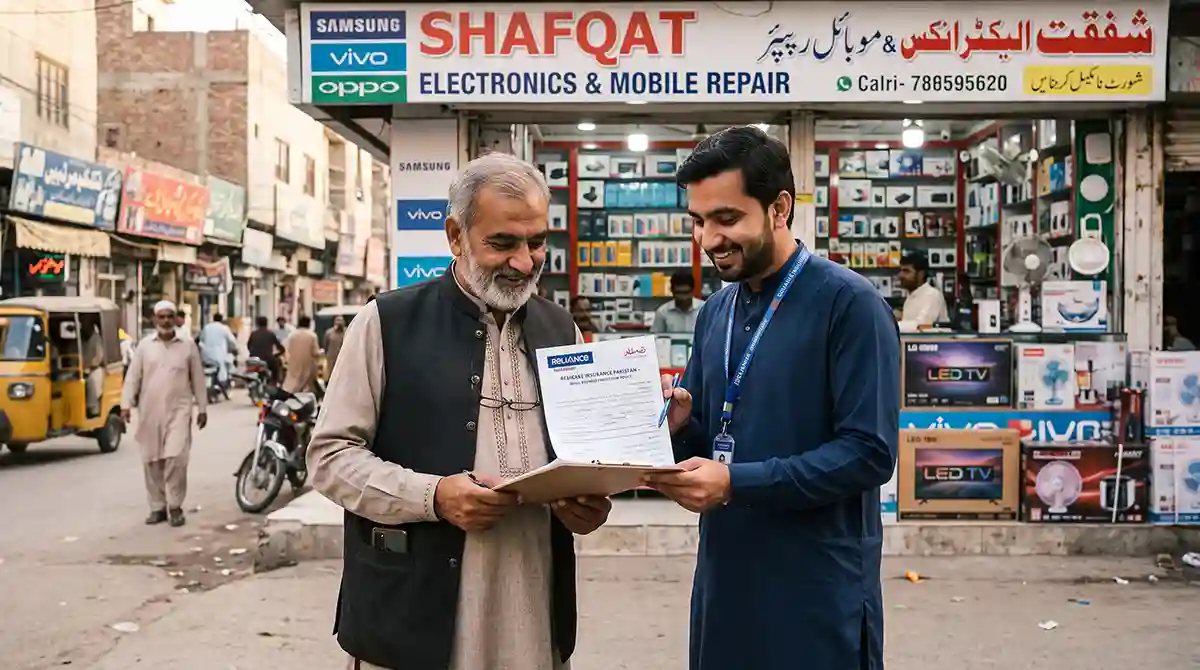
A small electronics retailer in Rawalpindi lost nearly his entire shop inventory in an electrical fire that started in the neighboring unit and spread before anyone could intervene. He had spent years building up his stock. He had no insurance policy of any kind, having assumed, like a great many Pakistani small business owners, that insurance was an expense reserved for large corporations with something genuinely valuable at stake. The fire did not distinguish between a large corporation and a small shopkeeper’s life savings tied up in inventory. This article helps you understand business insurance and takaful for SMEs in Pakistan in 2026.
Business insurance, and its Shariah-compliant equivalent, Takaful, remains one of the most under-adopted financial tools among Pakistani SMEs, despite being genuinely accessible and, for most small and medium businesses, considerably more affordable than owners assume. This guide covers the actual coverage types available, the real, named insurers and Takaful operators regulated to offer them in Pakistan, and how the Takaful alternative works structurally for business owners who want Shariah compliance without giving up meaningful protection.
Table of Contents
Why This Matters More Than Most Pakistani SME Owners Realize
It is important for you to know why this matters more than most Pakistani SME owners before you learn deep about business insurance and takaful for SMEs in Pakistan in 2026. Unlike a personal expense you can defer or reduce, a genuine business loss, a fire, a theft, a liability claim from an injured customer, or a lawsuit over property damage, does not wait for you to be financially ready for it. As covered in the business finance management article in this series, building a cash reserve helps absorb smaller shocks, but a fire that destroys an entire shop’s inventory, or a liability claim running into the millions, is precisely the kind of loss that even a well-managed reserve cannot realistically absorb on its own. Insurance and Takaful exist specifically to transfer that catastrophic-scale risk to an institution built to carry it.
The Core Types of Business Coverage Available in Pakistan
Fire and property insurance covers loss or damage to your business premises, inventory, furniture, fixtures, and equipment from fire, lightning, explosion, and related perils. This is the single most relevant policy type for any business operating from a physical shop, warehouse, or office, exactly the coverage the electronics retailer in the opening story lacked.
Liability insurance covers your legal responsibility for injury or property damage caused to third parties in connection with your business, whether a customer injured on your premises or damage your business activity causes to a neighboring property. For any business open to walk-in customers, this fills a genuine legal exposure gap that most owners never consider until a claim actually arises.
Marine and transport insurance covers goods in transit, whether raw materials arriving from a supplier or finished products being shipped to a customer or exported, and is particularly relevant for the import and export activity covered in the earlier articles on e-commerce logistics and exporting from Pakistan in this series.
Motor insurance covers business-owned vehicles, whether a delivery van, a company car, or a fleet used for a service business, against accident, theft, and third-party liability.
Group health and life coverage for employees has become an increasingly standard part of formal employment packages in Pakistan, connecting directly to the obligations covered in the hiring your first employee article in this series. While not universally legally mandated for every small employer, offering group health coverage is both a genuine employee retention tool and, for growing SMEs, an expectation increasingly set by more established competitors for talent.
Real, Regulated Insurers and Takaful Operators in Pakistan
All insurance and Takaful companies operating in Pakistan are licensed and supervised by the Securities and Exchange Commission of Pakistan under the Insurance Ordinance 2000, with minimum paid-up capital requirements set at PKR 300 million for a new non-life insurer or general Takaful operator, and PKR 500 to 700 million for life insurance or family Takaful operators, alongside a mandatory statutory deposit held with the State Bank of Pakistan. This is a genuinely capital-intensive, closely regulated sector, which is worth knowing before assuming any insurance offer you encounter is automatically legitimate.
| Company | Established | Notable Focus |
|---|---|---|
| EFU General Insurance | 1932 | Pakistan’s oldest private insurer; fire, engineering, marine, aviation, motor, plus Window Takaful since 2015; PSX-listed (EFUG) |
| Adamjee Insurance Company | 1960 | Largest general insurance company in Pakistan by market share; fire/property, marine, motor, accident, Window Takaful available |
| Jubilee General Insurance | Established player | Strong motor and general insurance presence; digital claims tools |
| Askari General Insurance (AGICO) | 1995 | SECP-regulated, PSX-listed general insurer |
| State Life Insurance Corporation | 1972 | Government-owned; Pakistan’s largest life insurer, also offers Takaful and group products |
| Pak-Qatar Family Takaful & Pak-Qatar General Takaful | Pioneer entrant | Pakistan’s first dedicated Takaful company; fully Shariah-compliant, owned by Qatar Insurance Islamic Company and Qatar International Islamic Bank |
How Takaful Actually Works, Structurally
As covered in the Sukuk and Islamic banking articles earlier in this series, Islamic finance replaces interest-based and uncertain (Gharar) contractual structures with models rooted in mutual cooperation and shared risk. Takaful applies this same logic to insurance.
Under a Takaful arrangement, participants (policyholders, in conventional terms) contribute to a common fund based on the Islamic principles of Ta’awun (mutual assistance) and Tabarru’ (a voluntary donation into the shared risk pool, rather than a premium paid to a for-profit insurer betting against you). When a participant suffers a covered loss, the claim is paid from this common Tabarru’ fund rather than from the operator’s own commercial reserves.
The Takaful operator itself typically manages the fund on a Wakalah (agency) basis, charging a disclosed management fee for administering the pool rather than earning profit from underwriting risk against participants in the conventional insurance sense.
A genuinely instructive piece of regulatory history worth knowing: when SECP first introduced its Takaful Rules 2012, permitting conventional insurance companies to open dedicated Window Takaful operations alongside their existing conventional business, the established, dedicated Takaful operators pushed back hard, arguing this would dilute and distort the still-young Islamic insurance market. The resulting legal dispute reached the Sindh High Court, which issued a stay order blocking implementation for roughly two years before an out-of-court settlement between conventional and dedicated Takaful players finally allowed conventional insurers, including EFU and Adamjee, to launch their own Window Takaful operations. This dispute mirrors, almost exactly, the tension between full-fledged Islamic banks and Islamic banking windows discussed elsewhere in this series, the same underlying question of whether a “window” model genuinely delivers the same Shariah integrity as a dedicated, purpose-built institution.
What Actually Determines Your Premium (or Contribution)
Rather than a fixed, publishable cost, every Pakistani insurer and Takaful operator prices SME coverage based on a combination of specific risk factors, and this is worth understanding before you request a quote so you can present your business accurately and get a realistic figure back.
The value and nature of what you’re insuring is the primary driver; a shop carrying PKR 5 million in electronics inventory in a busy commercial market carries a different risk profile than a small home-based tailoring business with modest equipment.
Your industry’s inherent risk level matters significantly; a business handling flammable materials or operating heavy machinery is priced differently from a low-risk professional services office.
Your location and building construction affect fire and property risk assessment, since a shop in a densely packed market with older wiring carries different underwriting risk than a newer, better-maintained commercial building.
Your claims history, if your business has been previously insured, directly affects the rate you are offered, exactly as a clean driving record affects motor insurance pricing.
The specific coverage limits and deductibles you choose trade off directly against your premium; a higher deductible (the amount you absorb yourself before the insurer pays out) generally lowers your premium, a genuinely useful lever for a small business trying to balance cost against protection.
Because these factors vary so significantly between businesses, the only reliable way to know your actual cost is to request a direct quote from at least two or three licensed insurers or Takaful operators, comparing not just the headline premium but the specific coverage limits, exclusions, and deductible structure of each.
How to Verify an Insurer Before You Buy
Given how capital-intensive and closely regulated this sector is meant to be, verifying that a company offering you insurance or Takaful is genuinely licensed is a straightforward and important first step, echoing the same verification discipline covered in the investment scam checklist earlier in this series. The Central Depository Company of Pakistan maintains a centralized industry information-sharing platform listing SECP-licensed insurance and Takaful companies operating in the market, and SECP’s own official registry provides the definitive confirmation of any specific company’s current licensing status.
Common Mistakes Pakistani SME Owners Make
Assuming insurance is only relevant once a business has grown large enough to “need” it. As the electronics retailer’s story shows, a catastrophic fire or theft loss does not scale down its impact simply because a business is small; if anything, a small business has proportionally less reserve capacity to absorb an uninsured loss than a large corporation does.
Buying the cheapest available policy without checking the actual coverage limits and exclusions. A policy priced attractively low but carrying a coverage cap far below your actual inventory or property value leaves you significantly underinsured in exactly the scenario you bought the policy to protect against.
Not disclosing accurate information about the business when requesting a quote. Underreporting inventory value or business activity to secure a lower premium can result in a claim being reduced or denied entirely if the insurer discovers the discrepancy at the time of loss.
Treating a Window Takaful product and a dedicated Takaful operator’s product as automatically identical without checking the specific Shariah governance behind each, an important nuance given the historical dispute described above; both are regulated and permitted, but a business owner for whom Shariah compliance matters deeply should ask directly about the specific Shariah Board and Wakalah fee structure of the exact product being offered.
Never reviewing or updating coverage as the business grows. A policy sized for a business’s inventory and risk profile from several years ago may leave a now-larger, more valuable business significantly underinsured; reviewing coverage annually, alongside the broader annual financial review covered in the business finance management article in this series, keeps protection aligned with actual current exposure.
Conslusion
Business insurance and Takaful in Pakistan are neither prohibitively expensive nor reserved for large corporations; they are regulated, accessible financial products offered by well-established, decades-old institutions including EFU, Adamjee, Jubilee, and Pak-Qatar, priced according to your business’s actual risk profile rather than a fixed, one-size-fits-all rate. For a business owner for whom Shariah compliance matters, the Takaful structure, built on mutual assistance and a transparent Wakalah fee rather than conventional risk-based underwriting profit, provides a genuinely equivalent path to the same protection.
The cost of a modest annual premium or Takaful contribution is, for almost every small business, a small fraction of what a single uninsured fire, theft, or liability claim could cost. The electronics retailer in the opening story rebuilt his shop, slowly, out of pocket. A policy costing a fraction of his eventual loss would have meant a claim, not a years-long recovery.
Further reading and official sources:
- Securities and Exchange Commission of Pakistan: Insurance Ordinance 2000 and licensed insurer registry: secp.gov.pk
- Central Depository Company of Pakistan: Centralized Information Sharing Solution for Insurance Industry (CISSII): cdcpakistan.com