
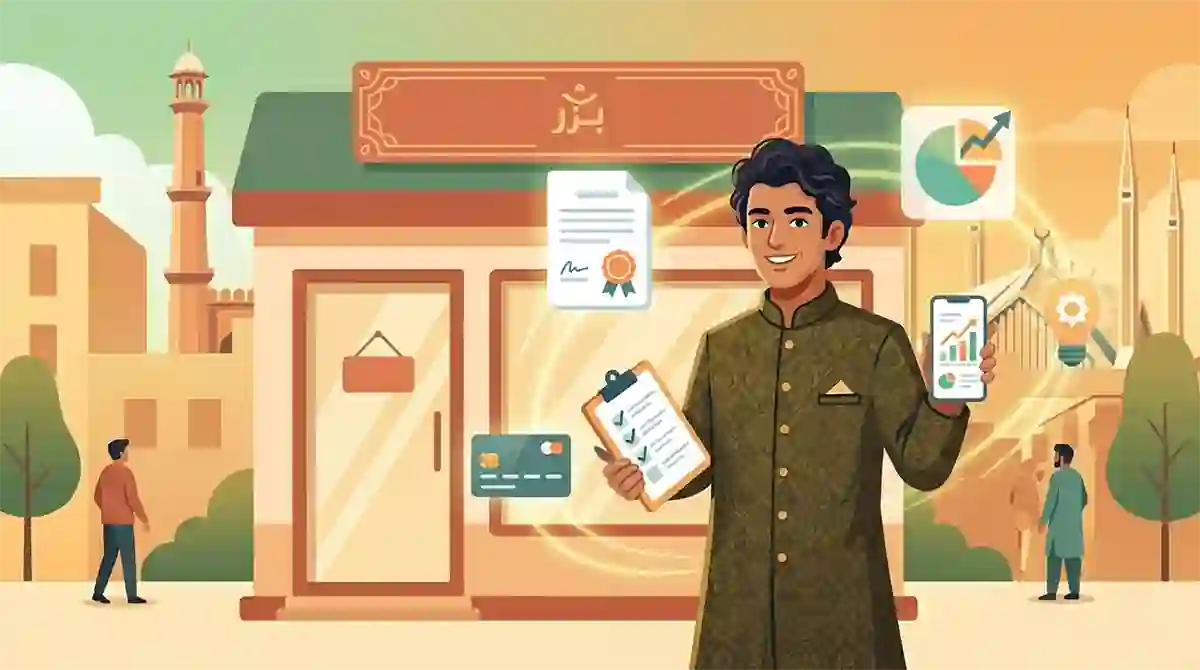
My uncle ran a small general store in a busy street in Lahore for over two decades. He never registered it anywhere, never had a separate business account, never wrote a single business plan. He just started, figured things out as he went, and made a decent living. That model worked for his generation. Therefore, in this article you’ll learn how to start a small business in Pakistan in 2026.
When a younger cousin of mine tried to start a similar business a few years ago, he did the same thing. No registration, no planning, no structure. Within 18 months, the business was struggling badly. Not because the idea was wrong or the location was bad, but because he had no clear picture of his costs, his margins, or where his cash was actually going. He mixed personal and business money, had no paper trail for anything, and when he needed a small loan to buy more inventory, no bank would touch him because he had nothing to show them.
Same city, same type of business, two very different outcomes. The difference was not luck or talent. It was structure.
Starting a small business in Pakistan in 2026 is genuinely more accessible than it has ever been. There are more support systems, more digital tools, more market access, and more financing options available than your parents or grandparents ever had. But the bar for doing it properly has also gone up. This guide is about doing it properly.
Start With the Right Mindset, Not Just an Idea
Most people think starting a business begins with the idea. It actually begins with an honest conversation with yourself.
Running a business, even a small one, is fundamentally different from having a job. There is no guaranteed monthly salary at the end of the month. There are periods when revenue is thin and expenses are not. Every problem that arises is your problem to solve because there is no manager above you to escalate it to. The stress is real, the uncertainty is real, and the early months can test your resolve in ways that are hard to anticipate.
None of this is meant to discourage you. Millions of Pakistanis run successful small businesses and build genuinely good lives through them. But the ones who last are almost always the ones who went in with realistic expectations rather than the assumption that passion alone is enough.
Ask yourself honestly: do you have some financial cushion to cover your personal expenses for at least six months while the business gets off the ground? Are you prepared to work harder in the first year than you ever have in a job? Can you handle uncertainty without it affecting your judgment? If your honest answers are yes, you are in a reasonable position to start.
Read more: Risk and Return in Investing: What Every Beginner Must Know
Validate Your Idea Before You Invest
One of the most expensive mistakes new business owners make in Pakistan is investing heavily before they have confirmed that anyone actually wants what they are selling.
Validation does not have to be complicated or expensive. It just means testing your idea with real potential customers before committing serious money.
If you want to start a food business, cook your product and sell it to neighbors, colleagues, or through a WhatsApp group before renting a shop. If you want to offer a service, find two or three clients and complete real paid work before building a full setup. If you want to sell products, try selling a small batch before placing a large inventory order.
The feedback you get from these early attempts is more valuable than any amount of planning done in isolation. Real customers will tell you things about your product, your pricing, and your pitch that you simply cannot figure out on your own. And if the idea does not gain traction even at a small scale, it is far better to discover that before you have invested your savings into it.
Choose the Right Business Structure
In Pakistan, you have a few main options for how to legally structure your business. The right choice depends on the size and nature of what you are starting.
Sole Proprietorship
This is the simplest and most common structure for small businesses in Pakistan. You operate the business in your own name, there is no formal registration with SECP required, and you are personally liable for all business debts and obligations.
For a small local business, a freelancer, a home-based operation, or a trader, sole proprietorship is often the most practical starting point. You will still need an NTN from the Federal Board of Revenue and should register with your local tax office, but the process is relatively straightforward.
The downside is unlimited personal liability. If the business runs into debt, your personal assets are not legally protected.
Private Limited Company
Registering a private limited company through the Securities and Exchange Commission of Pakistan gives your business a separate legal identity from you as an individual. The company can own assets, enter contracts, and take on liabilities in its own name. Your personal liability is generally limited to your investment in the company.
This structure is more appropriate if you have partners, plan to seek outside investment, want to work with larger corporate clients who prefer dealing with registered entities, or have plans to scale significantly.
The registration process is done through SECP’s online portal and is more involved than a sole proprietorship, but the protections and credibility it provides are worth it for businesses beyond the micro level.
Partnership
If you are starting a business with one or more partners, a formal partnership agreement is important even if you are close friends or family members. It spells out each partner’s contribution, profit share, decision-making authority, and what happens if one partner wants to exit. Many business partnerships in Pakistan fall apart not because the business fails but because the terms were never clearly agreed upfront.
Learn more: Difference between Islamic Banking vs Conventional Banking
Get Your Tax and Legal Basics in Order
This is the part many small business owners in Pakistan skip and then regret later. Getting your basics right early saves enormous headaches down the road.
Register for NTN
Every business in Pakistan should have a National Tax Number from the Federal Board of Revenue. Registration is now done online through the FBR’s IRIS portal. It is free, relatively simple, and opens the door to formal banking, government contracts, and a range of other business activities that require proof of tax registration.
Being a registered filer also has practical financial benefits in Pakistan. Filers pay lower withholding tax rates on banking transactions, vehicle purchases, and property deals than non-filers. As a business owner, these savings add up.
Open a Separate Business Bank Account
This is non-negotiable if you want to run a sustainable business. Mixing personal and business money is one of the most common reasons small businesses in Pakistan fail to grow or get access to financing.
A dedicated business account gives you a clean record of your business income and expenses. It makes tax filing dramatically simpler. It is required by most banks if you ever want a business loan. And it forces a discipline of treating your business as a separate financial entity rather than an extension of your personal wallet.
Keep Basic Records From Day One
You do not need expensive accounting software to start. A simple spreadsheet that tracks money coming in and money going out is enough in the early days. Record every sale, every expense, every supplier payment, every refund. This habit, started from the very first transaction, will save you enormous stress at tax time and give you a clear picture of whether your business is actually profitable.
Understand Your Numbers
Many people who start businesses in Pakistan are passionate about their product or service but deeply uncomfortable with the financial side. This gap between passion and financial literacy is where many small businesses quietly die.
You do not need to be an accountant. But you do need to understand a few basic concepts.
Revenue vs Profit
Revenue is the total money coming into your business from sales. Profit is what is left after you subtract all your costs. A business can generate impressive revenue and still be losing money if the costs are not controlled. Always know your actual profit margin, not just your sales figures.
Fixed vs Variable Costs
Fixed costs are expenses you pay regardless of how much you sell. Rent, utilities, any salaries you pay, loan repayments. Variable costs change with your volume of sales. Raw materials, packaging, delivery costs. Knowing which costs are fixed and which are variable helps you understand your break-even point, the minimum amount you need to sell each month just to cover your expenses.
Cash Flow
A business can be profitable on paper but still run out of cash if the timing of income and expenses is misaligned. If your customers pay you 30 days after delivery but you have to pay your suppliers upfront, you can face a cash squeeze even in a month where you made good sales. Understanding your cash flow cycle and planning for it is one of the most practical financial skills a small business owner can develop.
Build Your Market Presence Practically
In 2026, not having any online presence for your business is a meaningful competitive disadvantage even for small local businesses in Pakistan.
The basics are free and accessible to anyone. A Facebook page and an Instagram account cost nothing to create and can be set up in under an hour. A WhatsApp Business account allows you to present your products professionally, manage customer inquiries, and maintain a broadcast list for updates and promotions.
For product-based businesses, platforms like Daraz, OLX, and Instagram shops have given millions of small sellers in Pakistan access to a national customer base without the cost of a physical storefront.
You do not need a website on day one. But you do need some form of digital presence where potential customers can find you, see what you offer, and contact you. Start simple, stay consistent, and build from there.
Common Mistakes That Sink New Businesses in Pakistan
Starting too big too soon. Renting a large shop, hiring staff, buying expensive equipment before the business has any proven revenue is a pattern that ends badly more often than not. Start lean, prove the concept, then scale.
Underpricing to attract customers. Many new business owners in Pakistan price their products or services too low because they are afraid of losing customers to competitors. This leads to thin margins, exhaustion, and an unsustainable business. Price for profit, not just for volume.
Relying on one big customer or one revenue stream. If a single client accounts for 80% of your revenue and they leave, your business is in crisis overnight. Diversify your customer base as early as possible.
Ignoring taxes until it becomes a problem. FBR has significantly increased its monitoring of business transactions in recent years. Staying compliant from the beginning is far less painful than dealing with penalties and back taxes later.
Trying to do everything alone for too long. There is a difference between staying lean and refusing to delegate anything. As the business grows, the founder’s time becomes the scarcest resource. Learning to hand off tasks, even informally at first, is a skill worth developing early.
What 2026 Offers That Earlier Generations Did Not Have
Starting a business in Pakistan right now comes with genuine advantages that are worth acknowledging.
Digital payments through Raast, JazzCash, and EasyPaisa have made it easier than ever to collect money from customers anywhere in the country without a physical presence. Freelancing platforms have created export income opportunities for individuals with skills in technology, design, writing, and marketing. Government initiatives and incubation programs through organizations like SMEDA, NAVTTC, and various provincial governments offer training, support, and in some cases seed funding for new entrepreneurs.
The market has also evolved. Pakistani consumers are increasingly comfortable buying online, paying digitally, and engaging with small businesses through social media. The infrastructure that your customers use is better than it has ever been.
None of this guarantees success. But the tools available to a small business owner in Pakistan in 2026 are genuinely more powerful than anything that existed a decade ago.
Key Takeaways
Starting a small business in Pakistan is not easy. Anyone who tells you otherwise is either very lucky or not being honest with you. There will be slow months, difficult customers, unexpected costs, and moments when you seriously question whether it is worth it.
But there is also something that a regular job rarely gives you: the direct connection between your effort and your outcome. Every sale you make, every customer you retain, every problem you solve builds something that is yours.
The people who succeed at this are not necessarily the most talented or the best funded. They are usually the most consistent, the most willing to learn from mistakes, and the most honest with themselves about what is working and what is not.
Start small, start properly, and give yourself the best possible foundation to build on.











Just amazing. I thought it was so thought but you explained it well.
Pleasure all mine.
What a great idea. I will soon start my business. This really help me.
Sir, you have written absolutely wonderfully. This is clear, understandable, and practiceable.