By the end of June 2026, the State Bank of Pakistan counted 3,836,522 QR-enabled merchants registered with banks. A shop that still takes only cash is now the exception on the street, and customers who carry a phone and not a wallet notice. If you want to accept digital payments in Pakistan, the real questions are which method to use, what each one costs you, and how quickly the money reaches your account. So here I will explain how to accept digital payments in Pakistan as a small business.
This guide compares the four main ways a small business can get paid digitally: Raast QR, wallet business accounts, card POS terminals, and online payment gateways. It uses current published fees where I could find them, flags the figures I could not verify, and shows what each option costs on a PKR 1 million month of sales. Fees change often, so treat every number here as a starting point for your own quote.
Table of Contents
The Four Options at a Glance
As a business owner you must know how to accept digital payments in Pakistan and for this you need to know the four options at a glance:
| Option | Best For | Customer Needs | What It Costs You (as found) | Settlement |
|---|---|---|---|---|
| Raast QR | Shops, kiosks, home businesses, service providers | Any bank or wallet app that scans Raast QR | 0% to 0.25% depending on provider | Real time, or on terms agreed with the provider |
| Wallet business account (JazzCash, Easypaisa) | Kiryana stores, small shops, sellers whose customers use wallets | A wallet, or a Raast-capable app | JazzCash lists 0.25% on Raast QR and till payments; wallet-to-merchant fees are higher | Real time into the account at JazzCash |
| Bank card POS terminal | Retailers with card-paying customers | A debit or credit card | Set by your acquiring bank; I did not find a verified current rate | Set by your bank |
| Online payment gateway | Online stores | Cards, wallets, or Raast at checkout | Roughly 2% to 3.5% for cards and wallets in third-party guides; Raast lower | T+1 to 5 business days, depending on the provider |
Raast QR: The Cheapest Way to Start
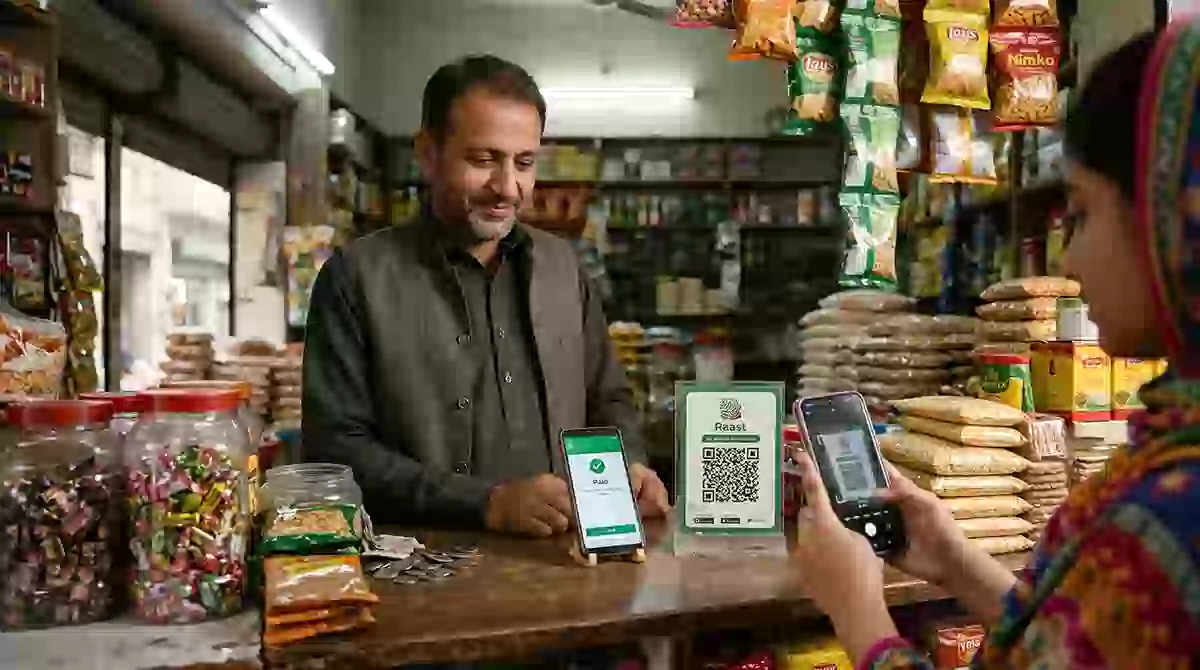
Raast is the State Bank’s instant payment system. Its person-to-merchant service, launched in December 2023, lets a business accept payments by QR code, request to pay, IBAN, or merchant alias, straight from the customer’s bank account. Under the SBP’s instructions, customers are not charged a fee for paying a merchant.
What it costs the merchant. SBP’s circular allows providers to charge merchants a reasonable fee and encourages them to waive it. Bank Alfalah states a merchant discount rate of 0 percent on Raast. JazzCash’s schedule of charges for October to December 2026 lists a 0.25 percent rate, including federal excise duty, on Raast QR and till payments. A secondary summary of an SBP circular on a QR subsidy describes a merchant charge of up to 0.25 percent and a government subsidy for payments between 1 September 2025 and 30 June 2026, with no extension found after that date. I could not check the circular itself, so confirm your own provider’s current rate.
Settlement. JazzCash says Raast QR money lands in a business account in real time. SBP allows real-time credit or terms agreed with the merchant, and an older Bank Alfalah page mentioned a next-day cycle, so ask which one applies to you.
How to start. Ask your bank or a wallet provider for a Raast merchant QR, supply your CNIC or business documents, and place the printed code at your counter. Customers can pay from participating banking apps and from wallets including Easypaisa and JazzCash.
Wallet Business Accounts: The Easiest Setup
A JazzCash Business account is free to open with a CNIC and is aimed at small shops and home businesses that want QR payments without a branch visit. According to the schedule of charges that took effect on 1 October 2026 and runs to 31 December 2026, a customer paying you from within the JazzCash account costs you 0.75 percent, and a Raast QR or till payment costs 0.25 percent. Sending money to another JazzCash account is free.
Easypaisa offers comparable merchant accounts, but I did not find a verified current rate. Third-party estimates for wallet-based gateway fees range from 1.5 to 3 percent, and one guide notes that the actual rate is set in your agreement.
The practical advantage is speed. A wallet account needs no POS hardware and settles in real time, so it works well for a kiryana store or a market stall.
Card POS Terminals
A bank POS terminal lets customers pay by debit or credit card. The merchant discount rate depends on your acquiring bank and card type, and I did not find a verified current rate, so ask the bank for the rate by card type and for the settlement time. Also ask what the terminal and monthly service cost.
One check before you buy. As the FBR POS integration article in this series explains, the statutory Tier-1 definition in FBR’s 2025 booklet included retailers that had acquired card machines. Secondary reports say the Finance Act 2026 removed that category, but I could not verify it. If you are a retailer, confirm your Tier-1 status before installing a terminal, since the answer changes your invoicing duties.
Online Payment Gateways
An online store needs a gateway that connects checkout to your bank account. Published and third-party figures from late 2026 include:
| Provider or Type | What Is Reported |
|---|---|
| Safepay | Accepts cards, JazzCash, Easypaisa, and Raast; onboarding requires business documents and a review |
| PayFast | A published Raast QR rate of 0.60 percent, described as the lowest published figure in one comparison |
| JazzCash and Easypaisa merchant accounts | Roughly 1.5 to 3 percent in third-party guides; settlement 3 to 5 business days in one guide |
| Gateways generally | MDR of roughly 2 to 3.5 percent, sometimes negotiable with volume; settlement T+1 to T+5 |
These ranges conflict, so get your rate and settlement time in writing. A comparison guide made a useful point: the right gateway is not necessarily the one with the lowest published fee, but the one that matches how your customers prefer to pay and integrates reliably with your platform, whether Shopify or WooCommerce.
Digital payment also helps with a problem covered in the e-commerce logistics article in this series. Cash on delivery ties up your money with the courier and drives return-to-origin losses, so every order paid upfront improves your cash flow.
What It Costs on PKR 1,000,000 of Monthly Sales
These are illustrative fee levels from the figures above, not quotes.
| Payment Method and Rate | Monthly Fee on PKR 1,000,000 |
|---|---|
| Raast QR at 0% | PKR 0 |
| Raast QR at 0.25% | PKR 2,500 |
| Raast QR at 0.60% (PayFast’s published rate) | PKR 6,000 |
| JazzCash customer-to-merchant at 0.75% | PKR 7,500 |
| Wallet or card gateway at 2% | PKR 20,000 |
| Wallet or card gateway at 3% | PKR 30,000 |
| Gateway at 3.5% | PKR 35,000 |
A shop example. A shop with PKR 1,500,000 in monthly sales gets 40 percent, PKR 600,000, through digital payments. At 0.25 percent on Raast QR the fee is PKR 1,500. At 2 percent on cards the same PKR 600,000 costs PKR 12,000. Steering customers toward QR can save a shop PKR 10,500 a month in this example, and the QR code costs nothing to display.
Protect Yourself from Payment Fraud
Digital payments create a new risk: the fake confirmation. A customer shows a screenshot of a transfer that never happened, or an edited receipt. Never release goods on a screenshot. Confirm the payment in your own banking or wallet app, or through the notification from your provider. The banking fraud article in this series covers how to protect your own account, and the same habit applies here.
Keep your merchant credentials private, use a separate account for the business, and reconcile your daily takings against your provider’s statement.
A Practical Setup Plan
- Look at your customers. Do they use bank apps, wallets, or cards?
- Start with Raast QR or a wallet business account, since both are low-cost and quick to set up.
- Ask each provider for the rate, settlement time, and transaction limits in writing.
- Display the QR code clearly and train staff to verify payments in the app.
- Add a gateway only if you sell online, and compare at least two.
- Reconcile daily, and keep the statements, since a digital sales record supports tax filing and loan applications, as the business bank account and business loan articles in this series describe.
Common Mistakes
Choosing by the lowest published fee alone. Customer preference and reliable integration matter as much.
Trusting screenshots. Verify every payment in your own app.
Not asking about settlement time. Real time and T+3 are very different for your cash flow.
Assuming a promotional rate lasts. The Raast subsidy period ended on 30 June 2026 unless an extension was issued, and JazzCash’s schedule applies only to October to December 2026.
Installing a card machine without checking the FBR implications. Tier-1 status carries invoicing duties and penalties.
Mixing personal and business money in one wallet. It muddies your records and your tax picture.
Ignoring transaction limits. Limits differ by provider, so check them before a large sale.
Summing Up
For most small businesses in Pakistan, the best way to start accepting digital payments is a Raast QR through a bank or a wallet business account. It costs between nothing and a fraction of a percent on the figures I found, settles quickly, and customers already have the apps to pay it. Card POS terminals and online gateways cost more, so add them when your customers or your channel require them.
Before you sign anything, get three things in writing: the fee, the settlement time, and the limits. And whatever method you choose, check payments in your own app. Fees move every quarter, so revisit the comparison once a year.
Further reading and official sources:
- State Bank of Pakistan, Raast and payment systems information: sbp.org.pk
- JazzCash, schedule of charges for the JazzCash Business account: jazzcash.com.pk
- Bank Alfalah, Raast P2M QR merchant information: bankalfalah.com