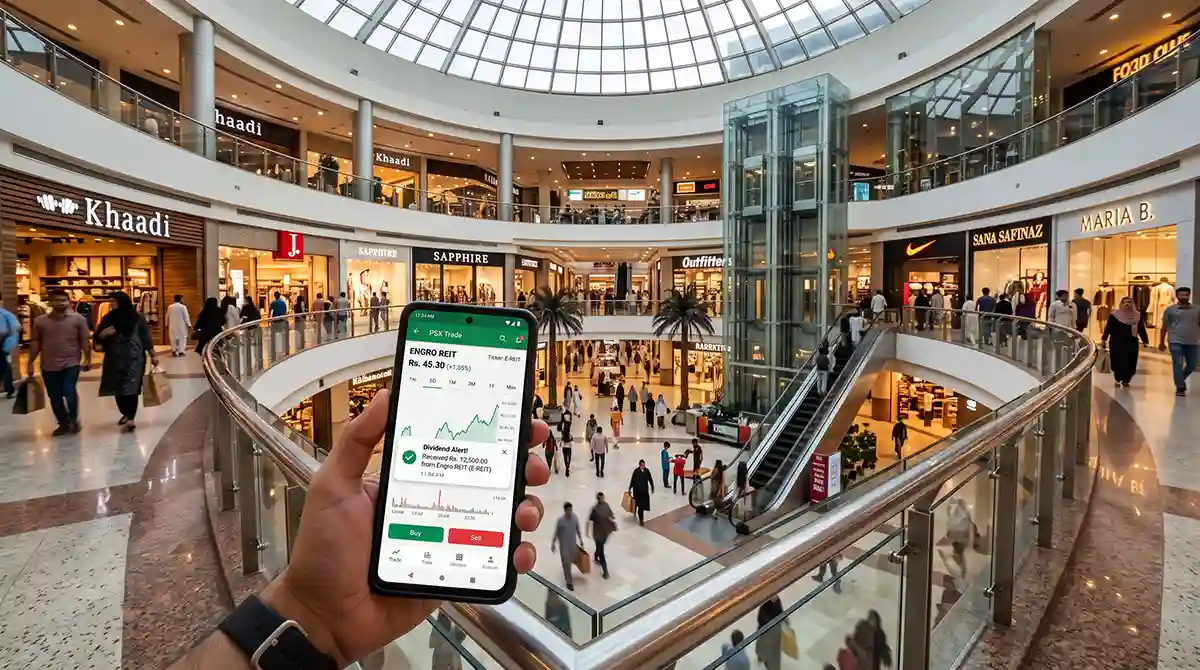
A relative of mine spent years wanting exposure to Karachi’s commercial property boom without the capital, management burden, or illiquidity that direct property ownership requires, the exact trade-off covered in the real estate investment article earlier in this series. What he eventually discovered is that he could own a small slice of one of Pakistan’s most successful shopping malls, Dolmen Mall Clifton, for the price of a few PSX-listed units, receiving rental income as regular dividends without ever having to manage a tenant, chase rent, or handle a maintenance call. Here you will learn about real estate investment trusts (REITs) in Pakistan in 2026.
This is the genuine promise of Real Estate Investment Trusts in Pakistan, and it has moved from a theoretical concept to an active, growing part of the PSX market. This guide covers exactly how Pakistan’s REIT structure works, the real, named REITs currently trading, and a worked comparison of what REIT ownership actually delivers against direct property investment.
Table of Contents
What a REIT Actually Is and How Pakistan’s Framework Evolved
A REIT Scheme in Pakistan is a listed, closed-end fund that pools investor capital to own, develop, or lease real estate, distributing the resulting rental income or development profit to unit holders as dividends. Rather than buying an entire building yourself, you buy units representing a proportional share of a professionally managed real estate portfolio.
Pakistan’s REIT regulatory framework was first introduced by SECP in January 2008, subsequently repealed and replaced by the REIT Regulations 2015, and further updated under the REIT Regulations 2022, the current governing framework. Central Depository Company of Pakistan Limited (CDCPL) acts as the trustee for every REIT scheme in Pakistan, a structural safeguard ensuring the underlying assets are held independently of the REIT Management Company that runs day-to-day operations, similar in spirit to the fund custody arrangements covered in the mutual fund investing article in this series.
The Three Types of REIT Schemes in Pakistan
Developmental REITs invest in real estate specifically to develop it, whether through new construction or refurbishment, for industrial, commercial, or residential purposes. Investors in a developmental REIT are essentially financing a construction project and sharing in the eventual value created once it is completed and sold or leased.
Rental REITs invest in already-existing commercial or residential real estate specifically to generate ongoing rental income, which is then distributed to unit holders as dividends. This is the model closest to traditional buy-to-let property investment, minus the direct management responsibility.
Hybrid REIT schemes combine both elements, holding an existing portfolio of income-generating buildings alongside land or projects still under development, giving unit holders exposure to both current rental income and future development upside within a single scheme.
A notable structural rule worth knowing: SECP requires every REIT to achieve public listing on PSX within three years of its inception, ensuring that what begins as a privately held real estate scheme genuinely opens up to ordinary retail investors within a defined timeframe rather than remaining permanently closed to the public.
The Real, Named REITs Trading on PSX Today
As of early 2026, five REIT schemes are listed on PSX, and the roster includes both established, income-generating rental REITs and newer developmental schemes.
| REIT | Type | Key Details |
|---|---|---|
| Dolmen City REIT (PSX: DOLM) | Rental, Shariah-compliant | Pakistan’s first REIT, established 2015; owns Dolmen Mall Clifton (~1 million sq ft, 130+ retail outlets, over 90% occupancy) and The Harbor Front; trading around PKR 39 in August 2026 with a dividend yield of approximately 6.64% |
| Globe Residency REIT (GRR) | Developmental | Approximately 400 residential apartments near Naya Nazimabad, Karachi; Meezan Bank holds a 50% Musharakah stake contributing roughly Rs 1.5 billion toward land acquisition and construction |
| Signature Residency REIT (SRR) | Developmental, Shariah-compliant | Fifth PSX Main Board listing of FY2025-26, and the second REIT IPO that fiscal year; 8.25 million units (25% of the total) offered to the public |
All three are managed by Arif Habib Dolmen REIT Management Limited (AHDRML), a joint venture between Arif Habib Group and the Dolmen Group incorporated in 2009 as Pakistan’s first dedicated REIT management company, licensed by SECP as a Non-Banking Finance Company under the NBFC Rules 2003. AHDRML’s dominant position in Pakistan’s still-young REIT market is itself a useful piece of context: the sector currently has relatively few management companies actively bringing new schemes to market, which is one of the reasons growth, while genuine, has been gradual rather than explosive.
The 90% Distribution Requirement
As covered in the passive income portfolio article in this series, PSX-listed REITs are required to distribute at least 90 percent of their net income to unit holders, a rule that gives REIT investing its core income-generating character. This is precisely why Dolmen City REIT’s business model, collecting rent from a fully operational, high-occupancy shopping mall and passing the overwhelming majority of that income straight through to unit holders, produces a dividend yield you can compare directly against other income-generating investments discussed throughout this series, from PSX dividend stocks to Sukuk profit distributions.
A worked example using Dolmen City REIT’s actual figures: an investor purchasing PKR 500,000 worth of DOLM units at approximately PKR 39 per unit acquires roughly 12,820 units. At the reported dividend yield of 6.64 percent, this position would generate approximately PKR 33,200 in annual dividend income, distributed from the mall’s actual rental collections, before any withholding tax is applied. This income arrives without the investor ever negotiating a lease, chasing a late-paying tenant, or funding a single rupee of mall maintenance themselves, precisely the administrative burden direct commercial property ownership carries.
REIT vs Direct Property: A Practical Comparison
| Factor | REIT (e.g., Dolmen City REIT) | Direct Property Ownership |
|---|---|---|
| Minimum investment | Price of a single unit (a few thousand rupees) | Typically several million rupees for meaningful commercial exposure |
| Liquidity | Tradeable on PSX during market hours, like any listed stock | Illiquid; a sale can take months to complete |
| Management responsibility | None; handled by the REIT Management Company | Direct, ongoing (tenants, maintenance, disputes) |
| Diversification | Exposure to a professionally selected portfolio | Concentrated in a single property |
| Transaction costs | Standard PSX brokerage commission | Stamp duty, registration, agent commission, as covered in the real estate investment article in this series |
| Transparency | Regulated financial disclosures, published NAV and dividend history | Valuation is subjective and market-dependent |
| Income distribution | Minimum 90% of net income by regulation | Entirely dependent on the owner’s own rent collection and tenant management |
How to Actually Buy REIT Units
Buying REIT units works exactly like buying any other PSX-listed stock, using the same CDC-linked brokerage account covered in detail in the stock brokerage account article earlier in this series. Search for the REIT’s ticker symbol, such as DOLM for Dolmen City REIT, through your broker’s trading platform, review the current unit price and recent dividend history, and place a buy order the same way you would for any blue-chip stock.
For investors specifically seeking Shariah compliance, it is worth checking each REIT’s own certification directly, since Dolmen City REIT and Signature Residency REIT are both explicitly structured as Shariah-compliant schemes, with all underlying rental and marketing income activities certified as conducted in accordance with Islamic principles.
Common Mistakes Pakistani Investors Make With REITs
Treating a developmental REIT like a rental REIT and expecting immediate dividend income. A developmental scheme like Globe Residency REIT or Signature Residency REIT is financing construction that has not yet been completed; meaningful distributions typically begin only once the underlying project is finished and generating income or has been sold, unlike an established rental REIT such as Dolmen City REIT which is already collecting rent from an operating mall.
Comparing a REIT’s dividend yield to a bank fixed deposit rate without accounting for capital risk. Unlike a fixed deposit’s government or bank-backed principal protection, a REIT’s unit price fluctuates with the underlying property’s performance and broader market sentiment, meaning both the yield and the unit price itself can move, in either direction, over time.
Ignoring occupancy and tenant concentration data before investing. Dolmen Mall Clifton’s over 90 percent occupancy rate, anchored by established brands, is a meaningful indicator of income stability; a REIT with lower disclosed occupancy or heavy reliance on a small number of tenants carries correspondingly higher income risk.
Assuming Pakistan’s REIT market has the same depth and variety as more mature international REIT markets. With only five schemes currently listed and effectively one dominant management company behind most of them, Pakistan’s REIT sector remains genuinely early-stage; diversification within this specific asset class is more limited than the broader mutual fund or equity market covered elsewhere in this series.
Conclusion
REITs give Pakistani investors something that was genuinely unavailable a decade ago: liquid, professionally managed, regulator-monitored exposure to real, income-generating property, priced and traded exactly like a stock. Dolmen City REIT’s real, documented performance, an operating shopping mall generating actual rental income distributed to ordinary unit holders through PSX, demonstrates the model working in practice rather than merely in theory, while Globe Residency REIT and Signature Residency REIT show the sector genuinely expanding into new developmental territory.
For an investor who wants real estate’s income and inflation-hedging characteristics, discussed throughout the real estate and inflation-beating strategy articles in this series, without the capital requirement, illiquidity, and management burden of direct ownership, Pakistan’s small but genuine REIT market is worth a place in a diversified portfolio, sized appropriately to the sector’s current, still-developing depth.
Further reading and official sources:
- Securities and Exchange Commission of Pakistan: REIT Regulations 2022 and licensed REIT Management Companies: secp.gov.pk
- Pakistan Stock Exchange: listed REIT data and trading information: psx.com.pk
- Central Depository Company of Pakistan: REIT trustee framework: cdcpakistan.com