By the end of August 2026, FBR’s own page counted 13,731 retailers and 37,770 branches integrated with its point-of-sale system, up from 12,861 retailers and 35,761 branches in March. That is progress, but not the whole story. Earlier in 2026, Business Recorder reported that about 80 percent of Tier-1 branches were marked “disconnected” in FBR’s data, and that FBR then removed those charts from its website. Compliance is not a one-time registration. It is a connection that has to stay live. Here I’m going to share with you about FBR POS integration and digital invoicing for retailers.
If you run a shop, a restaurant, or a chain of outlets, FBR POS integration and digital invoicing for retailers are now questions you have to answer, not ignore. This guide explains who is covered, what compliance involves, what it costs, and what the penalties are. It relies mainly on FBR’s own POS booklet, and it tells you plainly where the rules changed in 2026 and where I could not confirm the details.
Table of Contents
POS Integration and Digital Invoicing: Two Related Things
These two terms are often used as if they mean the same thing.
| POS Integration | Digital Invoicing | |
|---|---|---|
| Who it covers | Tier-1 retailers, who must integrate outlets for real-time sales reporting | A broader set of registered persons under the Sales Tax Rules, including manufacturers, wholesalers, distributors, and retailers |
| What it requires | Invoices issued through a POS system linked to FBR, with an FBR invoice number and QR code | Invoices transmitted to FBR through an integrated system |
| Legal basis | Section 3(9A) of the Sales Tax Act and Chapter XIV of the Sales Tax Rules | Chapter XIV of the Sales Tax Rules (Rule 150Q onward) |
A Tier-1 retailer is already under POS integration. If you are a registered business that is not Tier-1, digital invoicing may still apply to you, and I cover what I could confirm later in this guide.
Who Is a Tier-1 Retailer?
FBR’s booklet lists the statutory categories in the definition at Section 2(43A) of the Sales Tax Act. You are a Tier-1 retailer if you are:
| Category | What It Means |
|---|---|
| A chain store | Units of a chain store |
| A mall or plaza retailer | A retailer in an air-conditioned shopping mall, plaza, or centre, excluding kiosks |
| A high electricity user | Cumulative electricity bills above PKR 1.2 million in the preceding 12 months |
| A wholesaler-cum-retailer | One engaged in bulk imports and supplies to retailers |
| A high withholding-tax payer | Deductible withholding tax under Section 236G or 236H above the threshold the Board specifies |
| Any other class the Board prescribes | The Board can add categories by notification |
Older guides listed a shop-area test, such as shops larger than 1,000 square feet. The statutory text in the FBR booklet no longer includes it.
How notification works in practice. In 2024, FBR notified 1,680 businesses as Tier-1 because their withholding tax under Section 236H had exceeded PKR 100,000 in the preceding twelve months. They were given a deadline of 31 May 2024, after which their input tax claim for June 2024 would be disallowed. Check FBR’s published lists of notified retailers and integrated retailers to see whether your business appears.
What changed in 2026. Secondary sources report that the Finance Act 2026, effective 1 July 2026, changed the definition. Reports differ on the details. One says the card-machine category was removed and that FBR can now exclude a person or class by notification. Another says the definition was expanded through turnover-based criteria. I could not verify the exact current wording or thresholds, so check Section 2(43A) of the Sales Tax Act as updated to 30 June 2026 on FBR’s website, or ask a tax advisor, before concluding that you are in or out. One more detail from a secondary source: Tier-1 retailers are excluded from the voluntary 1 percent income tax scheme for shopkeepers.
What Compliance Requires
Under the Sales Tax Rules, as set out in the FBR booklet, an integrated retailer must:
- Supply goods only through the integrated POS system, issuing an invoice in the prescribed format with a unique FBR invoice number and QR code.
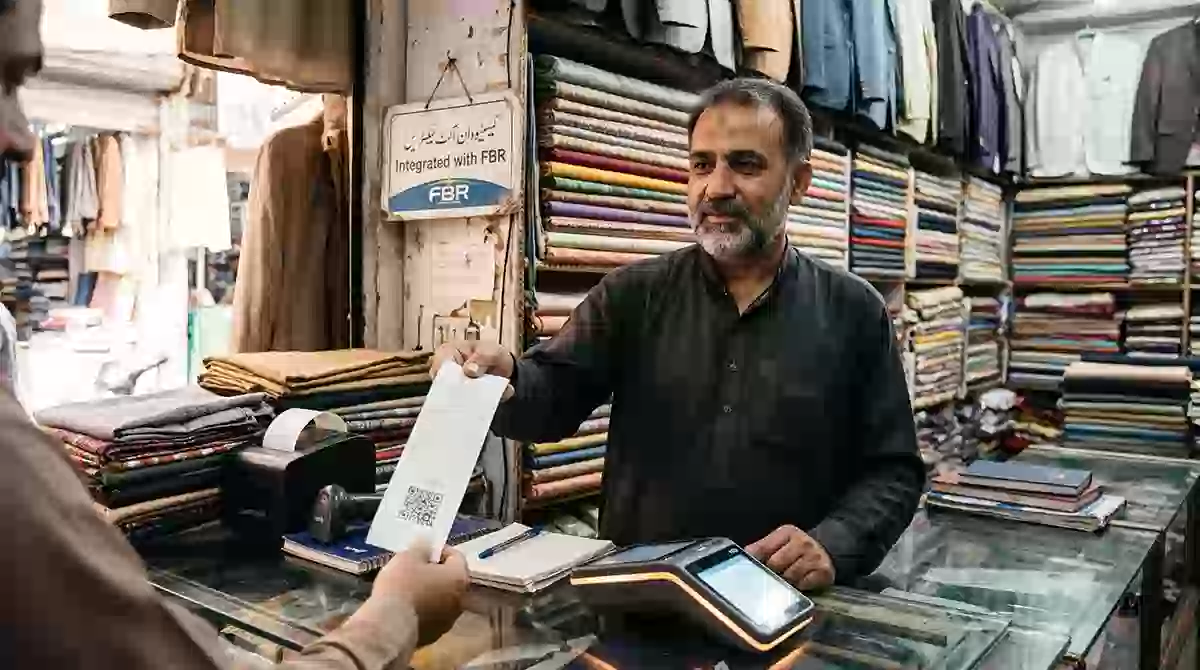
- Display a signboard saying “Integrated with FBR,” along with the POS software registration number.
- Close the day through the system and keep invoice records for six years.
- Register online sales channels if you sell online.
- Report an operational failure within 24 hours. In offline mode, you must identify the invoices and upload them within 24 hours of the connection being restored.
- Meet the cost of integration yourself. Integration costs are borne by the integrated person.
A Commissioner can grant an extension of up to 60 days in total, in 15-day intervals, while paper invoices continue in the meantime.
How to Integrate: Step by Step
- Check that you are registered for sales tax. If not, register first, as explained in the GST and tax filing article in this series.
- Check whether you are notified or covered, using FBR’s lists and the definition above.
- Choose an integrator. PRAL, the FBR-linked technology body, provides integration services free of cost on demand, and its POS software can be downloaded free. Private licensed integrators also exist, with fees subject to FBR’s cap.
- Connect your POS software or hardware to the integrator and obtain your POS registration number.
- Test the invoice format to confirm that the FBR invoice number and QR code print correctly on every receipt.
- Display the signboard and go live.
- Monitor the connection every day, because a lapse counts against you.
What It Costs, and a Tax Credit That Helps
Software from PRAL can be free, but you still bear the cost of hardware and any private integrator’s fee. The Income Tax Ordinance offers a partial offset. According to FBR’s booklet, Section 64D gives a tax credit equal to the lesser of the amount you invested or PKR 150,000 per POS machine, in the year the machine is installed, integrated, and configured.
A worked example (illustrative). A retailer buys terminals for three outlets.
| Cost per Machine | Credit per Machine | |
|---|---|---|
| Outlets 1 and 2 | PKR 90,000 | PKR 90,000 |
| Outlet 3 | PKR 200,000 | PKR 150,000 (capped) |
| Total credit | PKR 330,000 |
A tax credit reduces your tax liability directly, rather than only lowering your taxable income, so confirm eligibility with a tax advisor before relying on it.
The Penalties, in One Table
| Consequence | What the Law Says |
|---|---|
| Not integrating, first default | Penalty of PKR 500,000 |
| Continued default | PKR 1,000,000 for the second, PKR 2,000,000 for the third, and PKR 3,000,000 for the fourth; premises liable to be sealed |
| Input tax restricted | Adjustable input tax for the whole tax period is reduced by 60 percent |
| Selling outside the system or issuing invoices without a valid FBR number and QR code | The higher of PKR 500,000 or 200 percent of the tax involved, plus sealing; on conviction, up to two years in prison or an additional fine of up to PKR 2 million |
| Income tax side | Expenses attributable to sales can be disallowed, capped at 8 percent of allowable deductions; penalty up to PKR 1 million; prosecution is possible |
| Utility connections | FBR can direct gas and electricity companies to cut the connections of notified Tier-1 retailers that are registered but not integrated |
| Sealing for unverified invoices or disconnection | Under SRO 164(I)/2025, FBR can seal outlets that issue unverified invoices or stay disconnected from its database for more than 48 hours |
| Registration | Secondary sources report that, since the Finance Act 2026, FBR can suspend or blacklist a sales tax registration |
A worked example of the input tax rule. A retailer with PKR 1,000,000 of input tax in a month keeps only PKR 400,000 as adjustable, which creates an extra PKR 600,000 tax demand for that month. That can recur every month the retailer stays non-compliant.
Customers Can Check Your Invoices
The FBR booklet describes consumer-side verification: buyers can check an invoice using its FBR number and QR code, including through FBR’s app and a messaging channel, and there is a prize scheme and mystery shopping to encourage them. That means an invoice that does not verify may be reported by the person you sold to.
Digital Invoicing Beyond Tier-1 Retailers
Digital invoicing under the Sales Tax Rules also reaches registered manufacturers, wholesalers, and distributors. Secondary sources describe a first mandatory integration timeline under SRO 709(I)/2025 in April 2025, a 2026 order allowing multiple integrators with a 72-hour window to correct invoices, and broader enforcement from January 2026. I could not confirm those timelines or the categories phased in against FBR primary sources. If you are a registered business and have not been told whether the rules apply to you, ask your tax advisor and check FBR’s notifications, since waiting for a notice is an expensive strategy.
Common Mistakes Retailers Make
Assuming a small shop is exempt without checking. Coverage depends on the statutory categories and FBR’s notifications, not shop size alone.
Relying on old Tier-1 criteria. The shop-area test is gone, and the definition changed again in 2026.
Integrating and then letting the connection lapse. A disconnection of more than 48 hours can lead to sealing under the revised rules.
Ignoring the offline procedure. Invoices issued during an outage must be identified and uploaded within 24 hours of restoration, and the failure must be reported within 24 hours.
Skipping the signboard or the QR code. An invoice without a valid FBR number and QR code is treated as an offence.
Waiting for an FBR notice. Penalties and input tax restrictions run on the law, not on your reminder.
Treating this as a sales tax issue only. The income tax side adds expense disallowance, penalties, and possible prosecution.
Overlooking the tax credit. The Section 64D credit can offset part of the machine cost.
Summing Up
FBR POS integration is not a technology project. It is a legal duty that changes how every sale is recorded, with penalties that start at PKR 500,000 and climb to PKR 3,000,000, plus a 60 percent cut to your input tax and the risk of your premises being sealed. FBR’s figures show it is integrating thousands of retailers each year, and its enforcement attention is on connections that stay live.
The practical sequence is short. Find out whether you are covered, using the statutory categories, FBR’s notified lists, and the current text of the Act. If you are, choose an integrator, connect, display the signboard, and monitor the link daily. Keep records, and use the machine credit where it applies. And because the definition moved in 2026 and some details remain unverified, have a tax advisor confirm your position before the next filing.
Further reading and official sources:
- Federal Board of Revenue, POS booklet and POS integrated retailers list: fbr.gov.pk
- Federal Board of Revenue, Sales Tax Act 1990 and Sales Tax Rules 2006, Chapter XIV: fbr.gov.pk
- PRAL, FBR’s technology partner for POS integration services: pral.com.pk