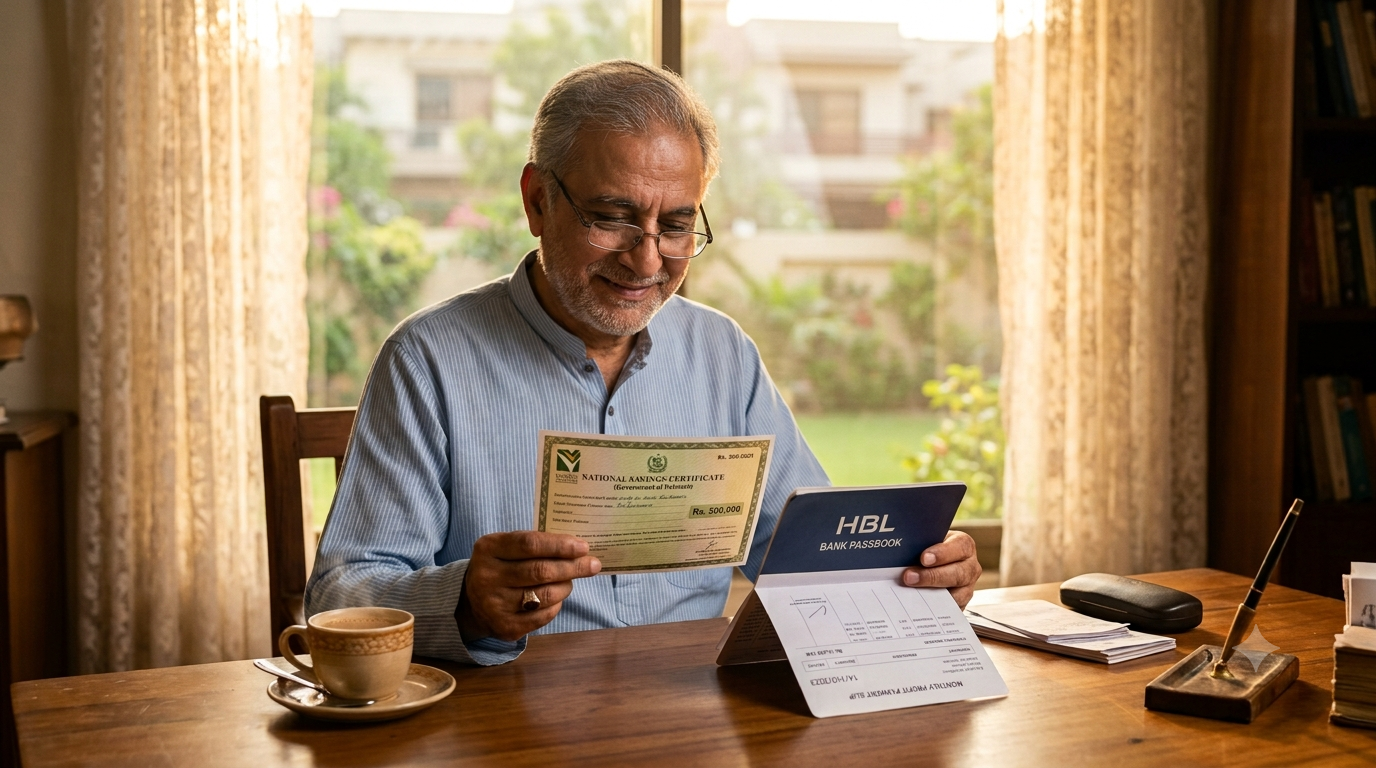
My grandfather kept his entire life savings in National Savings Certificates. He never invested in stocks, never bought mutual funds, and had no interest in anything that involved uncertainty. What he had was a Defence Savings Certificate renewed faithfully every ten years, a Regular Income Certificate that paid his household expenses after retirement, and a Bahbood Savings Certificate that covered his medical costs in his later years. He slept easily, lived comfortably, and never once worried about whether his savings were safe. Here you will learn about national savings Pakistan and a complete guide to all its products.
National Savings Pakistan, officially known as the Central Directorate of National Savings or CDNS, is one of the oldest financial institutions in the country with over 140 years of history. It is a department under the Ministry of Finance, which means your principal and profit are backed by the Government of Pakistan. In a country where trust in financial institutions can be fragile, that government guarantee is not a small thing. It is the reason millions of Pakistanis, particularly government employees, retirees, and conservative savers, have relied on National Savings products for decades.
In 2026, National Savings remains deeply relevant but also more varied and more accessible than many people realize. Profit rates have been revised upward from May 2026, digital account access is now available, and a growing range of Shariah-compliant Islamic savings options has been introduced under the Sarwa brand. This guide covers every product, the current rates, who each product is designed for, and exactly how to invest.
Table of Contents
What Makes National Savings Different From Every Other Investment in Pakistan
Before covering the specific products, it is worth understanding what actually distinguishes National Savings from bank fixed deposits, mutual funds, and every other savings option available in Pakistan.
The government guarantee is the defining characteristic. When you invest in a National Savings certificate, you are lending money to the Government of Pakistan. The government commits to return your principal in full at maturity and to pay the agreed profit rate throughout the investment period. This is not an insurance arrangement or a deposit protection scheme covering a limited amount. It is a direct obligation of the sovereign government. There is no investment in Pakistan with a higher security level than a National Savings instrument.
This security comes with a trade-off. National Savings products are not designed for growth. They are designed for capital preservation with a modest, predictable, government-guaranteed return. For people who have money they genuinely cannot afford to lose and who prioritize certainty of return over maximum growth potential, they are one of the most appropriate financial tools available.
Accessibility is another significant advantage. National Savings Centres exist in every major city and many smaller towns across Pakistan. Most major banks including HBL, UBL, National Bank of Pakistan, and Bank Alfalah are authorized to sell National Savings products at their branches. An online portal at savings.gov.pk now allows internet banking access to account management and transactions for registered users. Anyone with a valid CNIC can invest. No broker account, no investment knowledge, and no minimum income are required.
Current Profit Rates as of Mid-2026
The government revised National Savings profit rates on May 26, 2026, with further revisions effective June 10, 2026. The following rates reflect the most current available information as of mid-2026. Always verify the latest rates at savings.gov.pk or your nearest National Savings Centre before investing, as rates are linked to the SBP policy rate and change periodically.
Bahbood Savings Certificates: 12.48% per annum (monthly profit payment) Pensioners Benefit Account: 12.48% per annum (monthly profit payment) Shuhada Family Welfare Account: 12.48% per annum (monthly profit payment) Regular Income Certificates: 11.82% per annum as of the May 2026 revision, representing an increase of 1.86% from the previous rate (monthly profit payment) Special Savings Certificates: 11.6% per annum for the first five profits, 12.4% per annum for the sixth and final profit payment (bi-annual profit) Special Savings Account: 11.6% per annum for the first five profits, 12.4% for the sixth profit Defence Savings Certificates: 12% per annum compound (lump sum at maturity) Short Term Savings Certificates: 10.84% for 3-month, 10.58% for 6-month, 11.23% for 1-year tenors (revised from May 2026) Savings Account: 10% per annum Sarwa Islamic Savings Account (SISA): 9.96% per annum Sarwa Islamic Term Account (SITA): 9.96% for 1-year, 10.20% for 3-year, 10.44% for 5-year tenors
These rates are notably more competitive than they were in early 2025, reflecting the upward revision following renewed inflation pressures. The Special Savings Certificate in particular recorded a large increase of 2.20% to reach 11.6% for the first five profits, representing PKR 5,800 every six months on a PKR 100,000 deposit before withholding tax.
Product 1: Defence Savings Certificate (DSC)
The Defence Savings Certificate is one of the most traditional and widely held National Savings products in Pakistan. It is a long-term, compound interest instrument designed specifically for investors who do not need regular income from their savings and want maximum growth of their principal over time.
Tenor: 10 years
Profit structure: The profit is compounded internally throughout the 10-year period rather than being paid out periodically. This means your profit earns profit, and the compounding effect generates a final maturity value that is substantially higher than the face value of the certificate. At the current rate of 12% per annum compounded, a PKR 100,000 DSC matures to approximately PKR 310,000 after 10 years.
Profit rate: 12% per annum compound
Minimum investment: PKR 500
Who it is for: The DSC is most appropriate for investors who have a long time horizon, do not need periodic income from this investment, and want to maximize the total accumulated value at maturity through compounding. It is a natural vehicle for parents saving for a child’s future education costs or for any goal that is ten years away. The compounding effect is the DSC’s primary advantage over other National Savings products that pay profit periodically rather than reinvesting it.
Premature encashment: Available after six months from the date of investment, but profit is calculated at a reduced rate for the period actually held. Full contracted rate applies only if held to full maturity.
Product 2: Regular Income Certificate (RIC)
The Regular Income Certificate is among the most practically useful National Savings products for people who need a predictable monthly cash flow from their savings. It functions essentially as a government-guaranteed monthly pension from your own capital.
Tenor: 5 years
Profit structure: Monthly profit payments deposited directly to your registered bank account on a fixed date each month. Your principal remains intact throughout and is returned in full at the end of the 5-year period.
Profit rate: 11.82% per annum as of the May 2026 revision. On a PKR 100,000 investment, this translates to approximately PKR 985 per month before withholding tax deduction.
Minimum investment: PKR 50,000
Who it is for: Retirees, pensioners, and anyone who needs to convert a lump sum of savings into a reliable monthly income stream. The RIC is one of the most commonly held instruments among Pakistan’s retired population precisely because it combines government security with regular monthly cash flow, which no equity investment or stock can guarantee.
Practical note: For larger investment amounts, the monthly income can be substantial. A PKR 1,000,000 investment in an RIC at 11.82% generates approximately PKR 9,850 per month before tax, which covers significant household expenses for many Pakistani families.
Learn more: Small Business Ideas in Pakistan with Low Investment (2026 Updated)
Product 3: Bahbood Savings Certificate (BSC)
The Bahbood Savings Certificate is Pakistan’s most favorable National Savings product in terms of profit rate, and it is exclusively reserved for Pakistan’s most vulnerable investor segments: senior citizens aged 60 and above, widows, and disabled persons.
Tenor: 3 years
Profit structure: Monthly profit payments, similar to the RIC.
Profit rate: 12.48% per annum. On PKR 100,000 invested, this generates approximately PKR 1,040 per month before tax.
Minimum investment: PKR 1,000
Maximum investment: PKR 5,000,000 per person for the higher profit rate structure. Amounts above this threshold may attract different terms.
Who it is for: Eligible investors in the Bahbood categories, meaning senior citizens aged 60 and above, registered widows, and persons with disabilities. If you or a family member qualifies, the Bahbood certificate offers the highest profit rate among all National Savings products alongside government security. For a retired couple where both spouses qualify, the combined maximum eligible for the preferential Bahbood rate is effectively doubled.
Important note: Eligibility must be documented. Senior citizen status requires CNIC proof of age. Widow status requires a death certificate of the spouse. Disability status requires a certified disability certificate.
Product 4: Pensioners Benefit Account (PBA)
The Pensioners Benefit Account is structurally similar to the Bahbood Certificate in terms of rate and monthly income payment, but it is specifically designed for government pensioners of all ages rather than being restricted to the over-60 demographic.
Profit rate: 12.48% per annum (monthly payment)
Who it is for: Government employees who have retired and are drawing a government pension. For qualifying pensioners, the PBA offers the same exceptional rate as the Bahbood certificate with monthly income payments.
Product 5: Shuhada Family Welfare Account
The Shuhada Family Welfare Account offers the same 12.48% per annum monthly income rate as the Bahbood and Pensioners accounts, reserved specifically for the families of martyrs of Pakistan’s armed forces and law enforcement agencies.
Product 6: Special Savings Certificate (SSC)
The Special Savings Certificate offers a bi-annual profit payment structure with a rising rate that rewards investors who stay the full 3-year term.
Tenor: 3 years
Profit structure: Profit is paid every six months. The first five payments are at 11.6% per annum, and the final sixth payment is at the higher rate of 12.4% per annum. This tiered structure incentivizes holding for the full term.
Practical illustration: On a PKR 100,000 SSC, you receive PKR 5,800 every six months for the first five payment periods, and PKR 6,200 at the final payment. All subject to withholding tax.
Minimum investment: PKR 500
Who it is for: Investors who want periodic income but are comfortable with bi-annual rather than monthly payments, and who have a three-year investment horizon. The SSC’s bi-annual payment schedule also makes it convenient for investors who want to receive a meaningful lump sum payment twice a year rather than smaller monthly amounts.
Product 7: Short Term Savings Certificate (STSC)
The Short Term Savings Certificate is the National Savings equivalent of a commercial bank fixed deposit, offering defined tenors of 3 months, 6 months, or 1 year with full principal return at maturity.
Tenors and rates (post May 2026 revision): 3-month tenor: 10.84% per annum 6-month tenor: 10.58% per annum 1-year tenor: 11.23% per annum
Profit payment: Lump sum at maturity along with return of principal.
Minimum investment: PKR 500
Who it is for: Investors who need to park funds for a specific short period with government security, or who want to keep options open while deciding on a longer-term investment strategy. The 1-year STSC at 11.23% compares well with many bank term deposits while offering the additional security of a direct government obligation.
Product 8: National Savings Account
A standard savings account offered through National Savings Centres offering daily profit calculation and quarterly profit payment.
Profit rate: 10% per annum as of the May 2026 revision
Who it is for: Investors who want a basic, fully liquid account with National Savings that pays better than many bank savings accounts. Suitable for shorter-term parking of funds within the National Savings system.
Product 9: Special Savings Account (SSA)
The Special Savings Account mirrors the Special Savings Certificate in profit rate structure but functions as a savings account rather than a fixed certificate, offering slightly more flexibility.
Profit rate: 11.6% for the first five profit periods, 12.4% for the sixth profit period.
Product 10: Sarwa Islamic Savings Account (SISA) and Sarwa Islamic Term Account (SITA)
These are National Savings’ Shariah-compliant product range, introduced to serve Pakistan’s large segment of investors who require halal investment options. Sarwa products are structured to be free from riba, making them appropriate for investors who cannot participate in conventional interest-bearing savings instruments.
Sarwa Islamic Savings Account (SISA): 9.96% per annum profit rate. Fully liquid savings account structure.
Sarwa Islamic Term Account (SITA): Tiered rates by tenure: 9.96% for 1-year, 10.20% for 3-year, 10.44% for 5-year terms.
Who they are for: Investors who want the government security of National Savings products while remaining within Islamic finance principles. The Sarwa rates are somewhat lower than their conventional equivalents, reflecting the profit-sharing rather than interest-based structure, but remain competitive within the Islamic savings product landscape in Pakistan.
Premium Prize Bonds
Prize bonds are a distinctly different product from the certificate-based National Savings instruments. They combine principal protection with a lottery element.
You purchase a prize bond at face value. Your principal is always fully refundable when you wish to encash. Quarterly prize draws are conducted for bonds in each denomination, with prizes ranging from modest amounts to substantial top prizes. The denominations available are PKR 200, PKR 750, PKR 1,500, PKR 7,500, PKR 15,000, and PKR 40,000.
Prize bonds do not pay a fixed profit rate. Your return is either nothing beyond your principal if your bond does not win a prize in a draw period, or a prize amount if your bond number is drawn. For most holders, the effective return over time is lower than the certificate-based products, but the format appeals to investors who enjoy the possibility of winning a significant prize on their safe principal.
Note: The government has been transitioning from unregistered bearer prize bonds to registered prize bonds and Premium Prize Bonds for transparency and tax compliance reasons. Check the current status of specific denominations with your nearest National Savings Centre before investing.
Naya Pakistan Certificate for Overseas Pakistanis
For overseas Pakistanis specifically, the Naya Pakistan Certificate offers a USD-denominated National Savings product accessible through Roshan Digital Accounts at partner banks. The NPC currently offers approximately 8.25% annual return in USD, which in combination with the dollar denomination provides both a government-backed return and natural protection against rupee depreciation. Available through HBL, MCB, UBL, Meezan Bank, and other Roshan Digital Account partner banks online.
Tax on National Savings Profits: What You Need to Know
Withholding tax is deducted at source from all National Savings profit payments before you receive them. You see the net amount after deduction.
For FBR-registered tax filers, withholding tax on National Savings profit is 15%. For non-filers, the rate is 30%.
The difference is substantial. On a PKR 1,000 monthly profit payment from an RIC, a filer receives PKR 850 after the 15% deduction while a non-filer receives only PKR 700 after the 30% deduction. On a large investment, this difference over five or ten years represents a significant amount.
Registering as an FBR filer is free and takes under an hour through the FBR IRIS portal. If you invest in National Savings and are not yet a registered filer, this is one of the most immediately actionable steps you can take to improve your actual after-tax return.
Zakat is also deducted on eligible National Savings investments at the applicable rate on the designated Zakat date unless you submit a Zakat exemption affidavit to the National Savings Centre at the time of investment. Keep this declaration on file and renew it annually as required.
How to Invest in National Savings Pakistan
There are three ways to invest.
At a National Savings Centre
The traditional method. National Savings Centres operate in every major city and many smaller towns across Pakistan. Bring your original CNIC, two passport-sized photographs, a completed application form which is available at the centre, and your investment amount either in cash or by a crossed cheque drawn in favor of the National Savings Centre.
The investment is processed on the same day. Your certificate or account passbook is issued immediately or within a short processing period depending on the specific product.
At an Authorized Bank Branch
HBL, UBL, National Bank of Pakistan, Bank Alfalah, MCB, and other authorized banks sell selected National Savings products at their branches. The documentation requirements are the same. This option is convenient if there is no National Savings Centre near you but your bank branch is accessible.
Online Through savings.gov.pk
The National Savings online portal at savings.gov.pk allows existing account holders to manage their accounts, view balances, and conduct certain transactions digitally. New investors can also initiate the account opening process online, though initial in-person verification may still be required for first-time registration depending on your specific situation.
The online portal capability continues to expand as part of Pakistan’s broader financial digitization push, so check the current functionality at savings.gov.pk for the most current digital access options.
National Savings vs Bank Fixed Deposits: A Direct Comparison
This is one of the most common questions Pakistani investors ask, and it deserves an honest answer rather than a reflexive endorsement of either option.
Security: National Savings instruments are directly backed by the Government of Pakistan with no limit. Bank fixed deposits are protected up to PKR 500,000 per depositor per bank under the Deposit Protection Corporation scheme for amounts above this threshold. For amounts exceeding PKR 500,000, National Savings offers categorically higher security.
Profit Rates: At current rates in mid-2026, National Savings products compare favorably with most bank fixed deposits. The Regular Income Certificate at 11.82%, the Special Savings Certificate at 11.6% to 12.4%, and the Bahbood Certificate at 12.48% are all competitive with or superior to what most commercial banks are offering on equivalent tenor deposits. The DSC compound rate of 12% is particularly compelling for long-term investors.
Liquidity: Bank fixed deposits can generally be broken with an interest rate penalty that varies by bank but is typically calculated at the savings account rate for the period held. National Savings premature encashment is also available after a minimum holding period but similarly results in a reduced rate. Neither is fully liquid without penalty. Bank fixed deposits can typically be broken faster and with less procedural complexity than National Savings certificates in practice.
Convenience: Bank fixed deposits, particularly those booked through mobile apps, are faster and more convenient for most urban investors in 2026. National Savings Centre processes are more procedural and require a physical visit or the online portal for management. Banks offering National Savings products at their branches partially bridge this gap.
Profit Payment Frequency: National Savings offers monthly, bi-annual, and maturity-payment options across its product range. Bank fixed deposits offer similar flexibility. The monthly payment options of the RIC, Bahbood, and Pensioners accounts are particularly popular among income-seeking investors.
The practical recommendation for most conservative investors is to hold a combination of both: National Savings certificates for the government security and competitive rates on core long-term or income-generating savings, and bank fixed deposits for shorter-term parking where convenience and digital accessibility are priorities.
Who Should Invest in National Savings Pakistan?
National Savings products are most appropriate for the following investor profiles.
Retirees and pensioners who need reliable monthly income with zero risk to their principal will find the RIC, Bahbood, and Pensioners Benefit Account genuinely excellent tools for converting their accumulated savings into a predictable income stream.
Conservative savers who prioritize capital safety over maximum returns and do not want any exposure to market volatility should consider National Savings as the core of their savings strategy, complemented by a smaller equity fund allocation for inflation protection over the long term.
Parents saving for children’s future expenses with a long time horizon can benefit significantly from the Defence Savings Certificate’s compounding structure, which turns a modest regular deposit into a substantial maturity value over ten years.
Middle-income households building an emergency fund or parking short-term savings can use the Short Term Savings Certificate or National Savings Account as a safe, government-backed alternative to bank savings accounts that often pay lower rates.
National Savings is not primarily appropriate as the only savings vehicle for younger investors with a long investment horizon and the ability to tolerate market volatility. Equity mutual funds and PSX stocks have historically delivered meaningfully higher real returns over long periods. National Savings should be a component of a balanced strategy, particularly as a capital preservation layer, rather than the entire strategy for someone who has decades to invest and wants genuine wealth growth.
Common Mistakes National Savings Investors Make
Investing the wrong product for their need. A retiree who needs monthly income should choose the RIC or Bahbood, not the DSC, which pays nothing until maturity. An investor saving for a ten-year goal should choose the DSC, not the RIC, which does not compound the profit payments.
Not submitting a Zakat exemption affidavit when eligible. Zakat deducted at the standard rate on large investments represents a significant amount annually. If you are exempt, submit the declaration at account opening and renew annually.
Not registering as an FBR filer. The 15% versus 30% withholding tax difference on profit is substantial over a multi-year investment at meaningful amounts.
Breaking the investment prematurely without understanding the penalty. Calculate the reduced rate that will apply for your holding period before deciding to encash early. Sometimes keeping the certificate to the next payment date is significantly better than breaking it a few weeks early.
Not checking current rates before renewing. Rates change periodically. Auto-renewing a matured certificate without verifying whether the current rate is still appropriate for your goals is a passive approach that may not serve your interests.
Final Thoughts
National Savings Pakistan has served millions of Pakistani families as a financial cornerstone for generations, and in 2026 it remains one of the most compelling risk-free savings options available in the country. The government guarantee, competitive profit rates following the May 2026 upward revision, diverse product range covering monthly income, bi-annual income, and lump-sum compounding needs, and the growing availability through both bank branches and the digital portal make it accessible and relevant for a broad range of investors.
The key is matching the right product to the right purpose. Monthly income needs call for the RIC or Bahbood. Long-term compounding goals call for the DSC. Short-term safe parking calls for the STSC. Shariah compliance requirements call for the Sarwa Islamic range. Overseas Pakistani investment calls for the Naya Pakistan Certificate.
Use the government’s guarantee and the competitive rates as the conservative anchor of your broader financial strategy. Combine it with equity mutual fund exposure for long-term growth. And always check the current rates at savings.gov.pk before making any new investment, since rates are updated regularly and the numbers that applied six months ago may have changed meaningfully since then.