
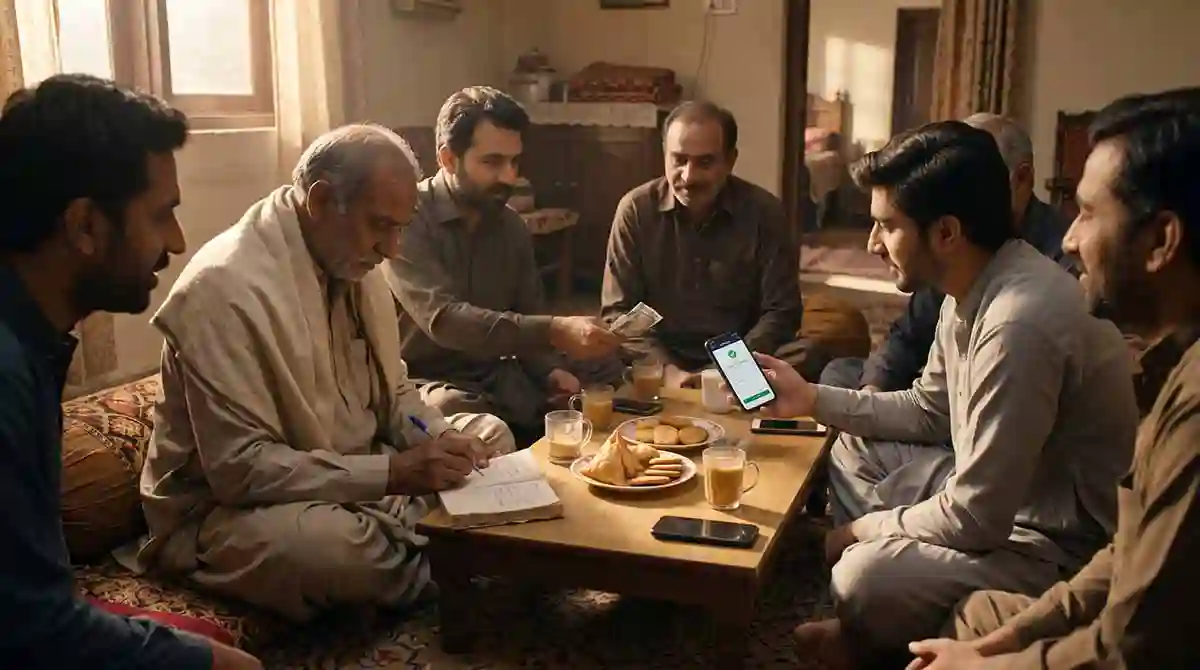
Ask almost any Pakistani family and someone is in a committee right now, a BC, beesi, or kameti. Reported estimates suggest that about 41 percent of Pakistani adults have used one, a figure that appears in a case study of a digital committee startup and in commentary on informal savings, so treat it as an estimate. Women use them especially often. One columnist in Dawn put the annual flow through committees at roughly PKR 4 trillion, a rough estimate resting on assumptions about the informal economy. Here I am going to share with you about Committees (BC) in Pakistan and how they work and their risks can avoid.
The same Dawn column also described what happens when the trust fails: a network of committees run through social media defaulted on about PKR 420 million. A committee (BC) in Pakistan is a genuinely useful savings habit and a genuinely unprotected one.
This guide explains how it works, shows with worked numbers who gains and who loses in each position, explains the real risks, and compares the alternatives. I am not telling you to quit your committee. I am showing you how to join one with open eyes.
Table of Contents
How a Committee Works
Before you learn about Committees (BC) in Pakistan, you need to understand how a committee works. A group of people agree to contribute a fixed amount every month, and each month one member receives the whole pot. The cycle ends when everyone has received the pot once. Nobody pays interest or earns it, so a committee is an interest-free savings circle. There are three common ways to decide the order.
| Type | How the Order Is Set | Main Concern |
|---|---|---|
| Fixed order | Agreed in advance | Late positions are lending to everyone else for longer |
| Draw (random) | A lottery each month | Luck decides whether you are lender or borrower |
| Bidding | Members offer to pay extra for an early turn | Pricing the early turn can raise riba concerns |
A Worked Example: Who Gains and Who Loses
Take 10 members contributing PKR 20,000 a month for 10 months, so each month’s pot is PKR 200,000.
The member who receives in month 1 gets PKR 200,000 after paying only PKR 20,000. They have effectively borrowed about PKR 180,000 interest-free and repay it over the next nine months. The member who receives in month 10 paid PKR 20,000 every month for ten months and gets PKR 200,000 only at the end. They have lent money to everyone else.
To put a number on that, I valued each position in today’s rupees using a 12 percent annual rate, close to recent T-bill yields. A positive number means the position works like a free loan, a negative number means it works like an unpaid one.
| Position | Net value of the position (today’s rupees) |
|---|---|
| Month 1 | Plus PKR 8,594 |
| Month 3 | Plus PKR 4,692 |
| Month 5 | Plus PKR 867 |
| Month 6 | Minus PKR 1,017 |
| Month 8 | Minus PKR 4,729 |
| Month 10 | Minus PKR 8,369 |
Nobody is cheating here. This is simply the time value of money. For comparison, the member in month 10 would have had about PKR 209,000 by saving the same PKR 20,000 a month at 12 percent, against the PKR 200,000 the committee pays out, before tax and assuming that return. Early positions are worth more, and in a fixed or draw committee everyone is quietly paying or receiving that difference.
Why Committees Work and Why People Love Them
- They force discipline. You have to pay every month, which is harder to skip than a personal savings intention.
- They give a lump sum early. That is useful for a purchase, a deposit, or a family expense when an early position falls to you.
- They need no paperwork or minimum balance. That matters for people outside the banking system.
- They are built on community trust. Members usually know each other.
These are real strengths. A bank account does not replicate the social pressure to pay on time.
The Real Risks
Default after receiving. A committee’s security is social. If a member stops paying after receiving the pot, there is no collateral and no formal mechanism to compel payment. Using the example above, suppose the month-1 member stops paying after the first month. They owe 9 × PKR 20,000 = PKR 180,000. If the other nine members keep paying, each later pot shrinks from PKR 200,000 to PKR 180,000, and each of those nine members ends up PKR 20,000 short, which is 10 percent of their expected payout.
Organizer fraud. Someone who collects every member’s money and disappears can take everything paid in so far, and the members who have not yet received their turn lose the most.
Late positions carry the most exposure. The member in month 10 has paid in nine contributions before receiving anything, so they have the most to lose if anyone defaults.
No paper trail and no recourse. Informal committees have no formal regulatory framework or deposit protection. Many run on cash, which leaves little evidence if a dispute arises. I could not verify how courts treat specific disputes, so assume your own records are your protection.
Inflation erodes late payouts. With inflation near 11 percent in mid-2026, a payout received several months later buys less than the contributions you made earlier. The position table above shows that effect directly.
Over-commitment. Joining several committees at once can stretch your monthly budget, and one missed payment affects the whole group.
Committees With Strangers Online
The Dawn example of a PKR 420 million default involved a committee network recruited through social media, not a circle of colleagues. Fraud has also happened among relatives and friends, but large circles of strangers add a serious extra risk. Warning signs include:
| Warning Sign | Why It Matters |
|---|---|
| You do not know the other members | Your only protection is trust you do not have |
| Payments go to the organizer’s personal account with no member list | No visible record of who has paid or been paid |
| The organizer offers early payouts for a fee or promises a bonus | Pricing time can raise riba concerns and often signals a scheme that depends on new money |
| Spots are sold in large numbers or the group keeps growing | A larger pool means a larger prize for anyone who disappears |
| The organizer guarantees nobody will default | No informal committee can guarantee that |
Large schemes that collect money from the public and promise a fixed return look less like a family committee and more like the unlicensed schemes described in the investment scam article in this series.
A Note on the Religious Side
Scholars generally treat a plain committee, where every member receives exactly what they paid in, as permissible, because it works as a set of interest-free reciprocal loans. Concerns arise where early recipients pay extra or late recipients receive a bonus, because that prices the time value of the money. This is general information, not a ruling. If your committee uses bidding or any extra payment, ask a qualified scholar about your specific arrangement.
Digital Committee Apps
Several apps have tried to formalize committees. Oraan, for example, runs fixed-cycle committees of 5 or 10 months with set monthly contributions and one member receiving the pooled amount each month, using an app for collection and records. Apps can add record-keeping, automatic collection, and a visible payment history. They cannot remove the counterparty risk of strangers, and I did not verify any app’s current regulatory status, so check who regulates it, where the pooled money sits, and what protection exists before joining.
Better Alternatives, and When Each Fits
| Option | Return | Lump Sum | Protection | Discipline |
|---|---|---|---|---|
| Committee | None | Depends on your position | Social trust only | Strong peer pressure |
| Recurring transfer to a bank savings account | Profit, usually modest | Your own balance | Deposit protection, covered up to PKR 500,000 per depositor per bank in earlier guidance; confirm the current limit | Automatic if you set it up |
| Money market or income fund SIP | Market-linked, not guaranteed | Redeem within a day or two | Fund assets held by an independent trustee | Automatic |
| National Savings certificates | Government-set rates | At maturity | Government backing | Locked in |
| Digital committee app | None | Depends on your position | Varies by app | Strong |
Three practical points follow from the table.
- For discipline with return, an automatic monthly transfer or SIP does what a committee does and earns something. The SIP article in this series covers how to set it up.
- For a safety net, keep an emergency fund in a bank or money market fund first, as the emergency fund article recommends, so a committee payment never forces you into debt.
- For a specific goal, such as a wedding or a deposit, a dedicated SIP or National Savings certificate with a target date is more predictable than hoping a good position falls to you.
If You Join a Committee Anyway: A Safer Checklist
- Only join with people you know personally, and keep the group small.
- Put the member list, contribution amount, order, and dates in writing, for example in a group message everyone confirms.
- Pay by bank transfer, not cash, and keep the screenshots. That creates the money trail a cash committee lacks.
- Use amounts you could afford to lose entirely.
- Pick a middle position unless you need the early lump sum, and understand that late positions carry the most exposure.
- Do not pay any fee or bonus for an early turn.
- Do not join several committees at once.
- Walk away from any organizer who pressures you or refuses to share the member list.
Common Mistakes
Joining a committee of strangers because the group looks professional. A polished social media page proves nothing.
Treating the early position as free money. You still owe every remaining installment, and defaulting after receiving breaks the group’s trust and can cost the others dearly.
Putting savings you cannot afford to lose into a committee. There is no protection if it fails.
Keeping everything in cash. Without transfers there is nothing to show if a dispute arises.
Ignoring the cost of waiting. A late position earns nothing and carries the most risk.
Joining a bidding committee without checking the religious concern. Paying extra for an early turn is the classic problem case.
Relying on committees as your only savings. They work best alongside a bank or fund account, not instead of one.
Final Thoughts
Committees survive because they solve a real problem: they turn good intentions into a monthly obligation, and they do it without a bank. That is worth respecting. They also run on trust alone, with no interest, no deposit protection, and little recourse when something goes wrong, and the same worked example that shows the value of an early turn shows what a default costs everyone else.
My practical advice is to keep committees small, personal, and written down, pay by transfer, and treat them as a discipline tool rather than a vault. Keep your emergency fund and your long-term savings in places with a paper trail and some protection. A committee that begins with five colleagues you trust is a tradition. A committee that begins with a stranger’s social media post is a risk you should price accordingly.
Further reading and official sources:
- State Bank of Pakistan, National Financial Inclusion Strategy and survey data: sbp.org.pk
- Securities and Exchange Commission of Pakistan, public warnings on unlicensed deposit schemes: secp.gov.pk
- FIA National Response Centre for Cyber Crimes, reporting online fraud: complaint.fia.gov.pk










Yeah committee is very famous in Pakistani society. Also, in India it is online as well. You can avail committee offline in different families and online too. Amazing!
Thanks dear for visiting.