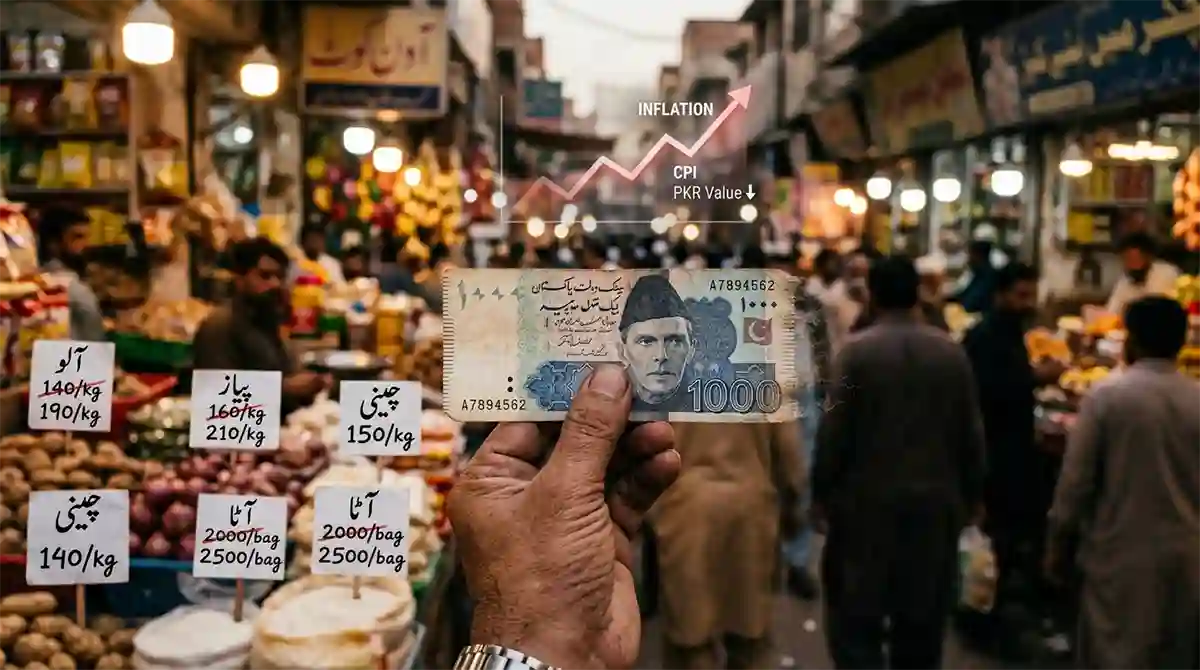
A few years ago, a family member of mine was genuinely proud of herself for keeping her savings in a bank account that paid a decent profit rate. She had PKR 500,000 saved and was earning around 7% annually on it, which felt like a solid return. What she did not know was that at the time, inflation in Pakistan was running at over 20%. Every year she kept that money exactly where it was, its real purchasing power was being silently eroded, not by bad luck or bad decisions, but by a force she had never been taught to account for. Therefore, in this article, you will learn how inflation in Pakistan destroys your savings and this is what you can do about it.
Inflation is arguably the most important concept in personal finance that most Pakistanis have never properly understood. Everyone feels it when they notice that the same grocery run costs significantly more than it did two years ago, or that a school fee that seemed manageable five years ago has become a stretch. But very few people understand how inflation specifically interacts with their investments, why it matters so much, and what they can do about it.
Understanding inflation in Pakistan is especially important in 2026 because the country has just come through one of the most dramatic inflation cycles in its recent history, and understanding what happened, where we are now, and what it means for your investment decisions is essential context for any serious investor.
Table of Contents
What is Inflation?
Before learning how inflation in Pakistan destroys your savings, you need to understand what inflation is. Inflation is the rate at which the general level of prices for goods and services rises over time. When inflation is positive, each rupee you hold buys less than it did before. When inflation is high, the erosion of purchasing power is rapid and visible. When it is low and stable, it happens slowly and quietly.
In Pakistan, inflation is measured primarily through the Consumer Price Index, commonly known as CPI, published monthly by the Pakistan Bureau of Statistics. The CPI tracks price changes in a basket of goods and services representative of typical Pakistani household spending, including food, housing, clothing, transport, healthcare, and education.
The State Bank of Pakistan monitors inflation closely because it is the central bank’s core mandate to maintain price stability. The SBP uses its monetary policy tools, primarily the benchmark policy rate, to influence inflation. When inflation rises above its target range, the SBP raises the policy rate to reduce money supply and slow spending. When inflation falls and the economy needs stimulus, the SBP cuts the policy rate.
Pakistan’s Inflation Story in 2026: Context You Need
To make investment decisions informed by inflation, you need to understand where Pakistan’s inflation actually stands right now and how it got here.
Pakistan experienced an extraordinary period of high inflation between 2022 and 2024. At its peak in May 2023, Pakistan’s year-on-year CPI inflation reached 38%, the highest in the country’s recent history. This was driven by a combination of severe currency depreciation, a global commodity price spike, energy sector price adjustments, and fiscal pressures that required difficult structural corrections.
In response, the State Bank of Pakistan raised its benchmark policy rate aggressively, reaching a record 22% in June 2023. The tightening worked dramatically. Pakistan’s average inflation for the full fiscal year FY2025 fell to just 4.49%, a nine-year low, a sharp decline from 23.4% the previous year. The SBP began cutting rates, reducing the policy rate from 22% all the way down to 10.5% by January 2026.
However, inflation has been rebounding in 2026. Pakistan’s headline inflation returned to 10.9% in April 2026, higher than even the Ministry of Finance’s own estimate of 8% to 9%. By May 2026, CPI reached 11.7% year-on-year, the highest reading since June 2024, driven by increases in food, housing, and energy costs. In response, the SBP raised its policy rate by 100 basis points to 11.50% in April 2026.
For the first eleven months of FY2026, average inflation stood at 6.69% against 4.61% recorded in the same period the previous year.
This trajectory matters enormously for investment decisions. Real returns that looked comfortable in early 2026 have compressed as inflation has accelerated through the year.
How Inflation Erodes Your Investments: The Concept of Real Returns
This is the core concept that every Pakistani investor needs to understand. The return you see on your investment statement is your nominal return. The return that actually matters for your financial wellbeing is your real return, which is your nominal return minus the rate of inflation.
If your mutual fund earned 14% last year and inflation was 10%, your real return was approximately 4%. Your money grew in terms of numbers, but its actual purchasing power only increased by 4%.
If your fixed deposit earned 12% and inflation was 14%, your real return was negative 2%. Despite seeing a positive return on paper, you actually lost purchasing power. Your money bought less at the end of the year than it did at the beginning, even after adding the profit.
This distinction between nominal and real returns is the reason why choosing investments purely based on the absolute percentage return without considering inflation leads to genuinely poor financial outcomes over time.
At Pakistan’s current inflation of approximately 11.7%, any investment earning less than that rate in nominal terms is delivering a negative real return. Your savings account earning 8% annually, while appearing to grow, is actually shrinking in real purchasing power terms.
How Inflation Affects Each Type of Investment in Pakistan
Different asset classes respond to inflation very differently. Understanding this helps you build a portfolio that protects your real wealth rather than just growing your nominal balance.
Cash and Savings Accounts
Cash is the most vulnerable asset to inflation. A PKR sitting in a drawer or in a low-yield savings account loses exactly as much purchasing power as the inflation rate each year. If inflation runs at 11.7%, a PKR 100 note today can only buy what PKR 88.30 worth of goods could buy a year from now.
Even savings accounts paying below the inflation rate create the same problem. The balance grows in nominal terms but shrinks in real terms. During Pakistan’s high inflation period of 2022 to 2024, Pakistanis who kept large cash balances saw devastating real purchasing power losses.
The lesson: never hold more cash than your emergency fund requires. Any cash beyond your immediate liquidity needs should be in an investment that has a realistic chance of beating inflation.
Fixed Deposits and National Savings
These instruments provide capital protection in nominal terms but are not immune to inflation risk. During periods when fixed deposit rates are above the inflation rate, real returns are positive and these instruments fulfill their capital preservation role well. During periods when inflation exceeds deposit rates, which happened dramatically in Pakistan between 2022 and 2024, fixed deposit investors suffered real purchasing power losses.
In mid-2026, with inflation at 11.7% and fixed deposit rates broadly in the range of 12% to 14% for one-year tenors, real returns from fixed deposits are modestly positive. The margin is thin, however, and any further rise in inflation could push real returns negative again.
Bonds and Fixed Income Mutual Funds
Government bonds and income mutual funds carry the same inflation dynamic as fixed deposits, with the added complexity that bond prices move inversely to interest rates. When inflation rises and the SBP raises its policy rate in response, existing bond prices fall. Income mutual funds that actively manage a bond portfolio are somewhat protected because their managers can adjust duration in response to rate changes, but rising inflation environments remain headwinds for fixed income as an asset class.
Equities and Equity Mutual Funds
Stocks and equity mutual funds are generally the most effective long-term hedge against inflation among mainstream investment assets. Companies own real assets including inventory, equipment, and property. As inflation pushes up prices, companies can often raise their own prices and revenues accordingly, protecting their earnings in real terms.
Over long periods, equity markets in Pakistan have delivered returns that have significantly outpaced inflation, though with substantial year-to-year volatility. The KSE-100 has gone through periods of dramatic underperformance during economic crises but has historically recovered and delivered strong cumulative returns for patient investors.
In the short run, rising inflation often hurts stock prices because it leads to higher interest rates which increase borrowing costs for companies and make bonds more attractive relative to stocks. But over five to ten year periods, equities have consistently been among the better inflation-beating investments available in Pakistan.
Gold
Gold’s role as an inflation hedge in Pakistan is both culturally embedded and financially supported by data. Pakistan’s gold price in rupee terms reflects both the international gold price in dollars and the PKR to USD exchange rate. Since Pakistan has historically experienced significant currency depreciation alongside inflation, both factors have worked in gold’s favor.
In 2026, with gold near PKR 492,000 per tola, the long-term track record of gold as an inflation and currency hedge in Pakistan remains strong. Gold should be held as part of a diversified portfolio at an allocation of around 10% to 20% of investable assets, providing genuine protection without excessive concentration.
Real Estate
Well-located real estate in Pakistan has historically appreciated in price faster than inflation over long periods, protecting and growing real wealth for property owners. However, real estate comes with significant illiquidity, requires large capital, and its returns vary enormously based on location and timing.
Read more: How to Build an Investment Portfolio in Pakistan
The Rupee Depreciation Dimension
Pakistan’s inflation story has a second layer that makes it more complex than the headline CPI figure alone: the persistent depreciation of the Pakistani rupee against major currencies.
When the rupee weakens against the dollar, everything imported into Pakistan becomes more expensive in rupee terms. Since Pakistan imports significant quantities of fuel, food commodities, machinery, and consumer goods, currency depreciation feeds directly into domestic inflation.
For investors, this means a rupee-denominated asset must not only beat local inflation but also account for the loss in the rupee’s international purchasing power. An investment that earns 15% in PKR terms sounds strong, but if the rupee has depreciated 20% against the dollar in the same period, the investment has actually lost value in dollar terms.
This is one of the reasons foreign currency exposure, whether through a foreign currency savings account, dollar-denominated instruments, or freelance earnings held in foreign currency before conversion, has been genuinely valuable for Pakistani investors who understood this dynamic.
Building an Inflation-Aware Investment Strategy in Pakistan
Understanding inflation’s impact on different asset classes leads directly to practical investment choices that protect real wealth over time.
Maintain minimal cash beyond your emergency fund. Cash is the most inflation-exposed asset. Keep only three to six months of expenses in liquid savings and ensure the rest is invested in assets with inflation-beating potential.
Always calculate real returns, not just nominal ones. When evaluating any investment, subtract the current inflation rate from the nominal return to assess whether you are genuinely growing your purchasing power or maintaining an illusion of growth.
Favor equities for long-term goals. For money you will not need for five or more years, equity mutual funds provide the best long-term probability of beating inflation meaningfully. Short-term volatility is the price you pay for long-term real growth.
Use gold as a hedge, not your entire strategy. A 10% to 20% allocation to gold within a diversified portfolio provides genuine inflation and currency protection without excessive concentration.
Ladder your fixed deposits. Staggering deposits across different tenors ensures you can reinvest at prevailing rates as each matures, preventing you from being locked into a below-inflation rate for a long period.
Inflation-adjust your savings goals. If you are saving for your child’s university education ten years away, the cost you target should be today’s cost inflated forward at a realistic Pakistan-specific rate, not the current cost. Underestimating future costs of education and healthcare leads to chronic undersaving.
Inflation in 2026: What It Means for Pakistani Investors Right Now
With headline inflation rising to 11.7% in May 2026, real returns from savings accounts and low-yield instruments are under pressure again. Investors who shifted heavily into fixed deposits during the high-rate period of 2023 and 2024 and are now rolling over at lower rates may find their real returns have compressed meaningfully.
With the SBP policy rate at 11.50% and inflation at 11.7%, real interest rates are currently near zero. Historically, near-zero real interest rate environments have been supportive for equity market performance as investors search for better returns and capital flows toward equities.
For gold, ongoing inflation uncertainty domestically and globally, combined with a weak rupee environment and geopolitical tensions, maintains the case for holding some gold allocation as a portfolio anchor.
The practical implication is that 2026’s inflation environment reinforces the value of diversification across equities, gold, and real assets for any investor with a medium to long-term horizon, while reminding those in cash-heavy positions that staying in cash or low-yield instruments is not a safe choice when inflation is running at double digits.
Key Takeaways
Inflation is not an abstract macroeconomic concept. It is a direct and ongoing cost applied to every rupee you hold, every savings account that underperforms it, and every investment that fails to keep pace with it. Pakistani investors who understand inflation and account for it in their investment decisions make meaningfully better financial choices over their lifetimes than those who look only at nominal returns.
Pakistan’s inflation history, marked by extraordinary price rises followed by sharp moderation and then renewed acceleration, makes this understanding more important than it would be in a more stable economic environment. The investors who protected their wealth through the inflation surge of 2022 to 2024 were the ones who had already allocated meaningfully to equities, gold, and real assets rather than sitting primarily in cash and savings accounts.
The lesson is not complicated: understand your real return, not just your nominal one. Build a portfolio that collectively has a strong historical track record of beating inflation over time. And remember that real safety in investing is not about avoiding volatility. It is about protecting and growing your actual purchasing power over the period that matters to you.